Kabuki Tricks
Games in This Video
1 game is featured in this video — it unlocks as you watch.
Transcript
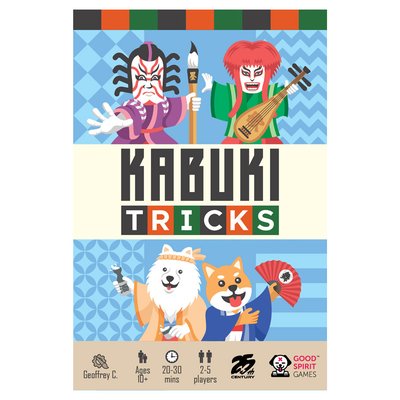
Hello. So, today I want to tell you about the game Kabuki Tricks. And this is, as you might have guessed, a trick- takingaking game, but this is not an intro tricktaking game. This is a trick- taking game that has a lot going on, but plays pretty quickly. So, I really enjoy that. This is an import that 25th Century Games did. This was in the batch that they sent me. So, let me tell you how it plays. It plays two to five players. The two-player is a variant. So, if you want to play the game the way I'm going to explain it, it is a three to five player game knowing you can kind of simulate a dummy third player if you only have two people. So, everybody is going to get a joker card that will be in their hand each round and then three number cards. And if you play your joker, you will get to make a prediction that you are going to take one, two, or three tricks. So, you will not make this prediction at the beginning. Each hand consists of seven rounds. So you'll have eight cards, but you're only going to play seven of them. So sometime during that seven, if you play your joker, you get to make a bet. If you don't end up playing your joker and it's the final card in your hand, then you are essentially hoping you took zero tricks.
So how do we know what are the most powerful cards? What's going to benefit us the most? That's where this gets interesting. So, if you're the dealer, you will put of the four suits that are numbered 1 through 10, numbers 1 through whatever based on your player count. So, if this were a three-player game, we use numbers 1 through seven. So, if I'm the dealer, I'm going to deal out seven cards. Obviously, I would do it correctly to everyone. And then everyone adds in their joker. And you look at your hand and you're like, "Okay, I have eight cards. What does this mean?" Well, because I was the dealer, I get to decide, are we going to say that high card wins or are we going to say that low card wins? And then I get to decide what order the four suits go in as far as power. So maybe I am really hoping to get that zero tricks because it's five points at the end. Or maybe I'm really hoping to take some tricks. So if I look at my hand, yellow's what I have the most of. So, let's just go by the order of the cards I have. We will go yellow and then green. And I like purple more than blue. So, we'll put it there cuz I have one of each. And I'm going to say that low number wins the trick. So, I set this up. And you're like, whoa, being the dealer has way too much power that you get to decide all of that for the round. I get to decide it for starting the round. It doesn't mean it's going to stay this way. So,
this is a mustf follow trick-taking game. Meaning, if I play a card out and the other person has that color, they must play it. Or you can play your joker. You can play your joker even if you have the color that's in the hand. The only caveat is only one joker may be played per trick. So, if somebody else has already played a joker, you cannot play your joker that turn. So, right now we're saying low number wins. So, if we all played, let's say I played purple and everybody else played purple because we're playing a three-player game, then really this order doesn't matter because it was purple and we know low number wins. So, I would win that trick. Now, let's say instead I played yellow and then the next person played yellow and then the other person didn't have yellow, so they played blue.
So, yellow is the strongest of these and low number wins. So, I would win that trick. Let's look at it another way. Let's say I played green and then the other person, the second person played green. And then the next person, let's say they don't have green, so they played yellow. Yellow is more powerful than green. So yellow wins that trick. So you can see how there's layers going on here to what will win. But then you're like, you mentioned jokers. How does that work? So if I'm leading off, which is the dealer I do, I cannot play my joker to nobody can play the joker to start a trick. So let's say I play this green and then another player plays their joker. Well, what does that mean? That means they get to do two things. So the first thing is they will look at their three bid cards and they will decide if they think they're going to take one, two, or three tricks and they will put it face down over one of these.
So let's say they put it here. So these two cards are now combined together for the rest of this hand. And basically they said they think they're going to make take this many tricks. And if they're correct, they're going to get points for doing so. And if this color is the final card left in their hand, they're going to get a bonus point. So then the other person would go and they played green cuz they had it. So we look here, green and low number, I would take that trick. So once we have gone to where everybody has one card left, now we score. So we will have played seven cards. You get one point for every trick you took, which is great. If you correctly predicted how many tricks you would take, you get two points. It doesn't matter if you correctly predicted one, two, or three, but you get two. If multiple people picked the same number, the person who has the higher card gets it.
And if you have the joker left in your hand and you took no tricks, you will get five points. Also, if the card you have left in your hand matches this, then you get a point. The thing I forgot to mention, excuse me, when you play this card, that is your mandatory joker action. You then have a optional joker action. With that, you may choose any two adjacent cards and swap them. So, this person could play purple and then could do this on their turn. So now purple is more powerful than green. And on my turn, when I decide to play my joker, I could then play out Whoops. my card here. And now blue is more powerful than green. So green just went from second to fourth all in one round. So this is what I mean by it's not an intro trick taking game because there's a lot going on and this is constantly swapping. If I didn't want to swap those, I can switch this.
So guess what? Now the high number wins. So things are constantly changing. And you will play number of rounds equal to the number of people. So three player game, three rounds, four player game, four rounds, etc. So then at the end, like I said, that's revealed. We do scoring. We play the number of rounds that are indicated for our player count and the most points wins. So this is a small box, but there is a lot going on. This is a really cool trick taking game. I really enjoy it. It's so fun how everything swapping and you're trying to get your bid, but getting your bid isn't the only way to get points or the most important way necessarily. There's a lot of ways to use this to try and switch things around, but also to be able to mitigate it. So, I am loving Kabuki Tricks. I would love to know, have you played it? What do you think of it? What's your favorite trick picking game? Give me a like and a follow, and I'll keep bringing you more board game content. Thanks. Bye.