Rebirth Review - Reiner Knizia at His Best!
Games in This Video
1 game is featured in this video — it unlocks as you watch.
Transcript
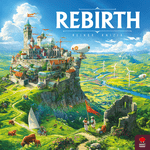
Miniature Market has thousands of board games at discounted prices. Click the direct link below to see all those discounted games. Hello my friends. Today we're going to be going first to Scotland where we're going to be seeing castles and cathedrals and energy farms and food farms and then we're going to be going to Ireland where we're going to be seeing towers as well as castles. Today we're taking a look at Rebirth. This is sort of an abstract strategy game by Dr. Rhina Kitia, one of my favorite designers in a beautiful package. Let's see how it plays. I'll see you on the other side. In Rebirth, each player is going to have their own components. They're going to have cathedrals and castles that they're going to be placing on the board. They're also going to have tiles that they're going to be drawing randomly and placing like settlements of different amounts and energy farms and food farms. Now, this game has two sides of the board. Uh, the first one I'm going to show you is Scotland. It's a little simpler. And this is what the game might look like uh 3/4 of the way through with the different uh colors.
Having place tiles, having place castles and cathedrals. So, let's talk about how turns work and what you're trying to do. Now, on your turn, you're simply going to be placing a tile. See, you have all these tiles that you're placing. Now, you have a whole supply of these face down, and you're only going to have one of these. You randomly take one, and that's going to be the one that you're going to place. Now you take it the turn before. So you get to think about where you're going to place this. And there's different places that you can place it. Like this is a food farm. Sometimes you'll find energy farms. And sometimes we playing castles, cathedrals, settlements, and stuff like that. So when you have one of these, you can place it on any of the food farm spaces that doesn't have one like this or you can place it in an empty space like that. That's your whole turn. Then you would from your supply draw a new one. You have a whole big supply of these and you draw one randomly. So yes, you only get one random tile. You don't get a choice, but your choice is where to place it. Now, why would I place it where? Well, if I place it here, I'm going to get one point because I've placed it just right here and there's nothing else touching it. But let's say on my next turn, I place one here, I'm going to get a point for this, but a point for this cuz it's a contiguous group. If I place one here next turn, I'm going to get three points. Here, four points if I have them all. So, you're trying to make these contiguous groups, but so are all the rest of the players. So, the next player instead might go here. They only get a point, but they're going to block me from trying to get a bunch of easier points there. Now, anytime you go next to a castle, let's say I am the first one here, they're going to place this big castle there. Now, if that's there at the end of the game, it's gonna be five points for you for every castle that you have out there. Now, next turn, the red player goes here, gets the one point, they you're tied. Each of this castle
has one red and one blue. And with the castles, if you tie, you're able to take it. Assume if there was still a tie, you would see who has the most food and uh or energy around it. But in this case, it would just be red would get it. So, it's scored a little bit of a battle of area control to get those. Now, let's say it's blue's turn again and they go here. These are settlements. And you have tiles that have 1, two, three, or four settlements on there. This is worth a value of three cuz there's three of them. But look at this. I'm surrounded. I have more here. So, blue is now going to take this castle over. Now, these settlements are important because uh when you go to these, some of these have ports, which gets you a point right away. But when when it's closed, uh whoever has the most control is going to get the most points. Now, in this case, it's tied three to three. And settlements are interesting because if you tie, the person who ended this or pushed the put the last tile to complete it actually loses the tiebreaker. So, you want to get in there early. Now, in this case, it's tied three to three. Uh, blue would have won because of that weird that interesting tiebreaker. And in the upper right, you can see depending on the size, it's a two size.
So, first place is five points, second place is three points, and so on so forth because there's different size of these settlements, and you'll get those points when those close. Now, another types of tile are the energy and food farms. Now, these can go again. This has this so it can go on these or or blank spaces. But, so let's say the tan player goes here. And look at they have two surrounding this castle. Blue had one. So, they're going to replace it with theirs. Again, it's going to be five points to end the game if you keep that castle. Now, let's look at this. Let's say this red player places a settlement here. They're now leading four to two, but there's still one more spot to go there. But because they're next to this castle, no one else is there. They are here. They also are thinking, "Okay, well, there's a good contiguous area for me. I can start getting a bunch of points and solidify my castle here. But also, you'll see that they're next to a cathedral. Now, when you go next to a cathedral, all players can have one at the cathedral.
And you stack them like this. So, gray was already there cuz they're next to it here. And this goes here. And then you'll draw a mission card. This is going to be a private mission card that you're trying to fulfill by the end of the game. So, since there are eight cathedrals, at most you can get eight of these. Now, there's different types. This one has to do with cathedrals, energy farms, castles, ports, food farms, settlements. You can see they're colorcoded like this. Like have the largest energy farm. Five points if you do. Or medium settlement ownership. Fulfill occupy the most two size medium ones. Or have the most food farm clusters of three or more having the most ports and so on and so forth. All sorts of different private goals that you'll get at the end of the game. So that gives you strategy throughout the game. Now, the game is going to end when you run out of tiles, and you actually discard two tiles at the beginning of the game that you get to see, but they're not in your supply. So, you get to know which tiles you may or may not have. Uh, and then once run out of tiles, the game ends. Any incomplete settlements, like they're not finished, you get the points that are on there.
So, this is two, that's two points. This is one, and you get one point. Uh, then you get five points for all the castles. Then you score your mission cards. Whoever has the most is the winner. Let's take a look at the other side of the board. Now, here's the Ireland side of the board. This is the more advanced gameplay. Now, you'll notice that on this map, the yellow spaces are no longer cathedrals. They're towers. And these towers will randomly get placed, these tiles, and then they're flipped face up. So, you can see which bonuses you might get when you build next to them. For example, if you go here, you can activate this, which is basically placing a second tile. Because in the beginning of this game, instead of discarding two tiles like the other side of the board, you actually put four tiles randomly that you look at them, but then they go randomly face down on a separate supply and you get to randomly draw one of those and place it again. So unlike the other version of the game where you get rid of tiles, one of those is going to come back or maybe even three of those or four of them. All of them are going to come back depending on how many of these you unlock because you've got uh them in different spots.
So, even though you have four randomly removed at the beginning of the game that you get to see, you also might be able to place them later if you unlock them. Now, the 13s, if you go next to all three of the 13s, then you get 13 points. Some of them is just worth straight points, like three points if you build next to this one. Now, some of these allow you to get private missions cuz at the beginning of the game, there's actually eight public missions that you all of these are going to score at the end of the game depending on how well you did in these. But, if you go to that private mission space, you'll get one of these that are left over and you get to look at it and keep it secret. That's a private mission. So, there's new public missions and you can still get private missions. And if you build next to it X2, you get one of your X2 counters. And you place an X to a mission you have not completed yet. So, occupy three offshore farm spaces. It shows you where they are. Uh, and if you're the first to do it, you're going to get eight points times two, but you're basically betting or saying that you're going to get it done before anyone else. Anyone else that gets to any of these later, they all are able to get the smaller points. So, those that's a big difference in the game as well.
And there's also four size settlements which give you even more points. and the rest of the game is played the same way. All right, I first want to state that I am a huge fan of Ryan Kissi. He's one of my favorite game designers. I love his the his abstract games, his route building games, his card games, pretty much everything. I just think he's he's gosh, he's one of the best. If there's a Mount Rushmore game designers, he would definitely be on it. And one of the things I like about this game that is pretty consistent through all of his games is he tends to have very simple rule sets where what you're doing on your turn is very easy. Like in this case, I'm placing a tile. Next, place a tile, draw a tile, a round tile. That's it. That's all you you're doing on your turn. But there is so much decision space and so much depth in this game, just like all of his games. It's just it's great. It's it's that I call it that sort of kinesius style uh you know, simple rule set. And it's it's excellent. It's absolutely super streamlined. I love games that are streamlined where all of the the the cognitive load goes into your decision space and not like understanding how all these mechanisms in a box fit together.
I don't like a lot of Fatimai games and he tends to do that and he did that here. This might be one of his most streamlined. You know, there's a lot of route building games. He's, you know, he's come out with a lot of tile area control games. You know, you got Samurai, you've got you've got uh, you know, through the desert, you've got Babylonia, you've got aristocracy, you've got Blue Lagoon. like it goes on and on and on, right? This is probably the most uh streamlined, the easiest to get into, and the easiest to teach, I'd say, from all those, but yet it still has packs a huge punch with the amount of depth it has. Uh I like that the presentation uh granted those tiles, but then there's those really cool castle pieces and the cathedral pleces. So, the presentation and the table presence of this looks more epic than it is. And some people might not like that. That might be a negative for some people. They're like, "You know what? The game could have been $15 cheaper if you just put, you know, tiles that look like castles there and you stack them or whatever." I love it. I think it just adds when you walk past the table and this being played, it looks like, whoa, what are you guys playing? This game looks epic. And it's like, no, it's not epic. It's awesome, but it's not epic, but it does look that way. It does make it feel bigger than it is. And I like that. Uh, I love that you're building the clusters of energy farms or food farms and you know, you're placing there and you're trying to build off those, but then other people are watching you and they're trying to like block you so that you're not getting a bunch of in a row by but also, you know, getting points for them. And so, you're trying to find the the places on the map that will a help block other people from getting lots of points, but at the same time is still being advantageous for you. That's the key to this game. Can
you benefit yourself while hindering other players? and and the timing of everything of when you do this and when you do that. It it feels very much like Blue Lagoon in that regard, which is I think might be my favorite Ryan Kier game where the timing is everything is where you have all these like irons in the fire and you have all these things going off on at once and all different parts of the board and you're you're looking at area control over here and you're trying to protect a group over here and you're trying to get to that cathedral over there and you at one point you're like, "Okay, I've got to go here now. Now's the time. I got to go here, but I'm giving up something else over here and it's all trade-offs." It's excellent. I love that the combo scoring allows for that. The area majority for the castles, it's great. And I like that the the tie favors early because, you know, you're getting in there early and if someone wants to beat you, they need to beat you. They can't tie you. If they tie you and end and finish that settlements area, they lose the tie. And so that really makes them have to come in heavy late. It and and it it it's advantageous for you to get in there early, which I like because otherwise it would be like a game of chicken where here it's like I'm setting a statement.
I'm getting in here. going to have to beat me to take this from me. I like that. I like that the settlement tiles have different sizes, one, two, threes, and fours, and they're evenly distributed. And you're trying to decide when is the right time to place the right one in the right spot. Uh, again, another layer of depth within a miniame of the area control. The cathedrals for the goals is awesome. You're going to these spots, you're going to them earlier. A lot of times they're next to things that aren't aren't great. They're in areas that like h you go here, you're not going to get a whole lot more. It's an empty space, you know, and it's not near a lot of other things, but it's going to help you get a goal and you get to order these things early and it gets you formulate your strategy. It's just brilliant. It's so streamlined and so great. The game scales with with with all the player counts even with two. You mark off a big portion of the board and it still feels tight enough like it it's these types of games typically don't work well with two players. This one does. I love that there's multiple sides of the board, uh, where you have, you know, the the island and the Scotland side. I think the game is obviously because of this reason very easily expandable. They could come out with even just one more double-sided board with some new rules and some maybe new components and cards and things, and they could just do so much with this design space and make it either similar in complexity or they could they have a lot of space here to make this more and more complex with each with each board if they want to. Uh, and I'm really looking forward. I hope they come out with new boards. I hope they're working on these. I like that Ireland has public goals that everyone is fighting for and it's a race to all these, but going up to some of those towers gets you a private goal and so you have a big good
mix between public and private. You can wait a little longer on trying to make these private goals cuz no one else knows what you're really going for. All these different tower bonuses are awesome. Some of them like the 13s, you got to get around three of them uh to get there. So, you know, you willy-nilly got that in the back of your mind as you're going through and where they're laid out is random every game. I'm sorry. Every game is going to be a different puzzle. The game is just so good and so so well defined. Things I don't like about the game on the Scotland side. I don't like the luck of the draw at the beginning of the game where you uh well number one is you choose uh you randomly get two tiles. You get to see what they are, but then you put them face down out of your supply and they're not there. Well, what if you drew two of your four settlement tiles? Someone else didn't draw those or any of those. I think you're at a disadvantage there. Again, that's supposed to be the more randomized, more more easygoing side of the map. Uh, and maybe they wanted to level the playing field with that. I don't really like that that much. Um, I might house rule.
If someone pulls a four, you shuffle it back in or something like that. Uh, I I don't like that aspect. Um, also, it's interesting that like you're just pulling one random tile and then you're just placing it. And like I get it. It makes you, it makes you get, you know, play whatever you play and it's random for everybody, right? But when you draw a certain tile, depending on what the board looks like, if you draw a four as your first tile, it's probably not as good as if you drew that four a little bit later in the game when you could be the hammer and end a settlement and win it, right? So, there is a lot of luck there. I part of me wishes that you had like two or three tiles in your hand, you just choose, but then it might be too easy. But the island side kind of helps with this, right? The setup is different. You get four tiles that are removed, but you get to see them. But you also possibly can unlock all of those if you unlock all the if you get next to all those towers. So that randomness goes away, which is cool. So that really helps with that. And it it also helps with sometimes you can place more than one tile. And so you're placing a tile, you're unlocking one, and you're getting to draw I think it was two or three tiles and you pick one of those. So the other side, the Ireland side does kind of fix this issue. It's really mostly an issue just on the on the on the single side. Minor nitpick here. Um I almost think that eight goal cards, public goal cards, almost seems like too many to be fighting for at once. Um it's it's it doesn't quite seem quite as tight. Maybe maybe eight for four players and maybe scale that back for the amount of players. Maybe, you
know, uh maybe there's only three or four of them with two players, right? And then it makes it a little tired, makes the race seem a little bit better. I would have liked to seen that scale a little bit better. Um, still great. Just a minor nit nitpick. But that's it. Those are my minor nitpicks of the game. Overall, this game is fantastic. It's probably one of my favorite Rhino Canitzia games. I think Blue Lagoon's up there. Axio's up there. Um, Yellow and Yangy actually is probably my favorite all the time. But this is this is in the top five, I think, for me for Rhinoia games. And for all those reasons, it's staying in my library, which does not happen. probably one out of every 20 games that come through this door now get a sax one serenade. Um, you might think more of them do because maybe one out of every five games might get them that I review, but I don't review every game I play. In fact, I only review probably about a third or even less of the amount of games that I actually play and get in here because there's only so many things we can cover. And I tend to cover the things I I enjoy and want to spend time on. So, this is getting my favorite my my my big award, the Saxon Serenade, inducting it into my gaming library, which means I got to find a game with this box size to get rid of.
Oh boy, that's always a tough choice. So, here we go. Game Toppers upgrades every game you play and they just launched their 4.5 Kickstarter which will introduce the new Galactic Microoft and Watson game toppers with interchangeable rail inlays as well as new game mats, miniature gaming terrain packs, leg kit options, dining covers, accessories, and amazing package deals. Search for Game Toppers on Kickstarter or go to gamettopperslc.com.