I'm shocked by the new Lord of the Rings Game
Games in This Video
1 game is featured in this video — it unlocks as you watch.
Transcript
What's the most powerful force in the Lord of the Rings? It's not a sword or a spell or even the one ring. It's something quieter. That quiet strength is at the very heart of a new board game called Fate of the Fellowship. But why does a board game about hobbits and orcs feel so profound? For me, the answers begin in a movie theater back in 2003. I was a fortunate kid back then because I got to see the Lord of the Rings Return of the King on the big screen. Through my younger eyes, Lord of the Rings looked a lot like a video game. Legalis was the S tier archer who only got crits. Dandalf was the ridiculously overpowered wizard who could solo raid bosses. Aragorn was the prototypical gigachad everyone wanted to pretend to be. and the hobbits. Oh, they were the unskippable cutscene, the long drawn out escort mission where you would just hold W through forest and marshes while the accompanying NPC would never match your walking speed. It felt like total filler because I was there for the boss battles and giant armies, not two dudes on a multiove long go over here quest.
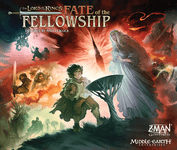
But time changes how we see things. I grew up, read the books, and returned to the films like a yearly Christmas pilgrimage. The story began to change with me. I came for the wizards and the warriors, but I stayed for the gardener. The grand battles that were once the main event were just like rolling thunder in the distance, a backdrop for the quieter, more profound story at its heart. What I really felt was a deep almost visceral connection to the journey of Frodo and Sam and the reentering of the entire narrative around these two characters. I finally understood that this epic was at its heart about the crushing weight of burden and profound sincere friendship, love, and sacrifice that makes it possible to carry such a weight. And now all those years later, I'm going to relive those memories and feelings, but through a completely different medium through the new board game, Fate of the Fellowship. This game tries to capture that entire journey in a cardboard box.
The only question is, does it succeed? Okay, I'm going to give myself 2 minutes to explain this game starting now. At its core, Fate of the Fellowship is a cooperative game built on a system many of you will recognize from that gigahit pandemic and its many variants. But instead of treating disease cubes, you're fighting back hordes of orcs. And instead of researching cures, you're facing the desperate, heartfelt struggle of the Fellowship. I see Fate of the Fellowship as a sincere reimagining, not just a simple reskin. It certainly has a rhythm that matches Pandemic, but it does feel fresh and unique enough to stand separately. Now, up to five players take on the roles of various Lord of the Rings characters, each with unique abilities and passives. As Arowin, you'll be able to reverse the tide of battle against a Nazoul. As Mary and Pippen, your song can rally the fellowship when hope, which is the player's life bar, is low. You'll need to use all of these abilities to accomplish a series of objectives before the final mission, destroying the one ring in the fires of Mount Doom. And there's no such thing as a hot new board game without a twist. Each player actually controls a pair of heroes. This means you could be commanding both the might of Aragorn on the battlefield and the stealths of Golem deep in enemy territory. This gives you a massive strategic footprint and ensures you're always involved in the action across the board. The game encourages open
communication and strategizing. While the players are united, Sauron's forces spread unpredictably across Middle Earth. Their movements are dictated by a pseudo randomized deck of shadow carts. These forces will eventually corrupt tranquil havens into strongholds and simultaneously relentlessly hunt for the ring with those Nazol. eventually crushing all hope and resulting in defeat. Ultimately, every choice comes back to the fellowship's dual burden. To win, you must complete the randomized objectives, but you must also support these two small hobbits, ensuring their path to Mount Doom stays open. So, that's the gist of it. And I want to focus on a concept many of you have probably heard of before, Ludo narrative dissonance. But here's the thing that kept bothering me. That term, it usually describes a conflict between a game's mechanics and its own story. What Fate of the Fellowship risks is slightly different. A dissonance with the established cannon. To me, it's more akin to something like established narrative dissonance.
It's as if what you do in the game feels wrong. Not against the internal game story, but against the external story we all know. For a game based on Lord of the Rings, that's a huge potential pitfall when what we do in the game feels off or inaccurate to what the official cannon we know is. Taken a step back, The Lord of the Rings laid off the foundational bricks of the entire contemporary fantasy genre. Other series will try to replicate it or deconstruct it, but it is undeniably the monumental era definfining creative force of the genre. So, Fate of the Fellowship takes that immensely strong foundation and creates a series of what-ifs that could exist in Middle Earth. Now, what this means is twofold. One is that you could potentially play a very canon game of Fate of the Fellowship. Aragorn could parlay with the oat breakers, save Gond from the forces of evil. Eisenard could fall through the help of the ants, and Gandalf can defeat the Balrog in Moria and become Gandalf the White. All while Frodo and Sam are escorted by Golem to destroy the one ring. Or two, you could play a complete fanfiction. You could have Gimy and Famir attain the blessings of the elves while Umbar is subdued by Arwin and Legalis avenges Balin in Moria. And yes, there's a sweet release.
Froto and Sam can finally hitch an eagle straight to Mount Doom. And I can practically hear the internet exhale after decades of debates. Of course, it's a high-risk, highreward play. So, hey, try it out and maybe finally put that argument to bed. Now, both styles of games are possible, and in all the games I've played, the unique player story has been in the middle of canon events and fanfiction. I actually think the game does a pretty decent job of evening out the canon events of the story. The character specific objectives create a somewhat onrails cannon narrative that makes you feel like you're actively accomplishing things from the novels and the movies, while the other objectives are more broad and flexible with who and what and how it can be accomplished. In other words, dependent on the objectives, it kind of creates this variance in the story. Now, a lot of critique might be directed at how these what-if scenarios can destroy any sense of immersion or remove the Lord of the Rings aspect from the game.
And it would create this overpowering sense of established narrative dissonance where the gameplay and actions actively feel wrong against the narrative we all know. And truthfully, I think this critique is a misreading of what games should be and how the gameplay and narrative should meld. Critiquing it as narrative mismatch misses the whole point that the story lives at the table, not in the books. Think of it this way. If the game maintains a perfect fidelity to the cannon where each character has a specific role to fill on the way to destroy the one ring, it would be a very linear and on rails experience. It would be more akin to a cinematic video game where the minutiae of the actions might be unpredictable, but the large scale approach of each game would be identical. Think of a game like The Last of Us. The story is linear, predetermined. But think of an individual combat encounter. The encounter itself is guaranteed to occur whether you play the game one time or 100 times, but the way it plays out can be different. This is in extreme contrast to many board games where the creation of an emergent narrative is necessary to engross players. The same encounters do not happen each and every time you play. There will be large variations in the story being told between each playthrough. Both styles of games have a narrative. Both The Last of Us and Fate of the Fellowship, but Fate
of the Fellowship randomizes the scenarios and the enemies and the characters in a way that forces players to make their own variant of the Lord of the Rings story. When playing Fate of the Fellowship, an original narrative emerges that is harmonious and equally valid in the mind of the players. Let me show you what I mean. One more time. There was a miracle when I was playing Fate of the Fellowship. I was blessed to actually play with the one singular millennial who has never read or watched Lord of the Rings. This person's narrative of Lord of the Rings was based off exactly and entirely what was happening on the board. He knew the rails of the game were defined by getting Frodo and Sam to Mount Doom because that was the consistent element in all the variants. But there was very little else to really define the minutia or the happenings of Lord of the Rings.
Every variant or whatif scenario was seen as valid through his eyes. So when we think of an established narrative dissonance, it's a disservice to critique Fate of the Fellowship. When the narrative itself is not defined by the books or the movies, but by the players and their creation of the story being told, it smartly retains that core journey of Froto and Sam, but the rest is up to the players and the randomness of each game. Over my many playthroughs, I never once felt like the game was again Lord of the Rings wrong because the critique misses the entire point. The cannon of the story is the one that unfolds on the table, unique to your group, unique to that night. It's your creation that is mostly immune from the external narrative pressures, except for that core mission of taking the ring to Mount Doom against Sauron. If this game were a slave to the book cannon, your victories would be more like echoes.
You'd simply be repeating feats that were already accomplished in your mind, following a fate that was already known. Each game would be a test to mimic your ability to replicate the original story, not a test of your fellowship's ingenuity. So, let me be clear. This narrative freedom is actually one of the games greatest strengths. The critique of narrative mismatch is simply not applicable in my eyes. The game understands that the book tells one path taken, but here at your table, you're writing your own story, your own fate of the fellowship. Okay? So, if you can't tell already, I think this game absolutely nails the feeling of Lord of the Rings. The map, the tokens, even the ever shift and eye of Sauron all pull you into Middle Earth. But here's the thing, there's two more elements that push Fate of the Fellowship beyond just good theming into something quite special. It leads to highlevel thematic cohesion. And it gets a little strange, so just stick with me for a moment. Tolken was a Catholic and that worldview shaped everything he wrote. He believed that goodness grows stronger through its struggle with evil.
He believed that love, but not necessarily romance, the kind of love that's between friends, the filia form of love, was the force that conquers darkness. And he believed in providence that everyone has a time, a place, and a role in the grander story. So, we have this profound almost spiritual concept of providence. How do you even begin to describe when a game captures it? In a way, you're always looking back 10 moves and seeing how the smallest adjustments in positioning or of strategy completely shifted the tides in a way that was unforeseen. Where the very small actions lead to being in the right place at the right time to do exactly what is needed to carry your team to victory. Let me give you an example. In one of my games, Boramir was in the game and so was his objective where he essentially needed to nobly sacrifice himself with the last troop and while another player was there to witness him. Okay, no problem. We were able to move Arowind to him and let Borimir die a noble death. So with Boramir's fulfilling his sacred duty as a Shaun being character, that player needed to get another character card.
Now this was at the very start of the game. It was the first objective we completed. So, as the game continued, we cleared the second objective, and out of pure RNG, that Boramir player got Famir. Truthfully, Famir didn't do much except occasionally muster some troops and move around the board once in a while. He kind of just hung out in Gondor, just doing one action per turn, forgotten like a halfused jar of Rouse Marinero sauce. Now, an hour later into the game, the last two of those randomized objectives were completed, and we were finally nearing the final moments of this heroic quest. Froto was right next to Mount Doom and he was able to cast it into the flames, except he was short. He was short on rings. He had four out of the five needed. And we were all collectively scrambling, thinking of a way to get him a final ring. When we remembered Phamir, his unique ability, he can recover a ring from any haven.
And from our fourth objective, we had turned Minis Morgal into a haven. It was right there on the edge of Mordor. But now we were short on actions. We needed just one more to make it all work. But then someone had the elven bread card that was saved from like 30 minutes ago, and it all just clicked. Froto got his fifth ring and could finally toss it into Mount Doom. It's hard to explain, but it felt hopeless until we realized we had exactly what we needed. We just needed to find the pathway. There was this intense feeling of providence that everything happened for a reason that led us directly to victory. It was as if Boramir dying and Famir taking his place only to get that final ring was the game placing the pieces in a kind of narrative inevitability.
Although I know it was all happen stance, it had this inkling that was destiny and not necessarily luck which won us the game. It was magnificent to see providence manifest itself in this tangible way over the table. And if providence is the invisible hand of that grand story, what's the force that actually gets things done? The Greeks had a word for it and CS Lewis made it famous. filia or as we might say today that ride or die kind of friendship. You see it when Bormir was tempted by the ring and finds redemption by protecting his friends. You see it when Gandalf gives it his all for his buddies to escape. Even Legalis and Gimy learn to overcome generations of animosity to fight side by side. But the core of it, the friendship that beats like a drum throughout the entire story is Sam and Frodo. Theirs is a bond forged in hardship fueled by loyalty and a simple powerful love in another. That sense of altruistic heroic friendship is the heart of Fate of the Fellowship. There's no animosity. There's no MVP. There's no competition. When a bad dice roll comes for Frodo, players eagerly spend their resources and will roll and hope for a better outcome. When the eye of Sauron searches for Froto, other players will willingly take a bad combat turn to shift the eye over. Players will trade cards and move each other and unite against the automated villain in a true
sense of camaraderie. Remember how I mentioned all those amazing characters doing these fantastic quests and fighting in giant battles? Amidst all of that adventure, the journey of Frodo and Sam is the story's unifying force. And Fate of the Fellowship captures this perfectly. It establishes them as the absolute focal point. Every other character, every other objective, every card, every token is ultimately in service of the journey of these two little buddies. The grand battles and side objectives are still captivating and are the perfect seasoning for that core story. Intentional or not, the game understands what I finally learned all those years ago. It all comes back to The Hobbits and it brings that exact feeling to your table. And honestly, it's just nice. It's nice to play a game where everyone gets along and just wants to help one another. Other games are cooperative, of course, but this game has a pure sincerity that Lord of the Rings exudes. Even in the most hopeless of situations, you and your friends will count on one another to find a way out.
Okay, let's heap some more praise on this praise salad. Here's a bunch of things that I haven't mentioned that I think this game does really well. The general vibe of the artwork, the little bits of lore, the details of the map, those miniatures and the tokens all look good and are appropriately polished to create what feels like a premium game. The cardboard dice tower, while completely unnecessary, is an everimposing presence and almost mimics the feeling of opposition sitting at the table. Plus, it's super easy to disassemble and store, which is fantastic. The game provides a ton of room for strategic thinking and mitigation. Every player can use resources to mitigate bad roles and find an alternate way to solve a problem.
Whether that's Sam using hearts to lure despair or Gandalf changing the outcome of combat, the game acknowledges the luck involved and wants you to find solutions for it. Having each player control two characters is a very wise decision to allow greater influence across the board and in general gives more opportunities to have exciting meaningful turns. Character designs are generally diverse and well thought of from Galadriel's Mir to Arowind's Nazgal slaying power. Each of the 13 characters feel distinct and having to pair these characters with another keeps your individual strategy fresh. The hunt for the ring is exciting and engaging. Froto and Sam require an extra stealth to move safely across Middle Earth, but there will be times when a search role is required. These searches can be devastating, but also are an excellent reason for other players to move those Nazol away with their abilities or to draw the eye of Sauron to a hopeless combat or to escort Froto and Sam along their journey. This constant need to support Froto and Sam, even at a distance, reinforces the game's core theme of fellowship. The game is tough.
The introductory difficulty feels appropriately challenging for the first game or two, and the standard difficulty feels challenging and engaging, which provides a strong puzzle for the entire table to discuss and solve, which if you approach as a communal puzzle more than a quarterbacking exercise, it can be immensely rewarding. I think the game plays well at any of the listed player counts. There is more individual movement and decision capability at a lower player count. But there is a certain joy with having 10 characters on the board. So pretty good overall with accommodating a range of players. Okay, so I'm done praising the game. Let me speed through some things you might not like. Some people I played with thought the game map was too small and that it's kind of hard to read. That said, I've played the game at max player count of five multiple times, and even then, I only found it a mild issue. I can see it becoming a bit annoying if all the Naz Ghoul are in a tiny region, and you really can't see past them. There is a fair amount of luck. Cards are drawn randomly, and the skies darken can really come out at the wrong time and ruin all your plans. The enemy movement is unpredictable for the most part, but it does that pandemic thing of reshuffleling the enemy's deck. So, you have a slight inclination of what could occur. That said, there are multiple randomized elements to this. The back of the cards of the next card being drawn affects the current card. So, it's almost like it's a layered form of pseudo randomness. So, while you can
mitigate luck, you can't really escape it. As they say, one does not simply walk into mortar, especially when you roll five despairs in a single search. Some turns will feel mildly unsatisfying where you might be able to only do two or three of the five potential actions. I think this is a small issue if you can frame your expectations that doing five important actions is the best case scenario, but in general, you'll be doing less. The game does an honest attempt to make sure everyone has meaningful turns, but sometimes it does feel inevitable that you might be just kind of wandering around or just waiting to draw cards. Like many many cooperative games, this one is weak to quarterbacking where one player could start directing everyone else's turn because all of the information is open and everyone shares the same goal.
There's nothing mechanically stopping a single player from trying to solve the puzzle for the entire table. There is no hidden information, no secret player objectives, and the game isn't past that threshold of complexity to force everyone to focus solely on their own turns. The game is designed more as a communal problem solving exercise. But it's a fine line between helpful discussion and one person dictating a grand strategy. So, when you put this all together, the high-quality components, the communal strategic thinking, the exciting hunt for the ring, the story, you're left with a game that does a ton of things right. So, how do I rate this game? To me, this game is a resounding success.
It's a challenging and engaging cooperative puzzle. The production is polished, and it wonderfully creates a strong, captivating story. While there's a bit of luck and they can get crowded, those are really small issues in my mind to what is otherwise a triumph in thematic integration and a strong sense of game design. So, putting it all together, I'm giving Fate of the Fellowship a very hefty 9 out of 10. It's a great time. Get three, four, five people on the table and make some adventures in Middle Earth. You'll be surprised at the stories that emerge, and you might even rediscover that answer I finally learned years after my child self sat in that movie theater. The biggest battles are won by a quieter strength. There's a unwavering bond between friends and sometimes a brilliant moment of unintentional planning. Fate of the Fellowship understands this completely and that's why it's such a special experience. As always, thank you for watching and bye.