Lightning Train Review: Clank Clank Clank Went the Trolley
Games in This Video
1 game is featured in this video — it unlocks as you watch.
Transcript
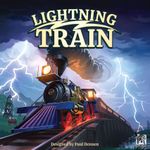
Hey everybody, I'm Tom Vassel and today we're taking a look at a game called Lightning Train. So, Lightning Train was, you know, I was very interested in this game. Not because it's a training game because there are thousands, and that's not an exaggeration, of train games that come out these days, but because it's from Direwolf, and it's designed by Paul Denon. This is Clank we're talking about, folks, or Dune Imperium. So, the third in this collaboration of sorts is Lightning Train. Well, what is a Lightning Train? No one knows. The game is about lightning trains and lightning train is a mechanism in this game, but it's not really explained exactly what it is. You'll see. I Let me show you the overview and we'll be back.
At its heart, Lightning Train is a bag builder. What I mean by that is you're going to have a bunch of tiles in a bag, and you'll be adding more tiles to that bag as the game goes by. These are made up of tiles that are going to give you actions as well as basic train tiles. And so each round of the game, you'll be pulling five of these out of the bag. And on your turn, you are going to activate these tiles. Now, money on the tiles is going to allow you to buy more tiles. These tiles that have colors on them are basically contracts. They're going to let me build in different territories on the main board. at the top of the board, more tiles are going to show up and you'll have a chance to buy stuff. This one, for example, gives more money. Um, if I have four stations, I can go anywhere. You might buy them based on the different contracts in the different areas on the board because one of the things you can do in your turn is if you have enough trains, you can place trains and connect routes. You have to start from the east coast or a station that you started, but I could put two trains here, for example. Now, that doesn't give me points right away. Some of them do. If you look on the board, if there are dots at the end of a route, like you can see the end of this route here has two dots, that will get me two points.
But what I'm trying to do is I'm trying to build stations in various spots. So, let's say uh maybe there's a station that's built here and that's my station. And then later on, roots are going to connect that station up to this spot here where there are passengers. I can move it through these completed routes here. And that's going to give a point to each person with a route there and a point to me for having the station here. Now, of course, to move stuff, to ship something, you need to have this symbol here, which will allow you to ship something. Some symbols allow you to build on tunnel routes. To build a route or to build a station is going to you're going to need to have the right basically contract to go in there. However, there's a couple other things that you can do. If you don't want to spend trains this turn, you can always save one in line storage for a future turn. You can also spend trains to build stations on the board. The size of the station is how many trains you need to spend. If you're going to build a tunnel, you need to either have a tunnel symbol or you put two trains here to build a tunnel. And you can put two trains here to be able to build anywhere to have a secure contract. Now, as the game goes by, you'll be able to get tiles that have a plus symbol on them.
When you draw those, you put them here. And that gives you a chance to draw seven tiles. And if you put two trains down here later on, you'll be able to upgrade this. And you can even have nine tiles that you draw in the turn. Just like you can go public here. If you spend three trains, whenever you draw that simple, you get a lightning train. Lightning train. The game's called Lightning Train. And everyone in their bag is going to start with a lightning train tile. Now, lightning train just means you get a lightning train that turn. just an extra train that you can spend. But you're going to need to do this because you're going to need to get lots of these trains because as you put them out on the board, you're not going to get them back. When you put them here, they'll clear at the end of a round and eventually your bag's empty. They'll get thrown back in. As you increase your score, you'll be able to pick some of these tiles to put in a bag, too. There's conductor hats. Two conductor hats gives you a lightning train. And when you also when you get a tile with a conductor hat, you get a locomotive, which is the same as a train, but with a plus symbol, but also they can give you more points when the Intercontinental Railroad happens. Now, that might seem a lot to throw at you at once. But once you play the game, the the gist of it is pretty easy. At the beginning of every round, we'll turn over one of these. It's going to produce some more resources on the board. And this is also kind of a way to track when the game ends. Then each player is going to take their turn. And as the game goes by, there's going to be more and more routes on the board. And if the Continental Railroad, Intercontinental Railroad starts at C that spans the the
nation and connects to a few cities and the cities it needs to connect to is based on a number of players that will trigger the end of the game and anybody who has railroads on it will score points. Players also will get points from score cards that they get. You have a chance to get a couple of these over the course of the game. So, if I build five railroad lines, I'm going to get an extra nine points. But most of your points will be coming from delivering goods and building railroad tracks during the game. And as you build those, it's going to give you tiles. Everything in this game gives you more and more stuff. You can buy debt tiles if you need extra money. And they're pretty easy to get rid of. And that's basically the game. You're just going to be taking turns over and over again until the Intercontinental Railroad is finished or until this deck of cards runs out. And whoever has the most points is the winner.
Lightning Train is an interesting game. I first read the rules for it and I thought this is just not jing in my head. And I have found that everyone that I have taught taught many people here in the Dwire studio and various things that first game is is a bit to kind of figure out how the wheels of this game turn because you play a few turns, you're like, I'm not scoring any points. You want to score some points, you want to get a few points because you want to be able to when you get to certain spots along the point track, you get to take one of those upgrade chips and throw it in your bag. and getting one of those is a big deal, but it it takes a while to get to that knowledge and you're sitting there and going, "Okay, locomotives, I can keep using them and they have that plus symbol on them, so I don't want to put them on the board too early, but I do want to get them on the board." And so, there's just a lot where you're kind of playing through and going, "Okay, how exactly does this game work?" And I think that's going to be the issue for a lot of people. They're going to come from other games like Age or Steam. And you'll come from Age or Steam or Steam and games like that. And the bag building part is going to feel weird to you. You'll have played a game like New Orleans or other bag building games where making this pool and the train part's going to feel a little odd. But I just plead with you to give this game a full playthrough and then to play it again because it takes a bit to understand. to croc the game isn't isn't necessarily that simple, but once you get there, I'm not saying the game's actually that hard. It's pretty
easy to play, but there's just a lot going on and what to do, I think, is going to throw a lot of people off. It doesn't help that the game looks okay. This is not really a looker of a game. The the tiles and tokens and bags and stuff, they're fine. The art of the board, it's fine. But nah, it's functional more than anything else. But playing it, it's just so fascinating because every game is different. Every game you have that starting bag, you use a start card to determine which neutral stations are on the board to start with. and then the the opening tiles that are out there and what the game does, and I didn't go over this in the overview, but it has a really interesting fact because one person starts and they're going to be first the whole game, but second and third get some free delivery tokens that they can use to deliver for free without having to have an icon for that. And that really counterbalances that not going first. It's a pretty strong second or third player advantage or even fourth, you know. And I I like that. I like that the the pool of chips is so different. This is also one of the first games I've ever played where I've taken debt chips because sometimes I just need that the debt chip gives you one extra money but sometimes I'll get six money and that seven chip is so tantalizing.
So I'll take that debt chip when it comes out it goes into a plus spot which isn't too bad and then I just pay off the money and get rid of it. It's easy to get rid of as the game goes by. Sit on it too late and also it isn't a good thing when it comes out necessarily, but I it it didn't bother me much, but the using of the contracts, there's so many things in this game that feel like restrictions, but they're not like I need to have a contract ship to be able to build in a spot. Well, it's easy to get that color, and if I can't, I can always spend two trains here. But everything really comes down to lightning trains. Yes, the theme of the game. What is a lightning train? You have one chip that gives you a lightning train, but once you upgrade and go public, then anytime you draw the the deliver token, you get more lightning trains. And there are other ways to buy lightning trains. And there are chips that give you lightning trains. And you want to get as many lightning because you want to keep getting trains into your bag cuz trains you're using as both putting them on the board and a currency to do actions over the course of this game. And that's where I think this game is fascinating. That's where this differentiates itself over other train games. The fact that the token I use is both a playing piece for the board and a currency to operate the actions I need.
I have five trains this turn. I want to build a four tunnel train. I can't do it because I want I need four trains for the tunnel and two to be able to use a tunnel. I only had that chip that let me just burrow through a tunnel. Okay. Well, what can I do? Well, maybe I'll save one and hope I get more trains in the future. Or maybe I'll do a different route over here. You always have things to do. The game does not outstay its welcome. There's a lot of things to do. I think I like it better with three than four because there's less downtime between turns and but there's still that interaction on the board between the different player, you know, move you're going to move the goods down different people's routes. This game in a sense is a Frankenstein of Age of Steam, ticket to ride and orons, you know, a bag building, root connection, item delivery, and I think some people might find that to be too many things piled up, but I think Paul Denning has done it again. Now, Paul Denon, this is not Clank in my opinion, and this is not June Imperium, right? Those are games that are up here, but this is a good solid one down the middle. I'm giving it an 8 out of 10. I think it's a really interesting game. It intrigues me. There are different things I want to try and every game of this I play, I'm like, but what if I do this? What if I collect these tiles? And I find that to be fascinating. So, if you like train games, you're definitely going to want to try this one out. If you're not a big train game person, you might still be interested in this one because it just has a different feel to it and it's so
rotates around the tokens you're throwing in that bag and how you utilize them. And I just feel like there's so many fun options. It's easy to build stations in this game. It's then when you get the upgrades and you're like, I can throw one of these four in the bag. Which one do you do? Cuz they all seem good. And so I like these kind of decisions and I think that makes for this a very fun game. So that is Lightning Train. Definitely check it out. I'm Tom Bassel and you've been watching the Dice Tower. Hey everybody, thanks for watching this video. If you like this review or whatever you just watched, wasn't it amazing? Uh, check out our channel, Dice Tower. We have all kinds of things. We review games, we do top 10s, we play games live. It's all about board games, but especially the people who play them.
Check out Dice Tower YouTube channel.