Yokai Sketch Review - Chairman of the Board
Games in This Video
1 game is featured in this video — it unlocks as you watch.
Transcript
Hey everybody, today I'm taking a look at Yokai Sketch. This is a two-player only tug-of-war style card game that takes around 20 minutes to play. Now, before I get started on my review of Yokai Sketch, I want to give a shout-out to the show's sponsor, keyenda.co.uk, who are my go-to online retailer. And if you use the link in the show notes or the QR code, then you can get 5% off your first order. So, let's take a look at the setup for Yokai Sketch. So, essentially you're going to have these four piles of these Yokai cards, which are essentially going to be your end-game points, should you be lucky enough to obtain them. They come in values from three up to seven, I believe, and they are shuffled randomly and are placed next to each other. You have this deck of cards here, which are the cards that will be what you're using to claim those Yokai cards. You can see that at the start of each game, each player gets a three of those to add to their hand.
And they come in two different colors. So, you can see that this one's got corresponds to this particular Yokai. This one goes this one. And you've got this one here that goes for, you know, this one and this one. But they come in every different combination of two different Yokais. Now, gameplay-wise, it is very, very simple, where all you'll do on your turn is you'll always draw one card and add it to your hand. And then you are going to play up to three cards. So, if you have four cards, you always have to play at least one, but if you have fewer than four cards, you don't actually have to play anything at all. But let's just say I wanted to maybe play two cards to this one like so. And then I say, you know, that's the end of my turn. I'm done.
Then next player will say, I'll just simulate their turn. They say they want to play one here. I get My turn will be draw up. Maybe I want to commit one here as well. And my opponent will play, let's say to to this one again. And basically we'll keep going until there is a number of cards played on one of these Yokai stacks that is equal or more than the number depicted here. So, in this example, I've got three of these bird style cards next to a number three. So, therefore, this particular card is going to score. The player who's played the most cards on their side will gain those as victory points at the end. Um, however, you will also lose your existing cards there, and they'll go on a discard pile. There is a twist to this though, where if somebody had, say, bid some cards, like let's say, for example, it was like this, and then I played my two on my side. Let's say it was like this. There's still that total of three available, and I've still got the most, so I would have still called scored those scored that card as normal. However, I would lose my cards, but my opponent's committed cards will stay there ready for the next stack. So, you've got to kind of pace yourself and, even if you are losing a stack and lose that card, you are set up better for the next round.
Now, that's pretty much how the game works, but there are a couple of little twists. The first of which comes from these Well, basically they come from these symbols here. This like hut symbol, basically when you play this card, you have the option to force that your opponent who played the last card there to the other side. So, it would flip like this and go to that particular Yokai instead. That's an optional thing you can do, but you can imagine how much that can mess with the state of play. The other one is the one with a handprint that looks like this, where when you play this one, you can move one of the top cards from another stack on top of that one. So, if you're, say, confident on winning that stack, and you want a bigger points and value, you can move it over like so. You'll still use the cards you've already committed to to claim that particular Yokai card, but you can see how much it's going to mess with the game state of play, and you can use that to your benefit. And that's essentially how the game works. You're going to keep on playing until at least one of these stacks has been depleted of those scoring cards, and then the player with the most victory points will be the winner.
Okay, so let's share some thoughts on Yokai Sketch. And they're going to be pretty brief thoughts, because the game is so simple, as you could see there from the play-through. However, there are some nice little touches that I do appreciate in a pretty standard tug-of-war style game. This game does feel somewhat familiar to those older games from, you know, the early 2000s. But those extra little twists, the little little tweaks I do enjoy, include the hand management system, where, you know, you are you have to draw a card and add it to your hand, but it is not actually mandatory to play cards on your turn, unless you have a hand of four. And what that means is that you can build up to certain colors without having to commit to anything each turn. And because you can play three cards at once, you can see here here that my opponent might be, you know, lured into a safe sense of security or false sense of security, and then I could smash three cards down and maybe grab the win from them, or even tie with them in order to prevent anybody from taking that stack, which I didn't mention in the play-through there.
But, yeah, I really do like that. And there's again lots of little things you can do, especially when it comes to the special abilities. You know, if you have a certain amount of cards, but you don't have any more in your hand, well, not enough to win anyway, but you want to play that hand symbol, move a card over, and then all of a sudden you have enough to win that card. Or maybe you're running so far ahead that you play one of those hand symbols, and you want to really amp up the points by, you know, increasing a fairly low points Yokai card into this massive seven value cards. At the same time, you know, the manipulation you have when it comes to those hut symbols is super interesting, because you can push people off onto cards that you're maybe not necessarily worried about, or that you're pretty sure you're going to win anyway, and you can dampen their efforts there. So, yeah, lots of little twists there that you can consider when playing your cards.
After playing this game for yourself, you'll come to notice that a lot of the kind of strategy and tactics that you'll consider when playing this do come down to tempo and timing. Because, you know, each of these stacks are actually, I think, they're perfectly balanced in terms of the way the points are spread, which might make you think that, well, by the end of the game it's going to even out anyway. Therefore, maybe whatever I play will be fine. Um, but again, because you dictate the pace and when the game ends in terms of one of these cards stacks being depleted, you can really use that to your advantage. You can even exploit the low-value cards, or getting those low-value cards in your hand, to win the game rather than those big sevens or sixes. Um, because, you know, those high-value cards require so many cards to be played to commit to them. Now, your opponent might fully commit to one of them and have to play, you know, a whole six or seven cards themselves. You can completely ignore that and mop up everything else.
And hopefully go through those decks so quickly that before they've even managed to resolve that card and score those points, you've already depleted a stack and you've you've you've ended the game in your favor. So, yeah, I really do like how much the tempo and the pacing come into play here. I think this game is going to have a good degree of replayability because of that familiarity and simplicity of the rule set. It's not going to take very long at all to digest the rules. And you know, even though there are a couple of these little bonus symbols, there are literally two of them that you need to remember. So, you're not going to be overwhelmed in terms of what the cards can actually do. And this is definitely going to be one of those games where, you know, if you can't decide what to play, you can easily pull this one off the shelf, teach it in, you know, 2 minutes, and get sunk right into the gameplay.
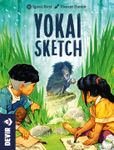
So, yeah, I definitely think the longevity is going to come through the ease of play with this one. And production-wise, I'm pretty happy with the way this game looks. You know, all the card quality is is high quality. They are linen finished. Um, they're quite easy to differentiate all of the different Yokai. And the artwork in general is very high quality, as it does have a great artwork by Vincent Dutrait. And it's nice that it all fits in this tiny little box that's not going to take up much space on your shelf at all. Okay, so let's share some final thoughts on Yokai Sketch. And what a lovely game this is. It feels somewhat familiar to many games that I've played. It really is a stripped-back version of so many other games, you know, boiled down to its most fundamental parts, but it's done so in a way that's not boring. You know, there's still enough here to get engaged with. Um, good decisions to be made in terms of that hand management, and the way you're going to smash down those cards, and how you're going to utilize those bonus powers. Yes, you have game is so well balanced that it's going to be somewhat in the same ballpark of what your opponent's going to finish on, but there's those little tricks, those little little sly tactics that you can use to win over your opponent. So, yeah, I do like this one quite a lot. Again, it's going to get it's going to definitely going to see some table time, because it is so easy to get to the table. It's fast. Again, and it's just a nice little package that I would recommend you check out, especially if you get two-player games to the table quite regularly. It comes at a nice affordable price, and it definitely is not going to take up much shelf space at all. So, that is Yokai Sketch.