





Yokai Sketch Deep Dive
What the Community Thinks About Yokai Sketch
Yokai Sketch has earned quiet appreciation from reviewers as an elegant two-player design with beautiful production and surprising tactical depth. Consensus centers on the game as a well-crafted compact experience, though reactions reflect genuine deliberation. One reviewer initially questioned how the game compared to established classics like Lost Cities, yet found themselves warming to it with repeated plays. Another discovered the game's tug-of-war structure rewarding enough to keep returning to the table. The community recognizes this as a game that punches above its small box weight, offering meaningful decisions without overwhelming rules overhead.
Core Mechanics That Define Yokai Sketch
Pattern Building Through Sketched Collection
Players accumulate sketch cards of matching elements on central yokai cards, building visible patterns toward completion. Each yokai card shows four elements (water, fire, earth, wind), and sketches slide under the element decks to reveal progress. Once accumulated sketches reach the target number, the player with the most sketches claims that yokai and its point value. This core loop creates the essential push-your-luck question: commit sketches now to secure a yokai, or wait for better cards and risk losing accumulated progress to an opponent's claim.
Constrained Hand Management and Timing Pressure
The card economy drives tactical play. Each turn players draw one card and may play anywhere from zero to three cards toward sketches in progress. A hand limit forces periodic plays, but players can choose to stay under the limit and hold cards strategically. This creates constant tension between using cards for immediate advantage versus preserving hand options for future turns. Deciding when to claim completed patterns versus waiting for stronger positions becomes the game's central puzzle, making hand discipline and timing awareness critical to success.
The Yokai Sketch Experience
Tight, Deliberate Decision-Making
Despite the small card pool and quick playtime, each decision carries weight. Reviewers describe the game as a "tug-of-war" where timing feels risky and consequential. Committing sketches to claim a yokai early locks in points but may waste card economy on a low-value card. Waiting too long invites opponents to steal the yokai through clever play or force a tie that discards both players' work. This creates a satisfying tension where players must continually reassess risk versus reward with incomplete information.
Elegant Simplicity with Surprising Depth
The game's beauty lies in its presentation and accessibility masking deeper strategy. Reviewers appreciate the compact nature and straightforward rules that make teaching easy, yet note that more plays reveal layers of tactical play. The physical act of drawing and playing cards feels natural and immediate, while the consequences of card placement decisions build throughout the game. This balance of approachability and hidden depth creates the kind of game that newcomers enjoy casually while competitive players find room to improve.
What Makes Yokai Sketch Stand Out
Compelling Compact Design
The game's small box belies its tactical richness. Reviewers specifically highlight how little cardboard delivers meaningful decisions; one reviewer called it "a small box" that packs substantial gameplay. This efficient design makes it an ideal filler that punches above its weight, suitable for quick play sessions while maintaining engagement through multiple plays. The game respects both the table space and the player's cognitive load, delivering satisfaction without demanding hours or complex rule mastery.
Beautiful Production and Presentation
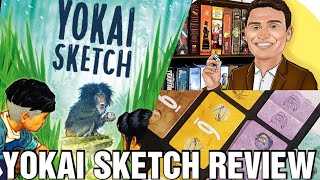
Multiple reviewers emphasize the game's visual appeal. The artwork capturing forest spirits and the clean, intuitive card layout create an immediate aesthetic draw. Reviewers note the game looks polished and professional, with presentation that complements rather than overshadows gameplay. This matters because it makes Yokai Sketch an inviting experience; the game announces itself as thoughtfully crafted before the first card is played, setting player expectations appropriately for a well-designed two-player experience.
Potential Drawbacks
Comparison to Established Classics
Some reviewers expressed initial uncertainty about how Yokai Sketch measures up to proven two-player standards. One reviewer mentioned not being certain it surpasses Lost Cities and similar competition, suggesting that players deeply invested in existing two-player games may need to be convinced of its value. The game must prove itself through play rather than reputation, which may delay adoption among those satisfied with existing options. However, reviewers who committed to multiple plays found their initial reservations eased.
Limited Player Count and Tactical Variance
As a strictly two-player game, Yokai Sketch serves a narrower audience than party or group games. Additionally, the small card pool and relatively quick playtime mean each game may feel somewhat similar to previous plays, at least initially. The shallow ruleset, while a strength for learning, provides less mechanical variety than heavier designs. Players seeking complex engine-building or asymmetric roles may find Yokai Sketch too straightforward, despite its tactical depth beneath the surface.
If You Enjoy Yokai Sketch
Players who appreciate Yokai Sketch's careful hand management and area control will find similar satisfaction in related designs. Lost Cities shares the two-player head-to-head push-your-luck tension and card economy, though with a racing theme instead of spirit collection. Land Air and Sea offers comparable set collection mechanics with the same tight decision-making about commitment timing. For those drawn to the area-control elements and spatial tension, Smash Up delivers combative card play, though with more players and greater complexity. Each of these shares Yokai Sketch's core appeal of meaningful choices in constrained decision windows.
What Reviewers Are Saying
"It's an almost like an area control game with cards, there's cards in the middle that you're contributing colors to, but the catch in this game is on your turn you always draw one but you can play between one and three. Sometimes you don't have to play, you only have to play if you reach a certain hand limit. So deciding when to play and when to claim the points is really tricky, because the way the game works is you're trying to claim those by playing a certain amount of ink towards it."
— kovray
"I played another game of Yokai Sketch. It's a little tug-of-war style game. It's okay. I know I do like it now I've played it more and more and more. I'm not sure if it's as good as some of the competitions such as Lost Cities."
— Chairman of the Board
"Playing Yokai Sketch, a two-player game where you are seeing spirits in the forest and trying to draw them."
— Paula Deming