PICK A PEN: GARDENS | An Abstract, Pencil Drafting Game (My Overview & Review)
Games in This Video
1 game is featured in this video — it unlocks as you watch.
Transcript
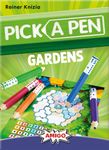
Hey everybody, Kimberly here. And I just recently picked up a Funfast roll and write game from Reiner Knizia, and that's really what sold it. I was up in my friendly local game store in Moscow, Idaho, which is Safari Pearl. And I saw this on the shelf and it says Pick a Pen Gardens, and it just said Reiner Knizia. Two to four players, and I'm thinking 15-20 minutes. And I was like, yeah, this sounds really fun. I want something cool and innovative. I looked at the back of the box and it showed these. You actually have colored pencils here that are six-siders essentially. They have um like a side where it lands flat, and then on the top you'll see it's actually got the pips, but it also has the number at the top. Um which is pretty cool.
So I've got these pencils out here. There's five colors, and then there are three different maps. Now I want to talk about really how the game works, the cool features, and then give you some of my uh caveats because I've got this massive massive double-sided no less, right? Of three different maps here, and uh we'll see if I can get to all of them. So, here's how it works. A player is going to grab all the pens, all the pencils, and they're going to roll them. And then they just make sure that they are um like just there, right? So I've got a two, a two, a four, a three, and a five. Now it's very very common to roll a one. I want to show you this is exactly what the sides look like. So there's two ones, um and then there's a two, a three, a four, and a five. So that's what every side of each pen is going to look like.
So that's the six-sider aspect of it. And then in turn order, players are going to select one, saying exactly what it is, and then drawing in that number of shapes. Um so, you were going to say out loud, "Two blue." And then you're going to color in blue spaces. Now, the spaces you color in with the color pencil have to be adjacent to each other, and they need to be adjacent to either the fountain or uh previously colored space. So, that's going to be all your rules you need to know. And when you fill in a garden, which is a space that is enclosed by the kind of darker hedge uh kind of like the space or the line, you are then going to evaluate, "Did I get any of my goals?" Um so, if you fully enclose the space that only has one color in it, you will color in that particular two, or the uh lowest number in that particular space. So, the first time you color in a garden that's entirely filled with orange, for example, you'll get two points.
The next time you fill in a space that has just orange, you'll color in a three, and then you'll color in a four for your third. That's how this goes. These are going to be columns, and then if you get all like you get one garden of any size that's completely filled with all of those types, you get the bonus of the 10. So, I'm going to put that back in two, and I'm going to show you that under here. So, that's going to be your bonus you get for there. So, the max here is worth 20 points. Each of these numbers is two, but if you get that fifth one for variety, you get the 10 points. And then down here, you're going to get those points um for your same types. Now, this one is all about variety. You want one of each color. Now, there are not six colors, but you get six points for every time you have a garden out here that has all five colors represented in each of the spaces.
So, don't think about the garden lines, the hedgerows, blocking your movement in placing colors. You're actually going to want to place them across lines if you only want one color of each in these spaces that are rather large. You're going to see that there are those that are six and seven spaces. You have to get all of those and you're going to get six each, but then you'll get that big push at the end. You'll get that big 30 points. So, let's say you can't play. You're going to actually take this. The first time you can't play a space, which you have to play all the spaces in following the rules I told you about to to be able to place your colored pencils out. You can't take some of the four or the five that are rolled. You're going to take a minus one and you're going to it's going to add. So, minus one and the next time you do it, minus two add it on.
Plus minus three, plus minus four, plus minus six. Oh, and one last thing is at the end of the game, whoever has the perimeter filled, this actually happens first. The first person to get there does get six points. First person to fill their entire board gets six points and at the end you're going to look at your largest grouping of one color and whoever has the most of that is going to get six bonus points. Okay. So, here's my here's my take on the game play. It's really fun. You're like, I'll take blue two and then your opponent says, I'll take orange five and then they take theirs and then you say, I'll do green three and you fill in green three and then they take purple four and you're like, great red two. And then it goes back to them. They don't have any pencils to to do, so they just go and then they just roll again and now they've got all different numbers, all different colors. They take one, you take one. Now, that's me playing a two-player game, but any number two to four, the next time a person wants to take a pencil that's not there, they pick all the pencils up and they roll. So, once a pencil's taken, it's out of commission until you re-roll them all.
And placing them out here, it's a very solitary game. There are some competitions for first, get to first, the perimeter and filling it in. So, that's important, but there are some riskier decisions and there are some penalties for not being able to place a pencil. Maybe it doesn't give you um the right number in the right space. You have to take all or nothing and you may choose not to take one. You take the pencil and you just say, "I'm taking a minus one. I don't want that result." So, this is just the first map. There are two other maps. This one has essentially these uh bonuses of little uh little bushes, maybe little flower groupings. And when you play or when you color in the space that matches that particular space, you're going to get two points and if you get all of them, you're going to get 10 points bonus.
Plus, there going to be these, which is just two fives and that gives you 10. And then you're going to have your 2 3 4 configuration just as before and the person who gets all five of those before everyone else gets 10. So, this one has a slightly different configuration, actually very different, but then it also has that added feature. And then lastly are these little trees. And so, the trees are going to add an even different bonus. This has a different map. It's way, way bigger um compared to the kind of hex of the very first one, the hex size. And it's going to give you totally different things to score for and then of course those three basic ones here. So, this one's bigger. This one's more complex. Every single map is going to gain or add to complexity. So, make sure you play the first one first just so you can learn how the game works and how to score it all and really just how how it goes. It's very fast. It's very easy. Um the one critique I have is that it has a sudden death ending. The person who fills in their entire space triggers the end of the game and there's nothing after that or if someone fills in their last pencil. And that's what those exclamation points are for.
This says, "End of game." That says, "End of game." So, if those get triggered, the game is over. I am not a fan of immediate endings. I think that equal turns, especially in a game like this where you're picking pencils, and if one person or two people or three people in a four-player game get one more turn than you do, that just feels unfair. So, I don't necessarily understand why it is a sudden death and not just go to the end of the round order. Like, someone starts, and then everyone just always gets to take a pencil, um, until you get to the person that goes again. To me, that doesn't seem like that big of a deal, uh, big of a difference, especially when the first player just goes, and there's no benefit to going later in the round, period.
Like, you just go last, and then you don't get an extra turn. That just is like punitive for no reason. It kind of takes the fun and the joy out of the puzzle feature and the competition feature, especially with those races to get first. If you're first in turn order, you're early on, you're probably going to get to those before other players. So, there is a way that you can play that if you just accomplish it, um, you can earn it, as opposed to a race feature to get there first. I would play that way. And honestly, maybe a house rule for me would be to extend this to full round end, not a sudden death, because the very first game we played of this was pretty frustrating. Um, I was the one who didn't get equal turns, and it was just kind of like, "Pooh." I was like, "Dang, that stinks." Um, so, yeah, I would have loved to. I actually This is This is why it was so rough. Um, I had all four of those, and then I was filling in this one in my last turn that I would have gotten, but I didn't cuz my opponent ended it, and I missed out on 36 points, and that was the game. Like, I would have won had I gotten I had one more to fill in, and I had the right pencil for it. It was on the table, but I couldn't take it. So, just a little left me feeling a little raw, and I don't think that this kind of a simple game, this abstract game, really wants to leave people feeling poopy. So, Pick a Pen they're not pens, they're pencils. I don't know why it says pen instead of pencil. Couple weird things. I'm not sure how I'm going to sharpen these, they're real fat and I want to make sure that I maintain the
integrity of the the sides. So, we'll see once they start getting duller how easy it is to maintain that but a nice size box and a ton, a ton of these maps and again, they're double-sided so they have two uses before you throw away each paper and each of those maps does get a little bit more complex and a little bit longer but also more satisfying so start easy, work your way up or play the level that you'd like. More as an expert gamer or more as a casual gamer. All right, that's going to be it for my Pick a Pen Gardens, my quick pick when I went to my friendly local game store from Reiner Knizia. Like it but only with my house rule change. All right, everybody. I'll see you later. Bye.