
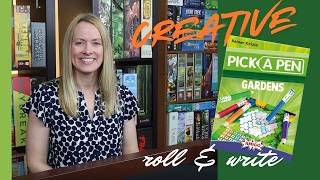
Each turn in Pick a Pen: Gardens, the active player rolls the five colored pencils, then chooses one and marks spaces on their individual player sheet. Each other player in turn drafts a pencil and uses it. Pencils show symbols on their different sides, and the symbols on top of the chosen pencil determine what players do on their sheets.
Each sheet shows bordered gardens, and on a turn, you fill in the indicated number of spaces in that color; all of those spaces must be adjacent to one another, in addition to being adjacent to everything colored previously. Your goal is to fill gardens with only a single color or with five different colors, scoring bonus points as you do so. The game ends when a player has completely colored all of their gardens or failed to color in five times.
Pick a Pen: Gardens includes three difficulty levels of player sheets, with flowers and trees on sheets 2 and 3 to help you earn bonus points in different ways.

- Fun and innovative concept
- Attractive component (colored pencils)
- Multiple maps add variety and replayability
- Fast and easy to learn
- Satisfying scoring on later maps
- Sudden death ending feels unfair and punitive
- Potential for players to miss out on significant points due to sudden death
- Uncertainty about pencil sharpening and component longevity
- gardens
Mechanics (from transcript analysis)
- area enclosure — Players fill in spaces on their board, and when a garden (area) is fully enclosed by hedges, scoring occurs based on the colors within.
- Push Your Luck — Players decide whether to take a rolled pencil result or take a penalty, with the possibility of not being able to play a chosen number or color.
- Roll and Write — Players roll dice (pencils) and then draw shapes corresponding to the numbers rolled on their player boards.
- Set Collection — Players aim to collect sets of colors within gardens or across gardens to score points, with bonuses for variety and specific configurations.
- Variable player powers — Different maps offer different scoring objectives and bonuses, changing the strategic focus for each game.
Video topics + discussion points
Quotes (from this video)
- I am not a fan of immediate endings. I think that equal turns, especially in a game like this where you're picking pencils, and if one person or two people or three people in a four-player game get one more turn than you do, that just feels unfair.
- So, this one's bigger. This one's more complex. Every single map is going to gain or add to complexity.
- It's really fun. You're like, I'll take blue two and then your opponent says, I'll take orange five and then they take theirs and then you say, I'll do green three and you fill in green three and then they take purple four and you're like, great red two.
- So, Pick a Pen they're not pens, they're pencils. I don't know why it says pen instead of pencil.
References (from this video)

- Unique pencil rolling mechanic
- Easy to teach
- Appreciates the idea behind it
- Generic gameplay mechanics
- Quality control issues with pencil stickers
- Wishes for colored dice instead of pencil rolling
- Gardens
- Knock-Knock
- Quacks of Quedlinburg
Mechanics (from transcript analysis)
- Area Control — Players try to fill in as many spaces as they can, with bonuses for the biggest colored-in space.
- Dice Rolling — Pencils with numbers on them are rolled to determine the color and number of spaces to mark.
- Roll and Write — Players mark off spaces on their sheet based on the roll of dice.
- Set Collection — Players get points for filling in specific combinations of colors.
Video topics + discussion points
Quotes (from this video)
- I don't need to get into this and be called Gramps and all this stuff.
- If you ever ever have questions about how your heart health is do not delay make sure you go see your doctor.
- I just don't remember being that lenient and I think colleges have gotten soft.
- The unique thing is the pencils being rolled.
- The problem is this is the only mode of play you have.
- This has got to be one of the more clever app-driven games Tony because of the use of the camera.
- It is not it is not it is a tile lane game with a little bit of a market Style game at the end based on cards that you play at the end of the game.
- The pace is so slow at the beginning of the game because that worm is so resource hungry each time you move it.
- I hate to be down on it but we've played a lot of amazing d games you know matter of fact one of them was in your game of the year right right this one White Castle White Castle this one just kind of fell flat to me.