The Yellow House Review: Wake Me Up Before You Van Gogh
Games in This Video
1 game is featured in this video — it unlocks as you watch.
Transcript
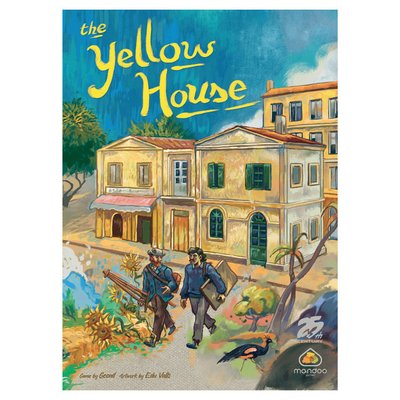
Hey there everybody, it's Mike Delisio and today I'm going to be taking a look at The Yellow House, a two-playeronly trick-taking game from designer Cunnell and the original publisher was Mandu Games, but it has recently been put in wider release in the Americas by 25th Century Games. This is a game themed around two famous artists who are debating over what is most important in art. So, let's head over to the table. I'll let you know how the game plays, then we'll come back here and I'll let you know what I think. Okay, here we see the yellow house all set up. And we've got here the board, the canvas board that's going to tell you the strength of all of the elements here. We've got four elements in the game. You've got money, you've got passion, you've got skill, and you've got inspiration. And these are going to be moving up as players play cards. Each player is going to be dealt a hand of 12 cards. There will be five of these support cards that are just available here. And then you've got four cards that were left over. Although this pie will be diminishing by one every round.
The game goes to a maximum of five rounds. although it could end earlier than that. Okay, so on your turn, you're going to be doing one of two things. You're either going to be making a claim, actually one of three things. You're either going to be making a claim, strengthening an element and making a claim, or passing. So, let's say the first player here, the one on the left, is going to look through their hand of cards, and they're going to pick any one element that they want to play. So right now since they're all equal and they're going to go ahead and play this inspiration card and then this is going to move up one and that is their turn. Okay? Because uh you'll see how it goes when you want to strengthen a claim. So when you are making a claim, one of the things that uh has to be the case is that you can only uh play a topic that is stronger than the last claim and has not yet been played into the trick. So the first hand there's nothing that have been played. They can go ahead and play whatever they want. Now player two cannot claim inspiration because it's already been claimed. They have to choose one of the other two. Now, all of these are of a lower value than inspiration. So, to be able to play it, they have to be able to move one of these other in one of these other inspir one of these other elements exactly one higher than the inspiration. So, they have to get one of these to a strength
of three before they can make a claim or they can just choose to pass. But in this case, they decide, no, what I'm going to do is I'm going to claim that passion is more important than inspiration. And so what you have to do is play a number of cards equal to the value that you're going up to from where you are. So if I wanted to move passion to three, I have to play two passion cards to get it to that strength. Now I can either just do this, play these two passion cards, then adjust this, and then play a third passion card to make the claim. Or I can choose to use one of these support cards. And that is what player two will do. They'll actually use one of these support cards. You can only ever use one per strengthening to move it up two. And now they will go ahead and claim with this passion card here. Okay. Then it comes back to player one. Now they're in a situation where they know that the only two elements that they can claim would be skill, which is purple, or money, which is yellow. and they do have a decent amount of yellow cards. So maybe they're going to go ahead and do that. They're going to go ahead and strengthen and then claim. So to get from one to four, they have to play three cards. So what they'll do is they'll play two and actually these cards would have been discarded.
They'll play two um and a support to move this up three. One, two, three. And then they make the claim right here saying money is more important than all of those things. And it comes back to player two. Player two, the only thing they can play would be skill because all of the other ones have been played already. They would need one, two, three, four skill cards plus one for the um to actually claim it. And they can do that. So maybe they decide, yes, I'm going to do that. I'm going to play three of these skill cards plus a support. One, two, three, four. And then they still have one left over and they can play that immediately. As soon as all four elements have been played into a trick, into a round, that's going to end that round. The other way it would end is if a player ran out of cards. So in this case, player two closed it out.
They would take this card as kind of their prize for winning that and they would put it underneath their pallet. The game is going to end at the end of any round where either a player has two of the same element or three of any element. At that point, the game will end with that player being the victor. If no one has won at the end of the round, as would be the case here, then the cards would be uh dealt back out. You'd have to put one extra card to be able to deal 12 to each because one has been under the uh uh one of the pallets here. And you can continue going on until the game end is triggered. Um which could be five rounds, it could be earlier depending upon how things play out. All right, that should give you a pretty good idea on how the yellow house plays. Let's head back up and I will let you know what I think.
All right. So, there you have the Yellow House, a two-playeronly trick-taking game with a very unique theme. And I do like the theme a lot. Even though the game itself um doesn't necessarily feel thematic, I like the theme that is there. And it does make some sort of sense when you are kind of discussing how that works. So, um, you know, you've got Van Go and Golang, who I'm probably very poorly, uh, pronouncing, who are debating what is best in art, and you've got those four elements that are represented by the different suits. And so, thematically, it's cool. It's a neat little touch. Um, does it help you learn the game? I don't know. But it certainly doesn't hinder from that. And so, I I I do like the theme in this one a whole lot. Um, I also love the art and I think that that is fitting in a game that is about uh what what is the most important things artistically. So, some very nice art on the cards. There's not a whole lot of uh different art, but what's there is very very nice. The components in the game are really terrific for a little little smallbox game like this.
The uh you know stitched canvas uh board is nice. It will curl up on the edges a little bit, but you really it it doesn't affect the gameplay at all. The wooden pieces here are very very nice. Um not necessary, but certainly uh welcomed in in a game like this. I think that it feels like a game about art because the you know the art in the game and the components are very very luxurious for the type of game it is. So let's talk about the game play. So, it's it's one that is a trick-taking game, but it's also uh part of what you would call a ladder climbing game where where you're trying to um play in ascending values. And so, you're usually having to play more and more cards to be able to continue to be in the trick. And so, um there are a number of these types of games out there, but what I think um this game does uh interestingly is kind of how that's handled. And and the inclusion of those support cards, I think, are very interesting, too, because you know, you have five of those per round. And um so if they all get played, one player is going to be able to play them three times while the other player is only going to be able to play them two. Um and and that can be an interesting pushpull element where, you know, you're you're incentivized to use those support cards, although you can only use one per trick. Um, it really does add a neat little twist to the
game. Um, and being able to, uh, if you're going to increase a particular element, only being able to go exactly one beyond the highest element, that's a nice little twist and kind of, uh, makes the game very concentrated on hand management. This is a game that has a tremendous amount of hand management uh, in it and and so that makes it feel unique as well. Um, the wind condition I also think is very interesting being that you really would like to be able to ideally um get two of the same element under your uh your pallet because that's the quickest way that you can win uh win the game. And uh but that's tough to pull off. It's not easy to pull that off. Um you know, alternately you can get three of any element. So, you know, winning three out of the five rounds will also win you the game. Um, and so I like those different win conditions, too. I think that that adds a nice little touch to the game. Um, deciding, you know, maybe when it might be best to just pass. Um, so, you know, you're not necessarily always going to want to increase an element and then, you know, place place it out. Sometimes passing is a better move for you, too. So, it's a simple rule set, not not complicated to teach or learn, but it's a lot more clever than you might necessarily expect just from reading the rules. Once you get into actually playing the game and
figuring out the pacing and the timing of things and how you want to best manage your hand really can lead to some very clever plays and um the the the kind of the subtleties of the g the game design will reveal themselves more through playing than you might find just by reading the rules. So with all that said, I feel like Yellow House is a game that I'll easily recommend. I'm giving this an 8 out of 10. Um, you know, the the only thing that might keep it from getting into that excellence uh category is that, you know, there are a lot recently of these two-player trickt taking games and and, you know, it takes something that really really is um so unique that that I feel like I have to like put it into that upper echelon, but this is right on the edge of that. I really do feel like this is a uh an excellent game and one that uh with an 8 out of 10 hopefully reflects that for me. All right, well that's going to do it for me. This is Mike Delisio and I will see you on the next one.
Hey everybody, thanks for watching this video. If you like this review or whatever you just watched, wasn't it amazing? Uh, check out our channel, Dice Tower. We have all kinds of things. We review games. We do top tens. We play games live. It's all about board games, but especially the people who play them. Check out Dice Tower YouTube channel.