
















The Yellow House Deep Dive
What the Community Thinks About The Yellow House
The Yellow House has earned a genuinely mixed but intrigued community response. Designer Gunnil's two-player card game divides reviewers between those who find it esoteric and genuinely confusing, and those who find it a clever, compelling puzzle worth returning to repeatedly. The game's complexity lies not in rules overhead but in how it makes you think: understanding what matters moment-to-moment in a game with no numerical card values challenges conventional card game intuition. Some reviewers, including The Dice Tower's Chris and Tabletop Tolson's Kimberly, found the access point steep and the theme disappointing. Others, including the couple at Kovray and contributors at Board Gaming Ramblings, describe it as worth the effort to learn, ranking it among their favorite games. Several note that Mandoo Games' production quality and the game's inclusion on BoardGameArena help demystify its mechanics through repeated plays.
Core Mechanics That Define The Yellow House
Card Shedding Without Numbers
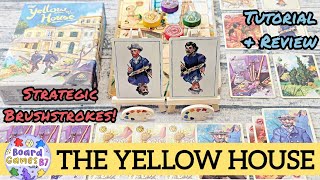
The Yellow House strips card values down to their essence: colors and suits, with no printed numerals anywhere. Players draw from a deck with four colors (representing money, passion, skill, and inspiration), and each round begins with a card exchange between opponents. This exchange actually sets the initial value of each color for that round. The goal is simple on the surface: empty your hand before your opponent. But the execution transforms the game into a timing puzzle. To play a card of a suit that is already "leading," you must first discard enough cards of any color to raise your card's value above the card already played. This creates a resource management layer where every card in your hand is currency toward future plays, and knowing when to spend them becomes the strategic core.
Support Cards and Variable Power
A small hand of five support cards sits in the middle of the table each round, available to either player as a way to boost a suit's value at will, but each player can use at most three per round. Additionally, Mandoo Games included a variant that adds special powers to each suit: activating these powers when you play support cards adds another layer of decision-making that several reviewers noted transforms the game from interesting to engaging. The variant rule appears nearly essential to the game's depth, though the base game alone provides a solid puzzle for those seeking to master it.
The Yellow House Experience
A Debate That Rewards Planning
The game's theme centers on two artists, Vincent van Gogh and Paul Gauguin, living together in a yellow house and arguing about what matters most in art. Rather than representing this as conflict, the game abstracts it as a series of rounds where players try to have the last word by emptying their hand first or winning back-to-back rounds with the same color. Reviewers noted the theme clicks best once you understand the mechanics; it is not immediately thematic, but over plays it becomes clear that you are indeed having a drawn-out debate where each exchange of cards reshapes what your opponent can and cannot accomplish. The game feels like a conversation where both sides constantly shift positions.
Mind-Bending but Compelling Puzzles
Players consistently describe The Yellow House as "mindboggling" in the best way. Unlike trick-taking games where you know card values at a glance, here you must constantly recalculate: given that the values I set at the round's start have likely shifted during play, what does my hand actually allow me to play now? The timing element means that plays that seem advantageous in isolation become disadvantageous if they leave you without the right mix of cards later. One reviewer noted playing it multiple times without fully grasping the optimal strategy, yet feeling compelled to return because understanding deepens with each play. This is a game that rewards study and invites you back.
What Makes The Yellow House Stand Out
Strategic Depth From Radical Simplicity
The design choice to remove numerical values entirely is unusual and powerful. By grounding all card power in player-controlled valuations, Mandoo Games created a game where the game state is not visible at a glance. Competitors must track mental models of current suit strengths, think ahead about what hands are still possible, and plan for cards they have not yet seen. Several reviewers marveled at how a 30-minute game with a small deck and simple rules creates such a rich puzzle. This is design by subtraction: the game works because of what it doesn't include, not because of what it does.
A True Two-Player Design That Plays Quick
In an era of bloated games, The Yellow House respects players' time. At roughly 30 minutes, it is fast enough for multiple plays in an evening, yet dense enough that each play feels meaningful. The two-player-only design is intentional and welcomed by reviewers who appreciate games that need no player-count balance or downtime mitigation. The cloth board for tracking wins, the small box, and the elegant component design also earned praise as examples of production that complements rather than overwhelms the mechanics.
Potential Drawbacks
A Steep Learning Curve That Doesn't Feel Like One
The game's greatest barrier is its abstraction: because cards have no numbers, the value relationships are invisible until you internalize the player actions that set them. The first play often feels confusing, and reviewers noted that the rulebook alone may not be enough to grant full understanding. One reviewer described stumbling through an entire first game despite both players reading the rules carefully. This is not because the rules are poorly written, but because the game's core insight (that players set values, not the cards) is counterintuitive. Players should expect to misunderstand something on the first play and embrace it as part of the learning process.
The Theme Can Feel Abstracted or Disconnected
While several reviewers came to appreciate the thematic elements (arguing about what matters in art), others found the theme abstract to the point of being cosmetic. The yellow house and the artists feel like window dressing rather than the driver of the game's mechanics. For players seeking games where theme and mechanics are inseparable, The Yellow House may feel like a puzzle game wearing an artist's costume. The lack of thematic resonance in early plays may frustrate those expecting the narrative to guide strategy or feel present at the table.
If You Enjoy The Yellow House
If The Yellow House resonates with you, Orbita by the same designer Gunnil offers similar abstract puzzle depth in a two-player trick-taking frame, though with more visible card values and a slightly more intuitive learning curve. Beyond Gunnil's catalog, seek out other Mandoo Games trick-taking titles and two-player specialists who push against the genre's conventions: designers like Kevin Lanzing and other contemporary creators working in two-player card games tend to share The Yellow House's commitment to elegant design and deep strategy in short playtimes. If you love games where repeated play unlocks mastery and where player skill in mental math and lookahead determines victory, The Yellow House should be on your shelf.
What Reviewers Are Saying
"I do feel myself kind of compelled to come back to it out of interest and trying to get better at it. The more I play it, the more I understand it. And I do like that hook of if you can win with the same suit twice, you win the game."
— The Dice Tower
"It's surprising more thematic than I thought because you are like passion is more important and like you're the different types of categories too. I really like this game. I think we should do a playthrough of it."
— Kovray
"I feel I still don't know the strategy of this game but every time we play I'm like again I want to figure this out. It is very very cool, it's gorgeous and it's really quick."
— Kovray