Trick Taking Corner: Orbita, Power Tricks, and More
Games in This Video
4 games are featured in this video — they unlock as you watch.


Transcript
Hey everybody and welcome out to Chris's trickt taking corner. This is not really much of a corner. I'm gonna go try sitting in the corner. Actually, let's try that. Okay, can confirm this was a bad idea. This is going to be more of a figurative corner over here. This is also going to be more figuratively trick because I'm also going to talk about some card shedding games. The idea is these are yes, these are types of games that I talk about a lot and yes, they get a lot of coverage on the channel. There's a lot of them coming out. There's some cool stuff happening with a lot of them. So, I'm going to talk about six of these, give you quick overviews and then my thoughts on them and not really any particular order here. So, I'm going to start off with Trick or Bid. This is from Baron Games, Baron John. Uh, so this is a company that does Kickstarter of these every so often or so. Uh, and I've played a few of them from this batch. So, I'm going to talk about this one, give you a quick overview, and then my thoughts. In trick or bid, players will use a deck of cards with three or four suits. If playing with three players, you'll take one of them out.
You can see the distribution here. Multiple ones, twos, and threes, and then 0, 4, 5, 6, 7, 8, 9 are unique. This is a mustfollow game. So, if someone leads with a black suited card, then a player must follow with that. Likewise, and then the last player can also follow. Now, the goal here is that as you win a trick, the highest of the lead suit is going to be able to either collect the cards and keep it face down in front of them as a trick that they've won, and then they will uh offset and so that you can make it visible how many tricks you've won, or you can instead choose to take one of the other cards from that trick in front of you as a bid and say, "I'm going to try to win three tricks by the end of this hand. Whoever first does this gets to appoint the trump suit for the round. So that if you play off suit, uh if you don't have a suit and you play instead that suit, then you can win that instead. So uh you will score three points if you match your bid exactly, one point if you just miss your bid by one, higher or lower, and you'll score negative one points if you do not qualify, if you don't take a bid at all in front of you. So that's tricker bid. Trick or bid has that very interesting wrinkle mostly in that you uh I mean I like games where there's that variable bid and you kind of make that bid in the middle of the round and the fact that whoever first does that gets to control the trump suit for the round. I think it's a nice hook. It is not one that does much more to kind of
keep my interest. The scoring is pretty simple. Kind of like a less interesting Tiki Shanzawa type scoring where you have to hit your bid directly. Uh and it gives you that flexibility of one off. I think it's fine. I think it's fun. Uh, and I I I like how cutesy and everything it all looks, but overall it's not strong enough of a hook that I'm going to keep coming back to it, but I do enjoy it. So, for all the things that it does well, um, it's it's yeah, just not as interesting as some of the other wrinkles. I know I'm a big trick taking enthusiast, so maybe that's part of why. So, I'm giving this one a six. Six for trigger bid. I think that it's a it's a good one. I would sit down and play it again, but I'm not really going to be reaching for it. So, there you go. six there. Next up, from the same uh line or same Kickstarter, this is Power Tricks.
This is certainly legally distinct from uh um uh He Dude, Master of the Galaxy verse. So anyway, let's take a look at this one. Here's Power Tricks on the table, which consists of multiple chapter cards, which tells you how to set up the game. So, what are going to be the scoring? What number of tricks are you trying to win here? Your bid, what is considered the Trump suit? It could be one of the suits of the game or it could be highest card regardless of value and how many points are each trick worth. There's also cards here showing the deck composition. So you see yellow is on average the lowest deck of cards uh of the lowest suit of the four in the deck and blue is the highest. So this player is going to be uh leading out a card and every other player must follow. So we'll say that this one here plays the one. This player over here uh does not have uh the matching color so they can play whatever they want. And let's say they play this nine here. You'll notice that in this particular rule, the highest value regardless of suit wins, but ties will eliminate. The other little gimmick here of power tricks is that when a player plays a card out, they may yell, "I grab the power."
They'll grab this card and keep it in front of them for the rest of the game. And now every card they play out will have plus one power. And they can also grab one of these gems here which changes a special rule for them or gives them extra points or changes what number of of uh what their bid is. So they're maybe trying to win zero or something to that effect. And they'll take this one here that says they have three points at the end of the game no matter what. This player over here plays the eight. So in this case, this person wins because they have the highest single value card in the table. They have a 10. So they'll collect the trick and they'll start off the next trick. Uh, however, at the second trick, the two power card will come out. So, one player per round may grab the power and increase their power for the rest of the hand and grab a gem as they do so. Uh, however, the longer that you hold off, the more valuable, more strength your plus power card will be up to 11 because that's the number of tricks that can play out depending on the player count. Uh, and then you'll go through and you'll score number of points per trick. And if you hit your bid, depending on what the power card was that you grabbed, you might get a number of bonus points if you hit your bid exactly. So that's power tricks. The theming, the art, the humor of this one is is fantastic. I really love that. I love I grab the power. And if you're at the right table of people, people are going to be, you know, so excited to chant that. This one has a lot more wrinkles to it. the fact that the scoring is going to be changing. The the each chapter card gives you a different
uh card to use for trumps suit. How many tricks is your bid, how many that you're aiming for. You never actually bid in this game. It's just kind of told to you, and I don't mind that. In fact, some games that I love do that, I think, really well. Uh different amount of tricks, points per trick that you win, and those gems are a nice little change up. I think that this one is a bit is definitely a more ambitious trick taking design. I think that it is a lot of fun and I don't know if all of the chapters are necessarily that uh like rock solid tight because sometimes the scoring per trick is it just really makes that bonus for hitting your bid so much less interesting. Other times it is the only way to score, but it kind of does it in this like roundabout way the way that explains things. Uh so I do like it. I like it a lot. I'm giving this one a 6.5 in part because I think that that theme, that humor comes across very well. I don't take this one too seriously, but I still like that idea of holding off. You know, maybe I wait until the bonus is like plus eight because the longer I hold off to take a bonus, I'll have fewer gem bonuses to pick from, but then I'll have all the power near the end of the game, and that feels cool. So, I think it's good. Like I said, ambitious, fun. Uh, a 6.5. Next up is going to be a war game, a historical war game set in World War I, one of the bloodiest battles out there. So, this is a tricktaker uh of sorts. I'll show you how this one plays, then I'll give you my thoughts on Verdun. Here's Verdun on
the table. This is either a team-based 2v2 trick-taking game. Two French players versus two German players, or one v one. The difference being that you deal one hand or two hands to each team. Uh, one player at a time, one team at a time is going to choose a target to assault and play cards out. This is a may follow trickt taking game. So if this case the French player plays out this card here, the German player, you'll notice here has French cards as well as German cards in hand, they will be forced to play all of these by the end of the round. Uh but maybe they'll choose to play out one of their own to bolster up their defenses. And then the French player is going to go here and play out this card over here. So now this is a French 18 versus the German 11 so far. Uh, and then this player decides, you know what they'll do is they're going to play this one here. So, Germany is defending with a 17 versus 18. If the assault is larger, uh, then you'll flip over this defense token and this adds to the defense value. And in this case, the battle is lost or so the battle does not succeed. However, you're going to look at the largest side of of cards here. The strongest faction is going to take casualties in this battle.
they will lose the uh smallest card that they've played. The losing side will lose the largest card that they've played. So, you take these casualties over here because points are these stars won by assaulting the other side. And uh the ones that you're able to successfully defend and keep face down, but also at the end of the game, you're going to lose points for every skull in your casualties area. So whether you take opponent's points or not, there's going to be more casualty, more losses. At this point, whoever played the largest remaining surviving card will get a tactics card, which will have some instant effects as they're played out into the game. And so as you continue playing this, at some point you are going to have to play more cards of the opposing side uh just as things will come up here. So, let's say in this case, this player uses the artillery shell, uh, which is going to kill all units involved in the combat. Nobody wins this one. All of the units go to the casualty pile of the respective player. And this is a bleak outlook, but representation of the war in a trick-taking game. That's Verdun. Verdon is a trick-taking game, sort of, right?
And I it it kind of builds itself as that, so I don't mind reviewing it as one. As a trick- taking game, I don't particularly like it that much. If you were to look at this and compare this more to a game kind of like uh Twilight Struggle or some of those where you draw your hand of cards and you have a lot of cards for your opponent in there, that's a weird feeling. How do you navigate that? So, this this follows that trick taking kind of form, but it really feels so different from from tricktakers out there. Now, I do applaud its ambition. I do applaud its thematic core at at the end of the day. Verdon was an incredibly bloody battle or series of battles or several months. Uh it was just it was so important and so crucial to World War I. I love the theming of it. I love the fact that the casualties just keep mounting and even if you're doing well, your loss pile is getting enormous. Your winning score in this is going to be negative. And I think that's for a reason. This is representative of something. I love how much it evokes that. It uses kind of period artwork. It uses the cards look so classy and historical and, you know, with all of its flaws and all of its issues. There's several special cards in there like the general that can be either the strongest or the weakest, the spy that can copy uh the the ones that are guaranteed to be your suit either way. I think there's a lot of good going on here. Some of those event cards that you earn are brutal.
So, I think the thing is that you have to go into this knowing that it's it's a historical war game. You're playing cards for your opponent. It feels like more than half the time. And so, it is rough. It's brutal. And it's so excellent at conveying exactly what this game needs to about this setting. I just don't like it very much. So, I'm giving this one a five uh as as a historical as something historical to explore that history. I think that this is this receives much higher marks for that in terms of as a game that I want to come back to and play. Unfortunately, it's a five for me for Verdun. So, let's move on now to Korea Board Games has published Phantom of the Opera from designer Gunnel, a two gunnell, a two-player tricktaking game. Let me show you this one. In Phantom of the Opera, one player is the Phantom and the other player is Christine. The Phantom is trying to place out all of these 12 musical notes onto the ledger here or the staff in the middle. And there are multiple boards to play on. Uh, and the Phantom is able to place out a note on these filledin ones if he wins the trick. And if Christine is able to win the trick on the half notes, the ones with the open in here. And for anyone who reads music, this is very painful.
Uh, if Christine wins these tricks, then the Phantom is able to place out a marker here. But you move from left to right. The deck is one through six in four suits, 10 cards each player. Uh, and the start of the round, each player is going to pass each other a card. And when this is done, they'll be revealed and the phantom gets to choose one of the two ranks here. In this case, let's say the two. That is going to be the seal number. And that's important because that will cause players to pass cards to each other mid round. At this point, the Phantom will play a card and then the other person, Christine, is going to have to follow if they can. And so, they'll play out a card here. The Phantom winning once again on these dark notes means that they get to place out uh a music note here and they're going to continue to try to do so and fill this board in completely with all 12 within two hands or two rounds of the game. So the fan is going to try to win multiple here and then is going to try to start losing tricks here. Uh now as I mentioned anytime the seal number or the two is played immediately the players have to pass two cards to each other which really disrupts this idea of trying to win or trying to lose tricks.
Uh now the last thing here is that the yellow suit is the trump suit uh in all standard play. However, depending on which staff or which uh quarter or which area of the sheet music you're working on, this is a super trump suit. So even if one player played out this leading card, uh if this person didn't have any of that, they could follow with the current rounds super trump suit and they would win the trick. Or they could follow with any other offuit and they would lose. In this case, Christina winning means Christine uh means that that note gets filled in. That's Phantom of the Opera. This game is weird. I like this type of weird, right? And and I like when uh this this designer, Gunnill, does a lot of very interesting two-player shedding and trick taking games. It's kind of his bread and butter. Uh and I think that this one is neat. I like that little theme of like filling in the sheet music. But oh my goodness, trying to look at that sheet music and being a musician, it just pains me so much. Like this this this measure has five and a half beats in it and that one has seven. What is going on?
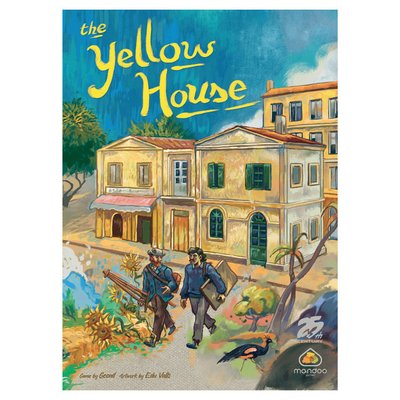
So, uh, yeah, it would have been nice if they had maybe done that correctly, but that's not going to affect my score. I think that this is this does a couple of strange things I really like. Passing cards, middle of the hand, the passing of cards in the in the beginning of the hand, changing Super Trump suit, but always standardly the yellow is the Trump suit. I think that that's it gives you a lot to work with, a lot to play with. And so, I find this one to be incredibly clever, very fun to play. 7.5. Uh it is it is tough. You feel like, especially as the Phantom player, you are under the gun to get everything out there. And sometimes I've seen this game go really tight and then just like just absolutely come to a you know a win. It just kind of sweeps over to one side or the other. But I still think that this is an intriguing puzzle to come back to. So 7.5 for Phantom of the Opera. Next up is going to be another game. Actually, these last three games are from the same designer, Gunnil. Uh, and this is a card shedding game called The Yellow House about painter Vincent Van Gogh if you're in the United States. And if you're apparently in every other part of the world, Vincent Van Go. Uh, so let me show you how this one plays. Mike reviewed this recently, but I'll give you a quick overview and then my thoughts. In the Yellow House, players are rival artists trying to empty out their hand of cards by playing them and strengthening up these different suits.
The suits have no values to them, but players will pass two of these cards to each other, revealing them, and that's going to bump up the respective markers of those suits. Players will then take these into hand and begin to try to outclimb each other. If this player here plays red first, it's the lowest ranked card, the next player can then play a yellow card because it is ranked currently higher. If the next person here wants to play a green one, they'll have to either bump it up by using one of the five support cards for the round or by removing another green card from hand. So, by discarding this one and then playing this one, discarding it one step moves it up and then they've played into it. And lastly, this player has to do the same thing with purple. In this case, they're going to use a support card. Players are allowed to use at most three support cards in a round. At this point, the player has won this particular climb or the debate. So, they'll start off again. Players continue doing this back and forth until one of them has emptied their hand of cards. And if by emptying their hand of cards with, say, this yellow money coin uh card, they're going to put this under their marker here. You'll shuffle up and add another card to replace the one that's removed. And whoever either wins three rounds or wins two rounds with the same colored card is going to be the winner. This game is is definitely more esoteric and I think that that's a it's it's a very classy production for Bandu.
I really like the way that it looks and as you open it, it does feel artistic all around. I think the actual card play is is strange. It's kind of odd to not hard to wrap your head around, but kind of hard to wrap around how you're doing if you're doing well in it. I think that this game play is very clever. Uh and I like the fact that there's those five cards. You can take a you can spend cards from your hand to move up different things, but there's these cards in the middle of the table. You can also use those to move them up. When do you do that? Is it better to get rid of cards from hand? Usually, but if you run out of stuff from hand, are you going to have a harder time playing things out? Yes. So, it's it's very interesting. I know some people this is one of uh their favorite games designed by Gunnil. But for for me, it's a little too strange. I like it. I love games that mess with cards that have no inherent ranking or number to them. And so I want to like this one more than I actually do, but I do feel myself kind of compelled to come back to it out of out of interest and trying to get better at it. The more I play it, the more I understand it. And I do like that hook of if you can win with the same suit twice, you win the game. But if you win it three times anyway, you you do just still win. So, I I think that it's good stilted in a few little moments. But, I'm giving Yellow House a 6.5. And maybe as I play it even more, I'll I'll grow to like it more, but with with a few plays under my belt and actually and having seen my my abilities in the game
grow, it's still it's still fun, but a little bit of an odd duck. So, Yellow House a 6.5 for me. And last up, another once again two-player card shedding game from Gunhill. This is from Korea board games again. Orbita. Let's take a look. In Orbita, players are playing one to three cards of the same color planet from their hand that have to be next to each other to be eligible to play together and moving the corresponding color planet that number of steps on the track. The other player responds by playing uh cards of one single planet as well. And then the higher value one will take cards from the other. So in this case, if this player here played an orange out, the orange planet would move one step. And this player could respond they by having three blues next to each other uh which does by the way close in two oranges next to each other again. Uh this player responds with three blues.
So the planet will move one to leaprogging any previously played planets three. And in this case they will be the winner. So they'll collect the three blue cards as well as the one orange card played by the opponent and then they will lead off. Uh so in this case playing out two orange one two you see that they are at this seven plus this is basically uh and half so 7 and 1/2 6 and 1/2 so on and so forth. So at this if this player responded with this blue then the blue moves one step and this player has now taken the oranges and the blue. You continue playing until one player cannot follow cannot respond at which point immediately the hand ends and players will count up the score. So, if at the end of the hand it looked something like this, players are going to score up all of the opponent's planets that they have more of than each other. So, this player would take two points in these planets. This one here would take two from this side. Uh, this player would take the one point in greens here. And then because this one completely avoided having any blue, this one doesn't actually award any points.
So now we see the score here is three to two. At the end of this example of Orbita, you're going to see some comparison points to Yellowhouse nonsuit or non-ranked different suits of cards. There's only four of them, but I think that this one gives you a little bit more to work with by having that ladder of the planets, the numbers 1 through six and then 1 through 7 and then 7 plus or like 7.5 and then working its way down. I didn't really discuss in the overview that once you kind of shoot past that, then the suits start to weaken as they move back down around the bend. And I think that that's so strange and so cool, but a little bit more easy to visualize. How are you doing? I think that this one compared to Yellowhouse uh for me allows me to feel and understand where I am a little bit more by trying to have more cards than my opponent. But ideally, I would like it to be a very narrow. I would like to have four of a suit and them have three because then I'm going to score those three as points. If it's seven to zero, I won the majority, but I don't get any points.
And so I think that that's incredibly clever. And so this is a game about not just when you win, but also what cards you play to lose to stick cards to your opponent so that you get to score them because you know that you have the majority of it. I find this one to be incredibly clever. One I keep coming back to joyfully because it's just a fun puzzle. And like I said, having some of those visual cues, uh, restricting your hand of cards so you can only play the ones like kind next to each other, having that ladder, the orbit of the planets, it makes this one more understandable to me without losing its its oddness and its depth. So, I really like Orbit. I'm giving this one an 8.5. I think this is an excellent quick game. You play one hand and you're done. You don't play multiple rounds. You play one hand and then you score it. And I suppose maybe there's rules where you play three rounds, add up score, something like that. But this is a very satisfying one-hand game. And I love that feeling because I'll play multiple games of this in a row. And yet that somehow feels even more freeing where, oh, let's keep playing. Oh, let's play another one. Hey, let's do another one.
I don't need to play to a target number of points. So, I think that Orbita is fantastic. My favorite of this particular bunch that I've looked at. So, thanks for coming out and making a little visit here to Chris's trick-taking corner. I'm going to work on making this a little bit more corner corner like corn coronary corneresque corner corn tubular cordish. Anyway, I better go. Thanks folks.
Hey folks, I'm Tom Vassel. Thanks for watching this video. Check out our channel. We have a lot of videos on our channel. We have live videos that go up each week from live Q&As's to videos where we take a look at the newest stuff on Kickstarter, crowd surfing to top 10 lists and more. There's lots of stuff on this channel. We encourage you to explore it. You can find out more at our website, dicetower.com. I'm Tom Bassel. Thanks for watching another video on the Dice Tower.