Patriots & Redcoats: Learn to Play
Games in This Video
1 game is featured in this video — it unlocks as you watch.
Transcript
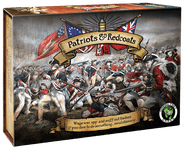
Welcome. Today we're going to be taking a look at Patriots and Redcoats. This is a four to 10 player deduction team-based party game. It's July 4th, 1776 and the Declaration of Independence has just been signed, either forging a great nation or sealing all of their fates. So, you're going to take the role of either American Patriots or British Redcoats trying to determine everyone's loyalty and win the war. How do you win the war and win the game? By either achieving four war victories or assassinating the other side's leader. Now that we know what the winning condition is, let's take a look at the components, set up and how gameplay works in Patriots and Redcoats.
Now let's take a look at the components. You have a war track board, war track marker, war tiles, a command card and stand, loyalty cards, spycraft cards, and your instruction booklet. Now let's take a look at the setup. We're going to be setting this up for a five player game, which takes five steps. Step one, deal loyalty. Collect a number of spies and leaders based on the number of players. In a four to six game, you're going to use both leaders and one Patriot spy. In a seven through 10 player game, you're going to use both leaders, two Patriot spies and one Redcoat spy. You'll return the rest of the box and place those face down to the side. Then you're going to shuffle the remaining loyalty cards and add a number of face down loyalty cards as needed to total the number of players. Then you'll set the remaining loyalty cards to the side. You will shuffle this stack and deal one from the created deck to each player.
And then you will finally take the remaining loyalty cards and deal two more to each player face down and return the remaining to the box. Step two, determine the commander. Randomly choose a commander and give them the command card and stand. Step three, place the war track marker and prepare decks. Place the war track board in the center of the play area with the war track marker on zero, then shuffle the spy craft deck and war tiles, placing them face down next to the war track board. Step four, determine your loyalty. Look at your loyalty cards. If you have either leader or either spy, you are on that side, either the Patriot or Redcoat.
If you do not have either, then the majority of the cards in your loyalty is your side. If it is tied and you have a turncoat, you can choose a side. Step five, share your identity. In a four to six player game, the Patriot leader and Patriot spy will get to acknowledge each other and in a seven through 10 player game, both the Patriots leaders and spies and Redcoats leaders and spies will get to acknowledge each other. This is based on the script that you will find in the rulebook. Now let's take a look at the gameplay. A game consists of a number of rounds until a side has either four war victories or has assassinated the opposing leader. A round. A round consists of two phases, the spy craft phase where players will draw, reveal and resolve spy craft cards and the council phase where the commander will select a player to be on the war council and then players will vote and then we would resolve that decision. Now let's look at each phase in detail. Phase one, the spy craft phase. Starting with the commander going clockwise, you will draw a spy craft card, reveal it and carry out its effects. This will continue going around until it is the commander's turn again. Now let's look at the types of cards that you'll find in the spy craft deck.
Spy cards, you would add this card to another player and when that player reaches three eyes, they must reveal a loyalty card from their hand. When they reveal that loyalty card, they will discard three of the eyes that are in front of them. If a player has revealed all three, then they are eliminated from the game. A conceal card. A conceal card cancels eyes or spy cards. These can be split between players. A reverse card. This has an immediate effect and for the rest of this phase, you will go in reverse, which would continue until it is the commander's turn again. Skip the next turn. This will skip the next player's turn, keeping in mind that if you skip the commander, everyone would take another turn until it is the commander's turn again. Draw two cards. You would draw two more cards and resolve them.
And then finally winter. To carry out this effect, that player would draw two and choose one war tile to cancel out a war tile from the war track. Then all the players would choose a loyalty card that is face up to flip face down, if they have any. And then you would select a face down loyalty card to pass in clockwise order, keeping in mind that spies cannot be passed. Then the players would then check their loyalties. The spies would stay on that side and if you recently held a leader, you are still on that leader's side. If not, then you would go by majority like in the initial setup. During this time, if a spy gets the opposing leader, then that leader is assassinated and the game is over. If a player receives both leaders, then they are both eliminated. Then the turns would continue and once the turns come back to the commander, we would move to phase two.
Phase two, the council phase. The commander would choose one player to be the agent that will help the commander in the war council. Once chosen, all of the players will simultaneously approve or deny the election. This is done with thumbs up or thumbs down. If it fails with the majority being no or there's a tie, you would advance the war token one space. If this token reaches three, then a war tile is drawn and placed. This is to simulate other countries getting involved in this war. If the vote passes, getting majority approval, then the commander draws three war tiles, discards one, and gives the remaining two to the agent. And then the agent will discard one and place the other on the war track. Once that is finished, the commander would pass their commander card and stand clockwise, and then a new round would begin. If you have a spy, you can try to assassinate the other leader at any time. But keep in mind that you will be eliminated from the game for doing so. Also, a spy can assassinate another spy to keep them from assassinating a leader. And if you assassinate the agent who just placed a war tile, it gets discarded. Then rounds would continue until one team either has four war victories or the other leader is assassinated. That team would win the war and win Patriots and Redcoats.