Operation Barclay - Review and How to Play
Games in This Video
1 game is featured in this video — it unlocks as you watch.
Transcript
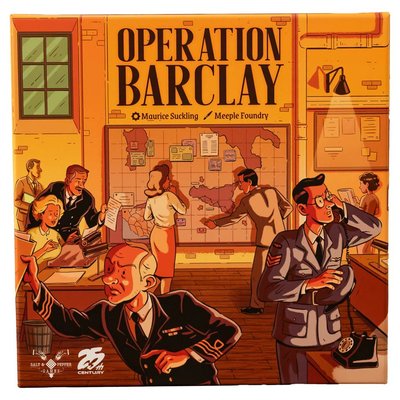
Hey there, Borgen Brody here with Let's Table It, where we get games to the table like this one here, Operation Bar Clay. Uh, it's a two-player bluffing and hand management game by 25th Century Games. In this two-player game, one player will have knowledge of what tiles are on the board, and they will have one location with four green tokens and one red, a secondary offensive sector with three green tiles and two red, and the other three sectors that have two green and three red. They are trying to keep these areas secret while the other player is trying to deduce information to find the primary and the secondary offensive sectors. You do this by playing over six rounds and you are trying to win evidence tokens seen in these sections by choosing cards from your hand each and every round. Each round the evidence tokens are placed in a bag and randomly placed out on the board. The first two are placed in the alpha box, the next three in the beta box, and the last one in the reconnaissance or the raid box.
Each player will have four intelligence cards dealt out to them, and they will play what is called the the first three cards. The card chosen for the first three cards needs to have the icon on the bottom right indicating it can be played during the first three cards phase. Players take turns and perform the effects shown on their cards as they play them. After playing a card, you will draw a new card into your hand, which can be the top intelligence card, or you can grab the top card from your own deck. Or if there are cards in the double cross deck, you can do that as well as it will slowly form as the game goes on. Playing a spy card numbered five, six, or seven will allow you to draw two cards from the intelligence decks and choose one and the other one is placed in the double cross deck.
Other cards will note, you know, where and how you replace cards. After each player has played three cards each, you will then have four cards in your hand. Then the intelligence assessment begins. Players will choose one of their intelligence assessment tokens to place on the board, indicating your bet on who will have the best tableau of cards after five are being played. At this time, you can see three from each player. Players then play their final two cards, which need to be cards with the final two cards icon shown on the the bottom right for it to be played at this part of the game. These cards, however, are played face down. The events will not get triggered at this time of playing them, but later when they are flipped over, players will play a card, choose to draw a card from either the intelligence deck, their own deck, or the double cross deck. Now that all five cards are played for each player, the evidence results phase occurs. The two cards are flipped and any effects will occur that are listed on them. Then cards are compared with each other to see who has the better tableau. This follows what you would expect from like a poker hand, but not identical to that. Five of a kind being the best, followed by a straight flesh, four of a kind, then full house, then a straight, three of a kind, two pairs, one pair, and the low end is highest card if no one has any of the others.
Then you figure out who wins the evidence tokens. The alphabox has two tokens for the winner with the best tableau. The player who is trying to keep things, you know, all secret doesn't do anything with their evidence tokens. They just just trying to prevent the other player of getting them so that they can use them. The beta box goes to the winner of the intelligence assessment tokens. Those tokens are flipped over and you're trying to see who guessed correctly. The player who guessed correctly of who will have the best tableau receive these tokens. If there is a tie from both guessing correctly, the player trying to figure out the primary and the secondary offensive places will pick one of the three tokens and the other player gets the remaining two. Now, if a tie happens because both are incorrect, then no one gets any of those tokens. Lastly, the reconnaissance or the raid box. The player who has the most reconnaissance icons or the most raid icons. Whosoever to you know totals is the highest in their tableau receives the evidence token in this box. Also remember there are icons that cancel out other icons from your opponent. So you have to kind of do a little calculation to figure out who gets this one. Each evidence token corresponds to a specific sector on the board with the black one representing all of the sectors. For each token the player has that is trying to deduce things, you know, on the board, they will be able to choose one token in that
sector and flip it over. Each token that the other player has is one less that the other player gets to flip over. The game repeats this over and over again until either six rounds ends or if the player has found the primary and the secondary offensives. They win if they have found four green tokens in an area and three green tokens in another area or if they can logically demonstrate where the primary and the secondary sectors must be and which is which of the two. And well that's Operation Barlay here. Again, it's a two-player only game with a military theme, but with some bluffing and card management mechanics in it. It's nice to play both sides because they seem a little bit different. Although, you know, you're playing with similar cards and trying to get good cards for your tableau while also guessing who will win each round.
But one side knows the hidden information while the other side is trying to crack it open to know what is going on. The hand management is really dependent on how you can use your cards to go, you know, for something. But many times you just don't, you know, luck out on getting every single card that you were hoping for. So trying for the same number card gives you, you know, a good backup to still get like three or or two while a straight might, you know, win it. But if you don't get that one card that you need, then you have nothing in your tableau. You're going for your highest card. But you will need to use the effects of the cards to get some new cards to hopefully find what you want, how you want to put your hand together. So there is some planning, some maneuvering, also placing some cards in the double cross deck can help you give you, you know, interesting cards so that you can always utilize that strategy as well. The game can be played in 30 to 40 minutes, so it isn't super timeconuming.
It's not a commitment for sure for a long period of time, which is nice to have. The most complex part is trying to plan out what evidence tokens you really need and try to win those elements to, you know, get them to reveal or hide tiles in that certain sector. There can be some luck in the game, but ultimately there are a lot of ways to maneuver your cards. And winning with your tableau isn't the only way to win. You can always guess correctly on, you know, who has a better hand to get some. So, there are some layers and some bluffing part of the game. So, there's different things going on. The theme for me is okay. I'm not a a huge history buff, but I know others, like my wife for example, she is. Uh, strange enough. The components are great in this game. I love the wooden tiles. Nothing componentwise are issues in this game at all. The art is done well, as well as the cards are done well. You know, check them out. When looking for a two-player game, this might be just where you want to be at. Not too simple, but not too complex or timeconsuming.
Again, Brody here with Let's Table It, where we get games to the table like this one here, Operation Bar Clay, a twoplayer deduction card management game by Salt and Pepper Games, produced by 25th Century Games. Again, please like and subscribe to our channel. We are working to bring you videos like this one so you know if these games here are ones that you want to get to your own table.