








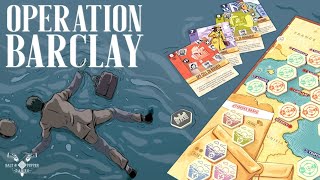
Operation Barclay Deep Dive
What the Community Thinks About Operation Barclay
Operation Barclay arrived to immediate acclaim from reviewers who recognized its unusual place in board gaming: a war-themed game that dispenses entirely with combat in favor of pure intelligence and deception. Reviewers consistently praised how the game captures the essence of its historical subject matter (the Mediterranean intelligence war of 1942-43) while remaining highly playable and engaging for modern players. The overwhelming response was that this is a genuinely fresh take on both war games and two-player strategy games, combining meticulous historical grounding with elegant, accessible mechanics that tell an interactive story about misdirection, bluffing, and logical deduction.
Core Mechanics That Define Operation Barclay
Hand Management and Poker-Based Card Play
At Operation Barclay's heart lies a modified poker hand-building system where players construct five-card hands from multiple decks over the course of each round. The central intelligence channels deck supplies 60 numbered cards across five suits. Each player also has a personal 13-card deck representing their historical intelligence agency: the London Controlling Section (Allies) and the Abwehr (German military intelligence). These faction-specific cards carry powerful abilities but are limited in supply, forcing players to decide when to deploy them. As players play three cards face-up, then bet on who will have the stronger hand, then play two cards face-down, the familiar framework of poker becomes a vehicle for intelligence gathering. The hand rankings mirror poker tradition (five of a kind, straights, full houses), but the twist is that the best hand is less important than reading your opponent and wagering correctly. A player holding mediocre cards can profit by correctly predicting the opponent's strength, or by intentionally revealing they hold weak cards to influence where your opponent places resources.
Evidence Collection and Deduction
Winning poker hands and winning bets both grant evidence tokens, each colored to represent one of five sectors on the board representing potential invasion routes (Sicily, Corsica-Sardinia, Greece, Turkey, and the Western Mediterranean). The Allies secretly select a primary invasion sector and a secondary sector at game start, hiding this information behind face-down tokens. The German player spends six rounds attempting to flip enough tokens to identify these locations through a combination of winning hands, successful bets, and accumulating reconnaissance or raid icons on played cards. With each round that passes without the Abwehr deducing the invasion route, the Allies inch closer to victory. This transforms every hand of cards into a contest over what information gets revealed and when, making the card game inseparable from the board state and the strategic puzzle beneath it.
The Operation Barclay Experience
Tense Mind Games and Constant Uncertainty
Reviewers consistently described Operation Barclay as delivering a high-tension, cat-and-mouse dynamic that unfolds across six game months. The Allies are perpetually under pressure to conceal their true landing zone while the Abwehr hunts for it using every tool available. This creates a palpable sense of psychological warfare: the Allies playing cards and placing bets with the knowledge of where the invasion will land, while the Abwehr watches for tells and patterns, trying to deduce truth from an opponent who can deliberately feed them false information. The genius of the design is that sometimes losing a hand is a winning move because it keeps your opponent confused. Reviewers noted that this creates fascinating decision points: whether to intentionally play weak cards to misdirect, or to push for control of a specific board sector. The tension never relents, and each card placement carries narrative weight.
Quick Play Time Masking Strategic Depth
Though billed as a 30-minute game, reviewers consistently found that the first plays take longer as players read card text and understand the cascading implications of their choices. However, reviewers also noted that after that learning curve, the game crackles with pace. The elegance of the system means that once players internalize the framework, turns flow naturally and decisions come into sharp focus. Players reported that the game plays decisively and doesn't overstay its welcome; six rounds is precisely the right length to tell its story without exhausting the deduction puzzle or the bluffing dynamics. The speed is deceptive; the game feels heavier in terms of strategic thinking than its play time suggests, because players are constantly weighing information asymmetry, reading their opponent, and planning multiple moves ahead.
What Makes Operation Barclay Stand Out
A Rare Glimpse at Intelligence Warfare in Board Game Form
Operation Barclay stands apart because it is almost alone in depicting war as something other than combat. Reviewers emphasized how refreshing it was to experience a historical military conflict abstracted as an intelligence game: no armies on a map, no combat strength factors, no tactical maneuver. Instead, the entire conflict is distilled into a contest of information control and deduction. The game draws directly from Operation Barclay and Operation Mincemeat, real World War II deception campaigns where the Allies deployed elaborate fabrications, fake armies, and even a corpse carrying false documents to convince the Germans that Sicily was a decoy. By making the card game itself a metaphor for the disinformation war, the designers captured something real about military intelligence that traditional war games often miss: the psychological dimension, the uncertainty, the constant parsing of truth from lies. The 25th Century Games edition includes a design diary that explores this history, making the game accessible to players unfamiliar with the historical background while deepening it for those who seek context.
Asymmetric Roles with Shared Rules, Different Rhythms
The game's asymmetry cuts deep. The Allies are playing defensively, trying to prevent information from leaking and to muddy the waters with false signals. The Abwehr player is hunting, trying to accumulate enough evidence to pin down the invasion route through a combination of card wins, correct predictions, and reconnaissance gathered from played cards. Reviewers noted that this creates a fundamentally different experience for each player: one plays with the advantage of knowledge, the other with the advantage of initiative. Both can win through skill: the Allies by maintaining their secret through all six rounds, the Abwehr by deducing the answer through logical elimination or overwhelming evidence. This lopsided information state is the entire game, and it works because the hidden deployment of tokens means the Allies can never be completely certain whether their misdirection is working or if they've already been figured out.
Potential Drawbacks
Not Designed for Solitaire or Casual Play
The designer explicitly stated that Operation Barclay is not suitable for solitaire play, and reviewers understood why: the entire game hinges on bluffing, reading your opponent, and manipulating their perceptions. Play against an AI or yourself removes the tension that animates every decision. Additionally, reviewers noted that players coming to the game expecting a light or casual experience may find themselves in deeper strategic waters than anticipated. The card interactions and special abilities are intuitive, but optimizing play (knowing when to deploy your faction-specific cards, how to read the board state, when to intentionally tank a hand) requires engagement and thought. Reviewers who came in with high expectations found themselves satisfied; those who expected a light filler experienced cognitive load that could feel heavy for the game's 40-minute runtime.
Card Draw Luck and Overthinking on First Play
Like any poker-based game, Operation Barclay's outcome is influenced by which cards enter your hand and when. Reviewers noted that while the card manipulation deck (cards with special effects) partially mitigates this randomness, a player can be hamstrung by an unfortunate series of draws or luck into a strong sequence of cards. This is rarely a dealbreaker because the betting layer and deduction puzzle reward meta-game play over raw card strength, but it is a factor. Additionally, reviewers observed that first-time players tend to overthink every decision and become tentative about information placement and bluffing, which can slow down play and make the experience feel more ponderous than it needs to be. This usually resolves after one play, but it's worth acknowledging that the first encounter may feel more plodding than the elegant 30-minute playtime suggests.
If You Enjoy Operation Barclay
Players drawn to Operation Barclay will likely appreciate Watergate, which shares the asymmetric information and cat-and-mouse tension between pursuer and fugitive. Battle Line is another strong recommendation because it combines a straightforward card-based trick-taking mechanism with bluffing and special ability cards that modify core rules, similar to how Operation Barclay uses faction decks to flavor its poker backbone. Chancellorsville 1863, another Maurice Suckling design, brings historical precision and elegant abstraction to the civil war, rewarding players who want more from their war games than traditional combat simulation. Freeman's Farm, a solitaire-friendly design about the American Revolution, similarly sidesteps combat in favor of hidden information and command-and-control challenges, offering a different angle on how war games can abstract away the battle mat. Finally, for those captivated by the historical setting and the intelligence war theme, Crisis 1914 offers brinkmanship and escalating tension in a historical frame, though its mechanics and player count differ significantly.
What Reviewers Are Saying
"There's just lots of layers of subtlety and strategy and fun to this game. And it plays really fast... I think there's a lot of thinking. I love the operation barklay and the World War II based theme very accessible so I think this would be a great game to introduce someone to a war game themed war game although the gameplay again is very much there's that poker card-based element which is an abstract level of play in terms of a war game element but that subtleties and the deception and the strategies I think are really fun in this game so this is a winner I think."
— Zilla Blitz
"It's an interesting game. It's quite abstract and it blends those two things very nicely where there's so much good game there that it blends those two things very nicely and there's the cat-and-mouse thing going on as you're just trying to do prevent information or trying to figure out information. It didn't overstay its welcome. Six rounds was the perfect amount of time."
— Ryan and Bethany Board Game Reviews
"It's a short game. A lot of the time you see time on games, this this game says 30 minutes on the box and I actually think that's right. Like I know that seems unlikely because we know how numbers and time work on games, but I certainly think after your first learn it's not a particularly complicated game. I I do think you can be cracking it in about 30 minutes."
— Beyond Solitaire