Operation Barclay w/ Maurice Suckling
Games in This Video
3 games are featured in this video — they unlock as you watch.

Transcript
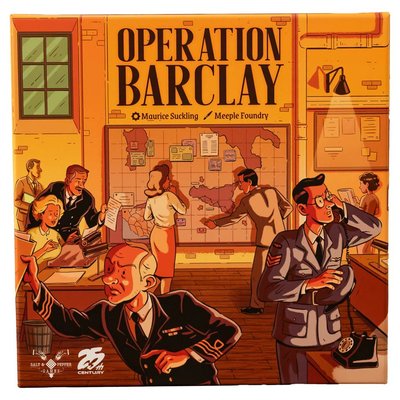
We are live. Okay, excellent. Um so, hey everybody out there. This is Liz from Beyond Solitaire and I'm here with Maurice Suckling who is a I would say prolific game designer at this point. You make a lot of games, man. You got a lot of games coming out. Um we're here to talk about one in particular. Uh so, why don't you introduce your your newest child to us? Hi everyone. I If I can show this. That's good. This is the It's not the final copy, but it's the prototype version that Salt & Pepper sent to me uh a few weeks ago, which uh has been great, really helpful for final playtesting and spotting stuff that it's harder to spot when you're still working off of older prototypes and you've got stickers on top of stickers on top of stickers that are partly falling off and you can't have you can only half read some of the stuff. So, anyway, it's been great to see something more final and and helped I think push things uh up in terms of the the final quality of the end product, hopefully. That's the idea.
I I think that'll be true. Yeah, one thing I've really been consistently impressed with when it comes to Salt & Pepper is that all of the prototypes look really really good. Like whenever I preview one of their games, it looks like finished. Um it looks like a complete game and there's something very nice about that. It makes me also feel more confident. I mean, obviously, we should feel confident, but it makes me feel like yes, this game is going to come out. We've got it We've got it under control. Um I I always just feel a a lot better when I see a nice prototype that's like ready cuz it means it's going to happen. They they just run it a different I mean, I'm not sure how much of this is for me to be speaking about really, but they they they sort of run it a different way really in that by the time they launch, they uh already essentially in the production pipeline. Like they they essentially that's already going through. They're not waiting to see if they get the funds to kind of pull the thing together, or not. Um So, it it means that they It gives them a few advantages. One is that they're giving nicer prototypes to reviewers, but also people who maybe are not going to publicly review it, but they're just going to maybe give some feedback that's going to come back uh to to the design team ahead of ahead of launch, so that that's stuff that you can you can use. So, it has that advantage, and yes, it also means that the the wait time for people after backing something is shorter than it would be otherwise. So, two big wins, really.
Nice. So, uh what is this game about? How's it played? How many people's it for? Give us the Give us the all the whole story. All righty. So, um the the whole story is that the So, Gonzalo at Salt & Pepper played my Chancellorsville 1863 game, and he liked that a lot, and he asked me uh Oh, hey. Um just people appearing in the chat. So, and he asked me uh if I'd like to make a game about Montgomery, General Montgomery, uh for him. And this has never really happened before that a a publisher had said, "Would you like to make a game?" I mean, I kind of have this arrangement with Worthington that essentially anything I make now they will always be interested in saying, "Can we Can we see it?" which is nice, but this is a situation where I didn't know Gonzalo. I knew Salt & Pepper a little bit, but uh it essentially was a commission, right?
So, it was tremendously flattering, and uh I I I said yes because I was so flattered. But then I started to think, "What am I actually going to do?" Uh because as you most certainly know, Liz, uh tactical and operational level World War II games, there's there's a high bar, right? If you're going to make something in that space that I you know, a lot of the players in that area extremely well read. Like they they they they're up on this stuff, right? So, um I thought, "Oh, well, yeah, I guess it'll probably take me a couple of years to kind of get into a space where I can make something on Montgomery that I think might be worth making." Bearing in mind, you're really talking about talking about El Alamein, you're talking about Arnhem, maybe D-Day stuff.
Those Those are There's a lot of reading to do, right? To to kind of move in that space with with confidence and competence as a designer. So, obviously I started to think, "I That's a problem because I don't really have 2 years to just devote to to this project." Anyway, I started to read more about Montgomery and it was starting to you know, the adrenaline started to kick in and you start to panic about what I haven't really got any idea for this and discovered that he was attached to the British 12th Army at one point in in discussions in 1943. What's interesting about the British 12th Army is that they did not exist. So, they were a a fictional order of battle that was created by this guy Dudley Clarke, who was a a spy in Cairo, quite a senior spy.
And he he created this entity to flummox the Abwehr. The Abwehr is the German military intelligence agency. And you can imagine this is actually tremendously powerful because the the Germans think there's this whole army out there in the Mediterranean. And they can't figure out where it's going to land and where it's going to be and you know, actually doesn't exist, right? The So, anyway, actually started to seem really interesting to me and I was already aware of Operation Mincemeat, which some of you know from the 2021 movie with Colin Firth, I suspect. and it was a Ben Macintyre book about 10 years prior to that.
And so, Operation Barclay is the name for the umbrella term for for the Mediterranean military intelligence war that happened in 1943. And and Operation Mincemeat was a subset of that. I could tell a bit more about the Operation Mincemeat in a moment. But essentially, what happens is you get to the end of 1942 and the allies are on the cusp of ejecting the Axis powers from North Africa. And the question is, well, where where are they going to go next? So, in January, the Casablanca conference, Roosevelt and Churchill meet and they discuss where they're going to go. Well, we know from history that they go We have Operation Husky in early July, right? They go to Sicily. Um but it wasn't necessarily obvious that that's what they would do. In in the Operation Mincemeat movie, they give Churchill the Churchill character a line there where any fool with a bloody map can see it's going to be Sicily.
Sicily was an important step on the road to taking Italy because of the air bases. So, yes, there's a certain logic there that it should be Sicily. On the other hand, there were some viable alternatives or some some potentially viable alternatives, including Southern France, including Corsica and Sardinia, the Dodecanese and the and the Peloponnese, parts of Eastern the Eastern Med. And so, what happens in sort of January, February 1943 is the allies figure out, well, we've got to do some stuff to make sure that the Abwehr, the German military intelligence, they don't understand where they're going, they don't know. So, we have to try and feed them disinformation. We have to confuse them. We have to make them think, "Hey, we're going to we're not going to Sicily, we're going somewhere else."
Operation Mincemeat was was a significant part of that where the allies floated a dead body off of the coast of Spain. It dressed as a British officer. It was a It was a British man who actually was a homeless man and they they took his body. It turns out it's actually kind of hard to get hold of legally get hold of a body even in World War II. Uh Owen Glendower was his real name. And they put dressed him up as a captain a major in fact and they uh put documents in his pockets showing that the allies were going to invade through the Balkans. And they float him out of the submarine. They kind of float his dead body and and hope that the Spanish Spanish fishermen or someone picks him up and takes him to Spanish uh official channels who will then with sympathies to to to the Germans will make sure that that information gets all the way to where it needs to go to so that the Germans will think, "Aha, we found the solution. In fact, they're not going to Sicily. They're going to go to the the Balkans or at least a major offensive is going to come through the Balkans."
And and it worked. So, Ian Fleming was involved in this uh concoction of a of a plan. Ian Fleming, the author of James Bond. And he was one of the people who contributed some ideas to this this kind of trout mellow as it was it was called a kind of a list of crazy ideas that that they were going to come up with. And and it works. Uh there there's a little bit more to it than that. They They it wasn't immediately clear that the Spanish were going to pass the body and the documents on to the to the Germans, but they they managed to ensure that that happened and they got the documentation back which was all sealed as if it hadn't been looked at, but then they you know, kind of like eyelash on a envelope deal. They kind of realized that it had been crinkled that in fact this was an eyelash that was missing. So, they figured out the Germans have seen it. They don't want us to know that they've seen it and they basically swallowed the bait. They they think that the Balkans are significant in a way in which that they really weren't and and the 12th Army is probably going to be a part of that. So, I thought that sounds super cool. That sounds super interesting. That's That's something that maybe we can make a game about that.
There was a movie in the '50s called The Man Who Never Was. It was based on a book uh of the same title, which is essentially Operation Mincemeat, but uh it was kind of shielded a little bit with official secrets and it was was portrayed as a sort of crazy one-off um bizarre uh plan, whereas really lots of what the LCS, the London Controlling Section, were doing in World War was this kind of stuff. They were doing this kind of stuff all the time. They existed in order to to concoct these ridiculous plans and to to confuse the enemy. And you know, it made me think that not only is this an interesting idea for a game, but uh we probably neglected these sorts of topics in board war gaming and historical board war gaming more than we we should given how significant a part these these kinds of operations play in in warfare. They're They're not just you know, that that they're more significant that I think we we give them credit for. And so, that's what happened. I decided, you know, I'm I'm going to make a game about that and so, I did and then I did it and then it was done.
Easy. Everyone just go do it and then you'll have done it and then it'll be done. So, you know, one of the problems was Oh, hi Hi, Alexander. One of the problems was I didn't really know how to do it, right? Like I had this idea that I thought was cool and I and I thought might um connect. I did Yeah, I that I did make Driver Yeah, a long time ago. Um in fact, it wasn't even called a PlayStation 1 in those days, was it? It was just a PlayStation. They hadn't invented the numbers that go on the end of it. So, yeah, that was my That was my first published game. Um so, yeah, I couldn't figure out how to do it. Like there weren't a lot of places to go to where I could say, "Oh, well, you know, what did Mark Herman do?" Or what did Folco Funky do? You know, like the the there weren't a lot of places to go.
John Prados actually made a game on Operation Bodyguard. It connects it to to D-Day, but it it sort of blends intelligence war with military operations. And I wanted to I decided, "I'm not going to complicate my life and make it a game that blends military maneuver and operations as well. Otherwise, I'm back to kind of a 2-year development to sort of lead time again. I I wanted to just focus just kind of laser-focus on the intelligence aspect. So, I knew that I didn't want there to be armies that we even moved. It was just about, can you get the information that you that you need? And this Yeah, like I said, this was a headache. Like I I I didn't really know how to do it.
And then I figured out that I could just be more abstract about it all. I essentially realized that the essence of this operation was about like I I I said disinformation, right? So, I needed something that could operate at the level of a metaphor that could be about disinformation. And I figured out the approach I was going to take was essentially at the heart of it would be a trick-taking game. But it wasn't that important getting the best hand. What was more important was betting on who you thought was going to have the best hand. And so you'd be playing cards to try and entice people into thinking, oh, this person's going to have a good hand or this person's going to have a bad hand. And you play three three cards face up so that everyone could see what everyone else was doing. Then you'd bet.
And you'd say, I think I think they're going to have the better hand. And that's going to give you more chances to to kind of get the information that you need. And then you're going to pay two cards face down so you can kind of actually be masking what you're really doing all along. And so that was the breakthrough for me when I realized, you know, I I can be Let's just embrace the fact that these games are abstractions. And Hey, one second. I let my boyfriend over to my apartment. I'll be right back. Keep going. Uh who else did I see was here? Alexandra was here. Um yeah, so that was the main thing that I I did was I um I decided to operate at the level of of metaphor. And and and there's really sort of two games here.
One is a a trick-taking game. And and kind of betting it on that. And the other thing is what you do with that information. I'm going to pay for that one later. So I was just saying so so I was saying that um there are two parts to the to to the game really. There's the trick-taking bit which is like I said, you know, it's kind of like poker but not quite identical to poker because the probabilities are different and there's other things going on. And there And actually one of the other sources was one of the games that's in the early 2000s got me back into Yes, two two put two players. Only two players. There's no bots or anything. One of the games that got me back into board gaming card game was Reiner Knizia's Battle Line.
Which has these two decks of cards. It's a trick-taking game as the regular deck of cards with I think six suits 1 to 10. And this other deck of tactics cards which which modifies those cards in all sorts of ways. It extends the the the hands the number of cards in a hand that you need or it it it kind of gives you wild cards and it does all sorts of interesting funky stuff. I don't think the Battleline is historical simulation game by any means, but it's a fun game and a skillful design. And I lent into some of that as I was thinking about how to make this game work. So there's a one central deck intelligence channels which is suits five suits one to 12 but one can also be a 13.
And then these two separate decks that just for the LCS the London Controlling Section and one for the Abwehr German military. Intelligence and these modify that that central deck allow to do some more interesting stuff but also are a way for me to in a way you could kind of think of it a bit like an event deck. Put that sort of information and put this sort of historical flavor into it to help it feel like I was addressing the history a bit more directly given how abstract a lot of this is. So there are cards there on Ian Fleming is a card, right? And Operation Mincemeat is a card and John Saunders who was part of the Operation Mincemeat team, she's also a card. And Wilhelm Canaris who was head of the the Abwehr is a is a card and so on. So there's um 13 to 16 cards in those decks each that help support the kind of narrative that I'm I'm attempting to to address.
And then yeah, so so trick-taking and then betting on that stuff and then essentially you could think of it a little bit like you could think of it a little bit like a game like Watergate, right? Where you do some stuff and then you win some some some stuff, some tokens and you can do something with them. In this game, the LCS don't do anything with the tokens. They they they are essentially preventing the Abwehr from doing something with them. So that's when the board comes in. So I I should explain the board. So the board has five sectors, each corresponding to one of the potential invasion routes. Or at least somewhat viable potential invasion routes. As we know, Sicily really was the one that they went for. But so in each of these sectors, there are five spaces. And you're going to put a series of tiles face down.
And and the Abwehr are attempting to flip enough of those tiles face up to understand where is the primary and where is the secondary invasion route going to be. That's what the That's really what it's all about. And so depending on the who has the best hand you're going to get some tokens. Abwehr is going to win some tokens. They get more tokens if they can bet correctly on who's going to have the best hand and that's not a tie. And they also get another token for having the most reconnaissance or or raid tokens on their on their cards. And so the Abwehr is going through this six turns, six game months. Each Each turn is a a month in the in the game sense. And they're going to attempt to flip enough tiles in each of those turns to to be able to figure out the answer, to see where's the invasion happening. And if they manage that, they win. And if they don't manage that, the LCS, the Allies they win.
So it's a it's a short game. I'd say, you know, a lot of the time you see time on games, uh this this game says 30 minutes on the box. And I actually think that's right. Like I know that seems unlikely because we know how numbers and time work on on on games, but I certainly think after your first learn, and it's not a particularly complicated game. I I I do think you can be be cracking it in about 30 minutes. I guess it depends who you're playing with and and how how much they like to pontificate, but that's that's the idea. It's kind of a fast play, quick setup, um quick into it, but you know, it shouldn't if you're not really getting the best hand, that shouldn't always that won't mean that you you necessarily lose, right? It's more about figuring out who you think is going to have the best hand. So, that's that's my sort of light, if you like, uh certainly a low cognitive load, I think, to it's it's a way of attempting to simulate the the core essence of of of that intelligence war, which is about, let me make you believe something that might or might not be true, and now you're not sure whether cuz you know I'm bluffing you at at least in some somewhere along the line, but you're just not sure you're bluffing me here or you're bluffing me there.
And I I'm going to have to take a guess that I think you're going for high cards, and I think that you think you're going to win this. So, therefore, I think I'm going to bet on you. But then maybe that didn't that's not true, and so you lose you lose your chance to win win tokens. So, that's that's the that's the essence of the the game, and that's the that's the background of how it came about. Nice. Uh so, Mike wants to know did a money card make it in there? He did, yeah. So, there's a card about leaking. So, they also leaked the whereabouts of Montgomery. They did the same for Patton. There's a Patton card in there, too. General Patton suit. Um and they work like they like wild cards, right? That they they give you a number, but they also can operate in any suit.
But this information was information that yeah, you know, the allies wanted to reveal, but the question was did the Abwehr know that that's clearly was a plant that they they released that information. So they think, oh well, Monty's Monty's in Cairo. So maybe that's maybe the invasion route's going to come through that axis. And and you know, they're going to attack through the through the Balkans. Well, but you know, Patton's uh whereabouts appearance has been leaked in Morocco. So maybe maybe that tells you that that they're coming through southern France. That's that's the basic idea. Yes. Uh and then of course we have the lovely if there were three money cards.
Oh, no. Uh so we have a what's going to stress me out a ton. Double think is my worst enemy. Um what have you seen in play tests? Are people You know, I feel like the game ends so quickly. A little tension my heart anyway. But it's it's fast, right? So I think that I think it would be more difficult an experience if it was much much longer. It would be just a different kind of design. And and you know, let me say this approach that I've taken with this uh topic, this is just one way to do it, right? I'm not suggesting that this is the only way to tackle the intelligence war in general or the intelligence war in the in the in the Mediterranean. There are lots of other ways to do this. I think we've barely scratched the surface on how to even do this. I just came at it this particular way. But what I what I've seen is that first time yeah, people overthink it a lot, right? They they definitely are hesitant to play it it's I had a play through today. Took about an hour. Hour and a half maybe with with teaching it. But surprised me even though I I guess I've seen it a few times, but it Yeah, I think people just overthink it a lot. They're they're they're sort of cautious about What am I What information am I am I revealing here?
And is this is this too much? Um But but you know, that's I think that's just sort of I think that's people playing prototypes and maybe playing with me. And you know, when you when people play with a designer, that's also I I mean, you don't have any other choice, right? As a designer, but you'd be more interested in seeing other people play it blind if you could have one of those uh police mirrors that lets you see what's what's going on. That'd be fun or interesting, right? Because then you actually get blind play testing and you figure out if the rules even make sense and that sort of stuff. So, yeah, I have I have seen that. I've I've seen people uh over overthink it, but yeah, I I haven't really seen people get you know, super stressed by it. It's it's um Like I said, short. Also, there's an The artwork for it plays with certain sort of tone of of voice that that keeps keeps it kind of lighter on the lighter side of uh a kind of tonal palette.
You know, it's it's sort of I think the To me, the artwork is is sort of redolent of a little bit of Hergé's work. It has this sort of naturalistic quality, but it's still got a It's it's still a kind of a cartoon world. And I think that's about right. I think that kind of fits the the tone for this. Um well. I I And also, I think it it sort of rarefies the people involved. It helps the people not just be uh ciphers for the mechanics, right? So, to actually see pictures I know you you've been reading Helen Fry's Women in Intelligence. And that's also one of the books that I I've used and there's a an agent Bronks was was her name and and through Helen Fry's book I found her.
And she's this double agent and super interesting you know and and as far as I know that's the first time she's ever been turned into a cartoony type illustration image. Cartoon kind of probably sounds like the wrong word to say but it's like I said it has this naturalistic quality to it. Yeah. Alex, I'm going to come back to you but just since we're on art I agree that the artwork is lovely. Salt and Pepper's really been like knocking out of the park on the art. How much of a say did you have in the the art generation process and like what was it like and I'm just sort of curious about the kind of interaction between the designer and illustrator. So, it was great and I I enjoyed working with them very much.
The Yeah, the way it worked was Gonzalo put a couple of different artists work in in in front of me saying that these were the two he was looking at and did I have any opinions and I think we both had the same opinion that there was a particular kind of look that we were getting from one of the potential candidates that had this yeah, naturalistic quality. So, I I think we both decided that's that was how we wanted to go and from there it was largely plain plain sailing. Like most of the time I would say here's the card, here's the kind of image that I think we might need. So, I don't know like the ultra card, right? When the the allies break the Enigma code There's a card on that. So, I I I suggested, well, maybe we'll do Bletchley Park. I mean, yes, there's other images we could have gone with. Uh but, I went with with that, you know. I I think if we were short of portraits, might have might have um approached that differently, but it it just felt felt like a good decision to kind of break it up a bit.
So, um yeah, I would mostly sort of say, I think this is the image that that we want and uh like I mean, mostly it was just me just seeing this stuff come through and go, "Wow, that looks great. That looks amazing." And um I'm just really thankful that we had had them on the had these artists on the on the project. And there were some other discussions to do with icons and like how to how to remove some text with with icons and um approaches approaches so that that the layout they essentially completely reworked the very basic prototype that I had to to kind of just put stuff on the card in better places that made more sense of the the space. And I largely I don't think I had really anything to do with with that. They just took care of that.
Um Yeah, how many unique card illustrations? Actually, not not that many. So, uh if you think there's five So, it's basically 60 60 cards in one deck and 13 in each of the others. Each of those 13, the 13 cards from the uh LCS and 13 from the Abwehr. Almost all of those are unique. They're they're different people or different concepts most of the time. There's one or two duplicates. But in that big deck of 60, lots of those images were the same because the same but with with like different treatments, like different color treatments. So if you think about uh if you have an image for a spy, that would be one image. But then the location would be different and the suit would be different and perhaps the number would be different, too. So that's that's an image that we could use many times over. And this wasn't pressure coming from the publisher to say, "Hey, I just need you to find the cheapest way to do this." In fact, when I said to Gonzalo, "I don't need that many. Lots of these we can reuse. They don't really make sense. I think it'd be more confusing for the player if every image is different when essentially the card is the same but just in a different suit.
Again, think about how Battle Line does that. There's There's no need for those images to be different other than just different colors, right? So um yeah, I think he was surprised when I said we didn't need need that many. There's There's probably 10 12 different unique images in that big deck. Um I saw a question there about Albert. So Albert Montes wasn't the artist in in this case. The the Meeple Foundry have worked with Salt & Pepper on various projects. I don't want to say which ones now in case I get them uh mixed up, but but they've worked sometimes as artists, sometimes as graphic designers. Uh so sometimes artists as in illustrators, sometimes as graphic designers, and sometimes as as both.
And uh yes, I I also thought that there was a there was a sort of stylistic similarity. There there's a sort of similar kind of uh approach in this particular on this particular project Um I think people find it do all sorts of different kinds of of stuff and I think that they my understanding is that they actually kind of like moving around different styles and I don't really like to be set doing the same thing over and over and and it just so happened that the style that we were looking for that Gonzalo and I were looking for was just the thing that they wanted to to be working on around the time that the project came to them. So it was sort of a lucky happenstance worked out that way.
Perfect. All right, so now I want to go back to Alex's comment from earlier cuz I thought it was cool. So he says, "I like the idea of calling less simulationist games metaphors. It's a nice way of describing abstraction in a game." Um is this the first time you've made a game that you think you would describe as metaphorical? Uh no, I think not but I think it's I think it's the most uh I think it's the game where that's that's the most suitable term to use. I think that I think that Crisis which Alexander played um last year I think it was uh also operates at the level of of a metaphor in that uh you're cuz this is Crisis 1914 you're asking players to engage with brinkmanship to to push their score up and till they push it too far and then and then they realize they've over-egged the pudding and and it's going to uh bite them.
So I would say that operates at the level of metaphor too and and you could probably say that maybe really all games are doing that at least all games that are engaging with mechanics the right way. The mechanics ought to be ought to operate as as a metaphor. Right? Um it's just that this was the this was the game where until I really fixed on on a whole uh metaphorical approach that was that was so abstracted, I didn't know how to proceed with it. Because otherwise uh you know, I think lots of game design is is turning concepts into numbers, right? It's turning qualities into quantities. And that's that's tough in a in a topic like like this. You know, as as it turns out, you can see I still did that because this information I turned into a numbers of tiles.
And I I defined a victory threshold as as being a certain number of tiles in a certain number of regions equals equals victory. So, I I still did it, but you know, lots of this information still not even available. So, there's a reason why lots of the spies I don't have their names. Like because they were good spies a lot of them. I don't know who they were. Like we don't have that that information. And I just I just couldn't see another way to to do it, but you know, yeah, I think in general I I'm not sure you can ever really get away from metaphor or that you would you would want to. Yeah, I think the the the contrast of metaphor with less simulation is interesting. So, I feel like there's always so many arguments about, "Okay, is this a simulation or not?" Which honestly is a question I like even less well than is it a war game?
Well, yeah, I mean I I and I think I think that whole question is is Yeah, I think I'd prefer that. Um less as well that that question because I I think I think it's on such shaky ground because there's I think there's this uh an understanding or misunderstanding that simulation equals more accurate equals more complex. And I think that this is hard to support necessarily. In fact, even if you look in the professional space, that isn't really how people are talking about what a simulation is. A simulation is is trying to drive it how people feel about something. And um complexity and and level of detail is not necessarily the best to to use a synonym the best representation of a situation. Certainly not necessarily how it how it feels to those engaged in it.
Yeah. So, you know, this is something I've spoken a little bit to you about before. In fact, I just wrote a chapter on this. I've written a book that will come out hopefully later this this year. But but I've been pushing for a way of thinking about this which is um abstraction uh simulation through abstraction, right? Simulation by virtue of of abstraction. So, we're getting at we're simulating something not through the vast amount of complex data that exists and not through vast complexities. But we're approaching it through the essence of how it feels and and how it feels to those engaged. And if we can we can tap into that, we're um hitting on something that's more important than vast amounts of of data.
If I give you an example of if we look at a I don't know, any any war game with a very detailed order of battle. And and we take that argument that therefore because this order of battle is so highly detailed, that that is a more accurate game. That's a difficult argument to sustain, and not one that I can I can support, particularly if we've got one game, let's say it's, I don't know, American Civil War game, and there's a detailed order of battle. And all the information is is revealed, there's no hidden movement or anything. And we've got another game that has no complex, detailed order of battle, but buys deep into hidden movements and and command control communication issues. I'm going to say, well, that one that doesn't have the complex order of battle is is a better, more there's more fidelity in that depiction of that history and how it felt to those engaged than having all this information and and seeing having all this perfect information and having this detailed order battle. And I think that's that's kind of the crux of really what where I come in with the with that argument that uh more data and doesn't mean more accurate in a way that matters to to depending on what it is you're trying to do as a as a designer, but uh sometimes it's better to uh be less accurate in order to convey a
feeling that that that's far more pertinent to your design agenda. Nice. So, Bill's trying to tweet me here, like coding, it's all probability conditions and randomness. Liz hates to hear this, but it's all math. Isn't that just like saying that a book is just letters? Like, it's what the math does and how it makes you feel that makes it something more than math. Like Yeah, I mean Right. It's so it's you know, game games are if the math it's math with emotion that's that's leveraged in a in a certain way. Uh and with without that and without knowing when to how to how to control your audience and how to set situations up in such a way that it feels what it is that you want people to be feeling or something in that in that ballpark then yeah, then I guess it is just it is just numbers and and and letters at that point.
Yeah, I don't know something about what you just made me think about, you know, there are there are architects who are experts at making you feel like a certain entrance of a building is the one that you should go into. Or that like oh, you know, like even just like the placement, the arrangement openness like, you know, light all those things, you know, they they come together to like direct human behavior. And I feel like with games what you're doing is you're offering an array of options, but there's like a there's something more to it where you're kind of directing a human experience in some way. I mean yeah, it's all rhetoric whether you uh fully aware of how you're leveraging it or or not, you're you're cultivating uh an experience.
And and that experience is is the key. To me that's the key thing. What what kind of experience do you want your players to to feel? Yeah. I my pre-calc teacher did not give me an experience. Let's put that way. Well, it was an experience, but it wasn't like a So, uh Rocky wants to know at first blush uh Freeman's Farm might look like a simulation, but I think the point is to get into the game and not map out all possibilities. Am I close? Yes. Yeah, it's it's it's more again, that that's a game that I I think of as being a a short game and trying to I I wanted to convey how um command control communication is is just problematic that you know, no commander in or very few commanders in history have got to look at situations top down and say, "Oh, I can see where everyone is and what their strength points are."
And at that point I don't know if you're if you're designing something that has that perfect information should you know, people want to play that and that's there's a whole convention that's very immensely popular, but that doesn't really do it do it for me. It doesn't do something very interesting. I I wanted to to to figure out how do I take a battle that's essentially static? There's there's some attempt to outflank which goes wrong. The British attempt to to outflank and it goes wrong and essentially we've got two lines that are that are fighting each other. How do I do that in an interesting way? I'd played before I made that game I played every game on that subject that existed by by one.
Um because I was doing a study on it. I wanted to just be able to understand I wanted to write the the a paper on it. And in the process of playing all these games uh lots of them I thought just were just not that interesting and they didn't make me feel like one of the historical actors. They didn't they didn't jive with anything that I was reading where the British don't really know exactly how many troops are where and the the Americans don't really know exactly. I mean, there's that there's that meme, right? Um we see it on Facebook groups where there's two Prussian generals. Um or maybe they're early Imperial German generals and they're they're looking over a map and one is saying, "If I could just get two more strength factors, I can get four to one odds here." Something like that, right? And and it's that's that's kind of the problem. If if you if you don't try and come at it another way and and show that it's hard to make things happen on the battlefield, and you don't have complete control over everything, then then you're going to get you're going to be kind of pushed into that kind of uh experience. And I didn't want to make that kind of experience. I wanted to make something that um showed that you you've got some stuff that you want to do, you make a few big decisions, the game only lasts whatever it is, 15 turns.
And, you know, stuff comes off or it doesn't come off, you win, you lose, you you set it up again, and you have another go, and you try and do better and a kind of reading the odds or looking at opportunities to make something happen. And in fact, that that's probably another example of of a metaphor where I I remember reading about the battle and and it feeling like there were these windows of opportunity that kind of passed the commanders to do something. And so, the the tableau of tactics cards that you can buy kind of operate like that. They they sort of move off. If you don't buy them in time, they disappear. You have this period of time where you think, "Oh, that's the thing that I want, and I can buy it now, and maybe I'll use it later, but that's an opportunity that I'm going to going to seize on." And I suppose that's a metaphor for uh windows of opportunity that open and close, and maybe you don't have the momentum cubes you need at the time to purchase them, in which case, it's closed. You just didn't get that that shot at it. And so, that those tactics cards ended up being really fundamental part of that that design that made it more interesting and more challenging to to play a more just a more fluid uh system. It's sort of harder to to to navigate, harder and and more fun as a result of that difficulty.
Nice. All right, we got the classic question that always happens on a channel like mine. Uh any chance for solitaire rules? Uh I mean, there's no plan. There's There's no plan. There's been no discussion. I I haven't even really sat down to think about what it would would involve to make it work, and it's not straightforward. Um so, when you set the board up, the Allied player has to turn away, look at their phone, do something else while the LCS player puts tokens on the board and flips them over in a certain certain order, certain way of of doing that. They They Each game, the sector can be different. The sectors you're looking for can be different.
Um but they have to be done It has to be There's a specific way of the game being set up. So, I'm not sure that it would work. And you know, at at a 30-minute game, it feels like just an experience that I think is more fun as a as a two-player. I think that that Remember, you know, I was really saying that that tension of of misdirecting or thinking that you're being misdirected and trying to read that, that's that's really hard without human actor to kind of bounce off of and and get that that sensation. And at that point, I sort of feel like uh you know, play another one-player game, and that's that would be a better use of your time. I think save this for playing it with with others, I mean.
Yeah, because it's a small game and a and a short game, I think it's just a better a better use of of resources and and also just you know, my own time. I I feel like in the time it would take me to make a solo player that I think could work or be worth playing. Given what I've just said about how I don't even think it could really operate. I I you know, I could make other stuff and probably that's what I would do. So. Yeah. Now, I mean, I do agree and maybe not all games should do all things. Uh you know, I know that the temptation like I love to play games solo. I really only buy solo games, but um that's just for lack of opportunity. Uh maybe things will change for me. But Uh but I I also think, you know, that just because that's my preferred mode, like that doesn't mean that you have to make a solo for all of us.
Yeah, I mean, I like I was going to say if you want a solo trick-taker, Four Northwood is the one and it just came back in a print, so. I I'd like I you know, I I actually normally do have solo games in my designs cuz I really like testing them that way. They they're really good development tool. But um this this turns out to be an exception where I just haven't ever thought about it and it never could it never conceived of it that way and I suspect that just won't I just suspect it won't happen. I mean, you know, when tens of thousands of people are begging for one, perhaps. I don't know. Perhaps I'll I'll speed dial Joe Dewhurst and get him to do something. So, you said that you often like to test things solo. How did it impact your testing to do a non-solo design?
Um It It Yeah, it just It just meant that I had to play it in my head a lot in the very early stages and then I I had a student who was doing an independent study with me and we played it a lot. So, uh It It's you know, with him we were probably I think we were down to about 15 minutes we would play it fast. Uh and we just played independent study I ever heard of. That sounds awesome. You know, I do quite a few of those. So, actually that same student, Eric Bress, uh he also did a lot of play testing on Crisis 1914. Um so, yeah, I did I tend to do that a lot. Uh and uh it's super it's it's invaluable as you as you know.
There's no way to test the Crisis 1914. I did, yeah. I did. And in fact um I could play that in about 10 minutes, 10 to 12 minutes when it was um later on and I kind of knew what I was doing. But yeah, in fact I also with that one I actually had two students. One was just doing solo for a whole semester. He just played that. And each week I'd give him updates to the cards and he would uh testing again. He He played it a lot. Uh and then yeah, I I I also tested it solo. All right, so we've got about 10 minutes left of our time. So, just to kind of like make sure we get stuff in. So, obviously we're going back to Operation Market Garden, but um what's what are your what's your general agenda of upcoming games? And then let's get back to the game in question and you can talk to us about when the campaign is starting and what we can look for it.
Um so, my what was the question? General agenda about Agenda. Like how much What games do you have that are currently coming into the world from where? Feel like there's a lot. Um you know, you you said I was prolific. I don't you You know this, right? You know that every time you say the word prolific David Thompson makes another game. Yeah, but he makes it with me now, so that's fine. Mhm. Well, yeah, that's perfectly good. Perfectly good. So, um So, this one is is So, well, Crisis, I think is shipping. I Some people told me it's shipping. I haven't seen any notification of that. I don't I don't know, but I'm hoping it's it's going to be with people imminently. So, uh I don't know. I don't know if that's next week or the week after, but I'm hoping it's it's soon. So, there's that.
Um then, so Operation Barclay launches on Game Found on June 7th. Oh, Mike got his shipping notice from Worthington. All right, that's good. I was confused cuz someone told me about it, but it was saying it was shipping in February. So, I don't know what happened. So, yes, so this is June 7th. Then, so I have some other things in the pipeline. I guess I know what I'm getting myself. Um there's So, I'm I'm making uh Rebellion Britannia with Daniel Burt. That's now uh the the the sort of the GMT's eyes have kind of turned to turned to that, and that's getting a bit more attention. I think that's going to get some more love and development there, which I'm excited about. That's been So, 2020 was that first Consim Game Jam that's uh it it it was part of that uh cohort of games.
Yeah, is it the one that you where you got banned? No, it was the second one. So, so So, that game So, So, Peace 1905, which I'm making with Nathaniel Burt, the SP Shaman, and Bill Sullivan, that won the Consim Game Jam two years ago. Year and a half ago, I can't remember. Um and that's I got banned for that one. So, uh because Britannia didn't win, it came second. And then, so I didn't I didn't really understand when Fred set these up, I didn't think that it was I I kind of thought, "Look, I want to do this stuff. I want to do game jams with my students. I really shouldn't be setting this as a task unless I've done it myself." And I actually have never done a game jam. For whatever reason, I guess, you know, in video games, I'm a writer, so kind of a game jam is going to be horrendous.
Um in video games, and I thought, "A board game game jam sounds great. Let me try it. Let me see what it's about." And I enjoyed it and got this work out of it and thought, "Hmm, that's kind of interesting. Um and I was sort of having this idea that maybe that the the time span of the of the competition actually generates or encourages a certain type of design. And I was thought I thought, "Anyway, let me do this other one." And I nearly didn't do the second one because I didn't There was no one that I knew was was taking part. And and then I I thought, "Well, let me just hear the brief." And then I heard the brief. And then I thought, "Oh, man, I'm going to let these people down now." So, I don't didn't want to do that. So, you know, made this game. So, so that's with Thought Circle, uh which I think it will come out next year. I think that um I think Kevin's plan is to to put it on Kickstarter later this summer, end of the summer, or the fall or something.
So, there's that. And that that's all that's that's all that's imminent, really. There's there's some other things. Uh Jason Matthews and I talking about doing a game later this summer. We'll we'll start work on that. And I'm working with Matthias Cramer on on a design. And then there are a couple of other things that have been around for a while, but I've only I'm only just this summer getting to prototype them. So, so one is a game on the fall of Camelot. It's not not a history game in this case. It's it's about Camelot and about uh It's sort of asymmetric design as as the the Mordred tries to defeat Arthur, but with Merlin and Morgana mixed in there, too.
Uh another one on Elizabethan spycraft. So, Elizabeth the first but with spies and different factions. So, French and Spanish and English agents all trying to uh win. And you're not quite sure who's who is the idea. Kind of hidden traitor mechanic. That sounds really good. So, uh as we wind up as we wind down, of course Russ wants to let us know that Ben sounds like canceled, just saying. Yeah, well. Fred overstepping his cancellation rights, which of course lie with me. I should uninvite you. Yeah, I need needs a higher power to intervene. Excellent. Uh but uh does anybody have any final questions about Operation Barclay before we before we go?
Just some dissing of Fred in the comments. A perfect end to a lovely stream. Um but all right, everybody out there, um this is Maurice Suckling. You should go check out on June 7th on Gamefound uh Operation Barclay, which is going to be published by Salt & Pepper. It looks good. It sounds really good. I might be tempted to get a two-player game. Um so, excellent. Good luck, Maurice, and I'm sure we'll have you back on to talk about more awesome stuff in the future. Thanks, Liz. All right, everybody. Uh thanks so much. Please like, subscribe, comment, ask questions, and most of all, happy gaming.