Sankoré Review: Support Your Local Library
Games in This Video
2 games are featured in this video — they unlock as you watch.

Transcript
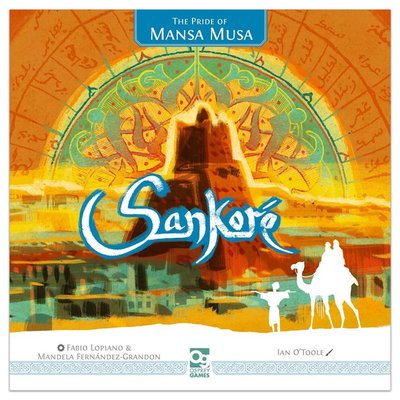
Hi everyone, I'm Tally. This is Farrell and we are bored of it. And welcome to our review of Sankor, the second game in the Osprey Fabio Lapiano trilogy, which also includes AR and MV. In Sancor, which is a heavy complexity euro for one to four players, you're tasked by Mansamusa with spreading knowledge around West Africa and improving Sankoro. So, this game is not one for the faint of heart or those without a few hours to spare, but there is something about it that has really engaged us and has definitely made it worth the buy in for us. So, we're going to get to that, but please note before we get to how to play that this was a review copy sent by the publisher.
On your turn in Sankor, you get two actions, but the same action can't be taken twice. Of note, on your player board is the area which contains lessons and then the four areas on the main board which correspond to the disciplines being taught which are astrology, theology, mathematics, and law. In relation to your playerboard, the two actions are enroll a student where you'll take a student from the main board and place them underneath the matching introductory lesson on your playerboard and establish an advanced class where you'll take an advanced class tile from a central marketplace and put that on your playerboard. The main action and the one you'll be doing most often is teach a class. Here you will take a student and put them on a lesson and then you will teach the class and interact with the main board in some way according to the discipline that you are teaching. This will always involve placing a building onto the board which requires you to calculate knowledge.
This is the sum of the highest number shown on the student track of the discipline that you're interacting with. Any knowledge the advanced lesson gives you and the knowledge on your playerboard for that discipline. The more buildings you have out from a certain discipline, the higher your knowledge will be. Having higher knowledge allows you to put buildings into better spaces, which in turn gives you better rewards. As you teach your students, they're going to move up to higher levels of education, which leads to the graduate action. Here, you can remove them from any one of the advanced levels of education on your board and graduate them, which just gets you some endgame prestige. And the higher the level, the more endame prestige if that token is still available, basically if another player hasn't already taken it. So, what prestige is is a key part of scoring and generally you're going to get it through the game and it's going to kind of fill up this track as you get it in the form of prestige tokens. However, this will lead nicely into the final action you can take, gain favor. So, favor is related to a track that the players will move up as they do certain things during the game. And the favorite track is a track full of bonuses. And when you take the gain favorite action, you can basically pick any bonus from where you're sat or previously on that track. And this comes
at a cost because you have to fill up your prestige slots on your player board with a favor token. And this is blocking you off from kind of in the future putting these prestige tokens in these slots. So, it's limiting your scoring, but you can also instead of doing a gain favor action, you can kind of take the favor action and return one of these tiles to the supply, freeing up some spaces on your player board. As you play, certain actions you take will trigger the movement of Sankori tiles from wherever you were taking that action to the middle of the board. And when 12 of these tiles have migrated, the end of the game is triggered. Now, during the game, a lot of actions you take will have a cost of library books, and you'll spend these and place them into the library. Now, library books will match the different disciplines, much like prestige tokens. So, you'll have one for each of the four disciplines. And what you're doing is you're playing this area control miniame in the library where for each row, the most common and second most common book type will be worth some points at the end of the game. And there's three rows.
And so at the end of the game, you're going to add up, you know, the most common, second most common for each row and then assign points. So what this can end up looking like is that law is worth six points and astronomy might be worth one point or even zero points. So then you're going to look at all the prestige the players have gathered across the game and using that value for each discipline, that is what each prestige token is worth. So then you calculate your points and the player with most points will be the winner. From what we've seen, Sankur is a divisive game. Some people find it over raw, over long, and doing very little to make it worth the very extensive setup. And on the other hand, other people find it a really engaging experience to navigate through and find that it offers some really excellent interactive elements that aren't often seen in Euro games of this complexity. So, where do we sit? It's a bit in both camps.
Yeah. So, the worst part of Sankor, other than the horrendous setup, is the fact that a lot of the actions are quite repetitive. So, for about four of them, it's just that they're quite simple. And for the fifth is the teach action. And this is what you're going to be doing basically every turn because it's what lets you do stuff in the game. It lets you interact with the main board. And when you look at this, you're going to think, "Oh, well, there's all these different areas with all these different looks, different disciplines. There's going to be a lot of different and varied actions, but actually they're all functionally similar no matter which discipline you're going into because you're always going to be adding up your knowledge. You're always going to be placing a building and you're going to be getting some kind of reward. Given that the last game in the series, Mirth, had a lot of different actions which all felt distinct in that they were their own miniame, feels disappointing that Sangor with all the grandeur and scale on show feels so repetitive. And while I don't want to say the word overall because that's a lot more negative than I mean to be and also kind of a little bit off to the side.
It does feel that the only reason Sankor doesn't feel repet horrendously repetitive turn to turn is because there's so much complexity and fluff kind of thrown on top that it drags your attention away from what you're doing turn to turn and more onto the puzzle that Sankor presents. That's important because Sankor is a very engaging game to navigate because of the complexity and the challenges that are put in front of you. For example, the action restriction. This means that you can't take the same action twice within a turn. And it actually makes it feel in some ways like games like Scythe where the challenge is is navigating your actions efficiently and kind of linking together multiple turns, bouncing between actions, and trying not to get in in a rut where you're you're wasting your turn doing something you don't really want to because you don't have something better to do. Then you also have spatial kind of uh restrictions that come into play which are very interesting to play around with and and plan ahead for. Because as you place advanced lessons on your playerboard and you educate your students and move them up, directing that flow is very important because you have limited space on the lessons to teach and you get bonuses if the students match the lessons. But on top of that, the best rewards on the board when you place a building, yes, they'll require a lot of knowledge, but often they're going to
also require you have a lesson with two students in it. And kind of managing to to plan that out properly and execute it at the right time. There's a lot of engagement and that and a lot of uh kind of added wrinkles that mean you're always spinning a lot of different plates.
But for us, the highlight of Sankor is the interactivity. Each area of the main board is divided into four sub areas, each of which has its own area majority battle going on. When certain students are taken from the student tracks, it will trigger the majority scoring. So, the player with the most buildings in each sub area will get rewarded with books or prestige tokens. This means that there's a constant low-level tension about when the scoring is going to get triggered and how well the other players are doing in each area. It's really spicy to take your first action to get ahead in a certain area and then the second one to trigger the scoring, snatching tokens away from your opponents. Sankur is full of interesting elements to navigate, such as the fact that you can get whatever you want on demand through the favor action, but it's at the expense of space for scoring tokens. That's spicy. Furthermore, Sankori is really great at allowing players to set themselves up to get a lot of bonuses which are vital for the affforementioned efficiency that they are trying to keep up. This is shown with great effect by the objective cards which are given to players at the start of the game and provide some direction in the beginning and they reward players when completed with asymmetric powers.
Similarly, we find that the endgame scoring of Sankor is excellent. We love the slow burn as players struggle over filling the library book by book trying to wrestle control to what they want it to be uh to make their prestige worth something. And it it just makes this kind of really misty vibe across the game where anything can happen. It could be anyone's game until the kind of final books are placed. And you know, you can be looking around the table and it's just quite fun to not know which way it's going to go and you know which color is going to come out on top. And it it just means that when you take the area control on the main board and you take this knife fight in the library, it really elevates Anor into this tense experience and and this helps it get over the more tepid elements in its design to be something that we thoroughly enjoy playing. A subtle but very important element of the game that really elevates the endgame scoring is the fact that the prestige tokens and the library books are of limited supply.
So what's going to happen at the setup is you're going to throw these books and these prestige tokens across the board. Sometimes randomly, sometimes set in a specific place. But in the end, what it's going to mean is that sometimes you'll have more color, more of one color in the supply or more of one color on the board. So, it means it's easier or harder relatively to get hold of that color of prestige token or or library book. And this means that you're also fighting with the other players for the supplies you need to score or get the scoring to be where you want it to be. And it just makes for this really interesting and tense concept where late game when that supply starts dwindling it it becomes this real scrap and you might have to find yourself thinking outside the box to to gain these books from the areas of the board or the prestige tokens from certain areas and it just means that it creates this really kind of tense like secondary fight. Uh, and it's just, I think, a really nice little element that really elevates everything else it's attached to. Final thoughts, while I can 100% see and completely get where people are coming from, when they they don't like Sankor, you know, the setup's too much for what you get out of it, it's it's over convoluted, maybe over wrought. I also think that there is a lot of great
elements here uh for a heavy complex euro. And as we touched upon, I think we both really like the interactivity and the flexibility of the scoring. The fact that it's a fight and this is uh like kind of low tension burn throughout the game. I and I think that this complexity does manage to to make what you're doing in the moment interesting as you weave your way through the game. So I think it's something I came out really enjoying. What about you?
No. Yeah, I feel exactly the same to be honest. Not too much to add. I do wonder a little bit if over time it would also get a bit repetitive maybe because I
think we talked about this.
Yeah. So that would be one little worry maybe. But yeah, I mean there's nothing that we like more than getting a heavy euro out, setting it all up and then having a tea and just spending a few hours trying to kind of navigate through the different challenges. And this is up there for me with an experience that we've really enjoyed. And obviously the aesthetics are great as well. It's very tactile with the token. So yeah, if you like this kind of thing
Yeah.
and you're not too worried about it being kind of Yeah. overought like you said, then I would definitely recommend giving it a go.
Yeah. I think touching on the the repetitiveness, I think it was something that came up very early because you can see the way the game goes and I think a lot of the fun is in that you don't know how the scoring will end up. Yeah.
But you know, it all goes back to what we were saying that you're doing very similar things turn to turn. So, it might end up being one of those games that it's nice to get out every once in a while, both for
the setup and because of that. You don't want to dilute it, I guess, too much.
But we do honestly like recommend it for for heavy Euro fans. If you like a bit of interactivity, even better.
But that is our review of Sankor. Uh please ask us any questions you might have. Really appreciate you watching and we'll see you next time. Fight by.