Legendary Game of Thrones: My Favorite Mechanism
Games in This Video
1 game is featured in this video — it unlocks as you watch.
Transcript
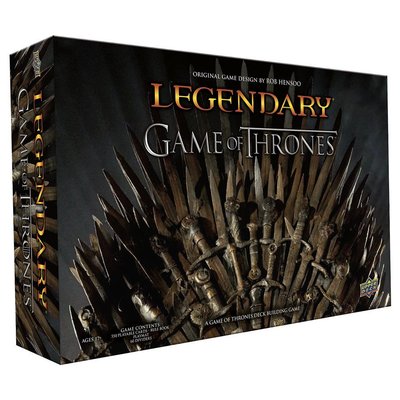
Hey, I'm Jamie from Stonemaier Games and today I'm going to talk about my favorite mechanism in the game Legendary Game of Thrones, which I went into assuming that it would be a cooperative game or at least a semi-cooperative game like Legendary the Marvel version, the Aliens version that I really love. There are a bunch of different versions of this game. But it is not. This is a competitive game. Uh maybe there's cooperative mode that I don't know about, but the core rules are competitive. We played it competitively and it looks like this. And it does something I think that's pretty unique with the card rows uh that's uh that lend to competitive play in an interesting way. I'll describe what I mean by this. So in in the other versions of Legendary that I've played, particularly in the Aliens version, that's the one that I played the most, played it maybe three times.
Uh it has a really neat mechanism where there was a central card row that's in the middle of the table and an alien shows up I think first near that card row um but it's face down and then it eventually enters that card row and it's it's dealing you damage every turn. So it's kind of like sneaking along the corridors in the ship in in the movie Alien or Aliens. Um I thought that was really really cool. This game takes that idea of a central card row and does something a little bit different with it, which is that all players have cards of their type, allies of their of their faction, their kingdom in the central deck and at the beginning of your turn you were revealing a card from that deck. Sometimes it's an event, sometimes it's uh some a few other card types, but often times it is an ally for you or another player and that enters the central card row.
And if there are no other card types of your own in that specific slot of the card row, it slides over to the left. And if it slides far enough, if your card slides far enough that it gets bumped off the far uh sorry, this gets bumped off the five-card row then it gets bumped to an area where you gain a bunch of benefits. You gain some points, you might gain a benefit from that specific card. So you're kind of hoping that your allies show up and that you try to protect them, you try to push them along um and you hope that other players don't attack them. Whereas if another player's ally shows up there, you might choose to attack them to eliminate that person from the card row. Uh so there's a quite a lot of interaction that happens in this in this card row, which is interesting because the game also features another card row that is has the feeling of a card market in most other deck-building games.
Uh so on your player mat, you have five cards that are face up at any given time and those are the cards that you are allowed to acquire, that you're allowed to like hire or buy in this game. That is the card market, but it's private to you. So I thought this was really interesting that in a competitive game they actually took the card market element out of the central area and made it private to the players, removing interaction from from other players. But they created a new type of dynamic, shifting not a card market per se, but a card row, a dynamic card row where you are rooting for certain cards and rooting against and interacting against certain cards within that card row um and where it's very dynamic. Those cards are constantly shifting over and sliding around. Also notably, even though your card markets are private there are ways that other players can get cards out of your own market. Not maliciously per se, it's it seemed pretty random in the game where example for example, a card would show up that says "When this card appears, everyone removes" I think the word was cycle.
Everyone removes their card in slot one and puts it back in the deck and replaces it with another card. And so it wasn't really interactive. It could have been more interactive, I don't think it needed to be, but uh it was a neat element to keep you on your toes a little bit that you couldn't just sit on a card forever because at any given time, randomly, one of your card one of the cards in your card market might go away. But it wouldn't go away due to due to another player and I thought that was kind of neat. So yeah, two different uses of card rows in this game. One very interactive and dynamic, one less dynamic, a lot less interactive, but it was kind of nice. I didn't I didn't miss necessarily competing over cards in the market. I could plan ahead and say, "Okay, I I want this card and it really actually I liked this more than I even thought, this this private card market because with cards with lots of text on them I don't want to reach into the center of the table and try to read it upside down. I just want it right in front of me where I can decide if this card is important or not for me. Um so yeah, I I didn't actually miss the interaction with the card market, which is a common thing in these games. Even Wingspan, Wingspan has a a shared card market. But I did like the mix of that the private card market plus the the dynamic card shifting row in the middle of the table.
So yeah, let me know your thoughts. If you've played this game or if you can think of other games that make the card market private or do different things with the dynamic card the shared public um card market or row. Um I'd love to hear your thoughts about that in the comments below. Thanks.