Dracula's Fortune Review: High Stakes Splitting
Games in This Video
1 game is featured in this video — it unlocks as you watch.
Transcript
Hey folks, I'm Tom Vassal.
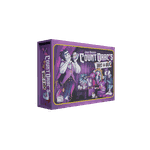
I'm Zee Garcia. Today we're taking a look at Trick or Treat Studios Dracula's Fortune. Uh designed by John Breger and [clears throat] packaged in a box that no one wants. Um It's a very nice long thin
like the size box? I don't really. No, I don't love it. It's It fits their other games in this box and no one else's games, which isn't great.
I guess if you stand them up like books on a shelf maybe. Anyway. Very tall. This is a game about Dracula and he's dead. He did not leave a will, so you're splitting his stuff. Right. Which you'll forget about pretty quickly and although there is vampiric stuff. Yes, but mechanically has nothing to do with that. It is a nice split you choose game in which you're trying to collect sets and uh walk away with the most victory points.
Yeah. Here's how it plays. Here we've got the game set up and ready to begin for three players. Uh we are going to be playing over six rounds and at the end of those six rounds whoever has the most victory points is going to be of course the winner of the game. We begin with two points each and we have uh a start player right here as well as everybody has one of these coffins, which is going to be holding some cards down in front of them. Each of those six rounds is going to go as follows. The first thing is the split. This is a nice split you choose game. So there's going to be a split that happens. Then there is a choosing phase, sacrifice which players may do, uh and then the creature scoring that will only happen during this third and sixth round and then an end of round where we pass the start player token kind of get ready for the next round. So let's go ahead and take a look at how that works. Uh we are each going to have four cards that we split. 1 2 3 4 for this player, four for that player, 1 2 3 4 for that player.
This deck can be set aside momentarily, okay? And then we are each going to select from these cards two offers. And that offer is going to during the first, third, and fifth rounds going to be offered to the player on your left, to the player on your right on the other alternating rounds. So, we'll take a look at these and you'll notice there's two kinds of cards here. These are sort of the the secret ones that you are going to offer to that player face down without them knowing what it is. And so, I would take a look at what all this does and I might say, "Okay, I'm going to offer you that as one option, and that is the other option." We'll all do that simultaneously. This player is offering that player a couple of offers, say those two and those two. They could even make it if they really wanted something, they could say three cards and one card. You could do that. And then this player's going to be offering me let's say two face down these two face up. And of course, any combination of that would be fine. Then we are going to simultaneously select which thing we have by putting our hand on that selection. Let's say I want to play it a risky, I'm going to take these two here and this player takes these two, and then they are taking these three over here, okay? And so, let's see. Da da da da this player's going to take these three, this player here took these two, and I'm taking these two, and then the
unselected thing comes back to us. So, my offer was these two things. This is the unchosen one, comes back to me, and then my own choice comes back to me. This player gets that, and then this player gets all that. We are going to put all of this in front of us. These stay face down, though we can look at them now, and the other ones go face up. So, this is what I've got in front of me. This is my my collection of goodies. Everybody will do that and put those things in front of themselves. You can sort that however is advantageous to you, okay? And then, starting from the start player, we can go into the sacrifice phase, in which we are going to, if we want to, pick one card and sacrifice that card down here, like so, um for the sake of this uh favor scoring at the end of the game. Plus, you might want to sometimes bury a card down there cuz it might be negative points, okay?
Uh these cards, the blood vials, will actually activate when you sacrifice them. They'll do the thing they do, and then they go away under your own little coffin there. Otherwise, anything you tuck under here doesn't do anything. It just goes away. It doesn't trigger any ability, all right? So, we'll all have a chance to do that. Maybe I'll, you know, I looked at this and I'm like, "No, I want that gone." I put that under there. Uh my friend over here is going to uh not do one yet, but they have this ability in their back pocket. And then this player over here says, "Um I'm going to do this one." I'll do that right there. With that all done, that is the sacrifice phase, and we go to the creature scoring, which does not happen right now, but it will happen here and here. And basically entails us comparing these symbols across the cards we've got. Whoever has the most is going to get six victory points and has to do a uh sacrifice of one of those things.
Second most gets three points. And then for the bad symbols, same thing. Five points and a sacrifice, two points uh for the second place. And uh that's it. And then we go on to the final phase, which is the end of round. We pass the start player token, and we will advance this, and we will do it again, drawing four cards, offering them this in this uh round in the other direction, and seeing uh what you want to pick, and then taking back the unchosen ones from the other side, all right? So, all of this in purpose of what? Well, at the end of the game, like I said, you're going to score first of all, favor scoring here. Whoever has the uh the most symbols down here, the most of the value, this value added up together, whoever has the most down here is going to get that number of victory points, nine or five or three for first, second, and third place respectively. Then we are going to score everything else we've got going on in the back here to let you know what that is. Basically, any points we've already taken during the game, which are these and some things will just give you those victory points. The next one here is vampire points gained and and or lost from curio cards. These are collection type uh things, okay? Uh and they're going to be like this, this little curio, Quacula. Quacula here is worth three victory points. Sometimes these are bad. Uh the disco coffin there is two, sometimes it'll be -1, things like that. And [snorts] so, sometimes those cards you might want to bury it because then they don't they don't affect you. Uh we've got the collections
down here, vampire points for each type of collectible. And so, the idea being cloaks, for example, if I end up with three cloaks, then I have six victory points. And those cloaks sometimes could be on even these hidden cards, you would reveal them at that point. Uh and so, that's how that works. You've got over here the candelabra is going to be for a single one, it's one point, two of them is seven. That's great. Three of them, unfortunately, is nothing. If you get more than three, that's terrible, you actually start losing points, -3. So, you'll score all the different kinds of collectibles you have, and then lastly, then we've got these vampire points from remaining mystery cards. Mystery cards would be these, and they have some kind of scoring opportunity for the most part. Like this one just happens to be a uh one victory point.
But this one here says one for each of your blood vial cards. And those are only the ones you still got, not the ones you tucked under here. So, that could be one of them. Uh this player over here has uh oh, I have another one here. Uh Lord of the Manor, four points if you have at least one of each of the four collectibles. The uh capes, the cravats there, the candelabras, and then there's something else we are collecting, which I'm not seeing out here, but there's something else there. Uh and so that's what you're getting little victory points from. Again, if you chose to sacrifice the card, you get this much influence under here in order to get these points, maybe, but then you lose what's on the card for any of that end game scoring.
Once you've played all six rounds, you're going to figure out that final scoring, and whoever has the most of those points right here is going to be the winner of the game. Thematically, this is a sillier take of sorts on Dracula. Not super silly, but like he has vials of health things blood. He has vials of blood from famous characters.
And authors. And authors, and like just sort of historical figures, which is funny. The whole thing is very light uh in in it's tongue-in-cheek, which is good, because it could be dark, but I like that the the the way they're going here is that it's silly. It's you're you're splitting these ridiculous things, little rubber duckies that belong to him, and his capes, and his cravats, and like also abominations, but there it's all kind of light-hearted. Which which is good, cuz the theme doesn't make any sense. I don't think a bunch of vampires are like, "Listen, here's how this is going to work. I'm going to take some things, split them. You can keep some or not." Yeah, and then you give me back the stuff you didn't take. I'm also doing that with the person on my right-hand side.
And we're sitting in a circle. All ritual. But as a game mechanism, it works pretty smoothly.
Sure, absolutely, yeah. It does demand a lot of table space. The The way in which this game chooses to handle ice plate you choose uh requires a lot of room on the table, right? You have to have two piles you're offering on this side or this side. You're going to be getting to that the the other way, and you're going 1 2 3 okay pick a thing, take that, look back to the other way you took. Okay, this is my okay. And then all that stuff stays face up in front of you, which it's only six rounds or whatever, but it's a lot of stuff. So, you're going to need more room on the table than you think you will. But, the flip side of that is I do like I split you choose where you're only doing two offerings and not five.
It used to be that's a much more like modern way to do I split you choose. It used to be like you're the splitter, make an offering for each of us, you get the last one. And so that person's going like, "Okay, I need to try to make here sets that are about even. I want this one. There's four of us. And so I'm glad that games are now doing this, where you're just you're just dealing with the person on your right or your left. It really is a game that's pretty simple, but the I split you choose is simplest part of it, where there's four cards. I'm take it's almost always two and two. Almost always two and two.
quite, but almost always. Yeah. It Other than the I split you choose, the game reminds me a lot of Sushi Go. That's a drafting game, but the scoring here you're collecting cards that score different ways and some have majorities. I will say though that there's a step up here because there's a few extra things. Knowing how to get rid of a card, doing it to get an action. Mhm. Um and there is a decent amount of text on some of the cards. There is. Um and the font's a little, you know, like the the layout, the look of the cards could have been a little stronger from a layout's kind of point of view. Um I do like the idea of there being this sort of secondary thing you're scoring by tucking the card under your little coffin. You're You're kind of chucking the card, everything on the card except the little value in the corner. And then if you have the most there, great, you got some points at the end. But you might also just do it to get rid of a card you didn't you were hoping not to have. And I like that. I like that there's like a a little safety valve, like a little escape valve there for like, "Ooh, I got some trash. I'm tucking that under there. Forget that. I don't have it."
And I like the idea that the blood vials trigger only when you do that. So you That's a good rule.
you don't have that kind of overhead mental load of like, "Wait, I have an ability. Hold on." No, they they do one thing, they go away. Um And then the other big one is some cards are face down, some cards are face up, right? Which is neat, but I'm not sure it needed to be I don't know if I they needed to be like printed on the cards. You could have just taken a chunk of the deck and shuffled it into the deck face down and boom. But then I guess you don't I guess when you look at them, you have to remember, "Oh, this one was face down." Yeah.
Or you could have just offered people two face down, two face up. I don't know. I wonder if that would make the game more or less mental, you know, load.
Yeah. So the game is definitely, like I said, a level up from I wouldn't call this super welcoming necessarily.
Right.
It's a slight step up from that. And part of the reason I say that is because it's a hard time keeping track of all the different things going on.
Yeah. I mean, score-wise. Like there's the majorities, and then there's you have these different scoring opportunities that will score you points, and you're like, "Well, let me Should I be going for this or going for that?" And it's going to take you a full game. You also don't know what's in the deck. I don't know if there's seven of these or six. A game or two, you'll get all that, but at the beginning, I think that's a little bit Again, I'm I'm making this game sound more complex than it is. But I'm also not trying to make it sound uber simple. I agree. If you're not someone who already plays drafting and or I split you choose games, you haven't played any game like that. Then then the first time you play this you're learning a lot of systems. There's a lot of like different little things you're learning. And so I agree the first time you play first couple times you play even you'll be like There's a lot of little things to keep track of.
That'll go away if you really get into the game you really dig it and um You could ease that but I agree with you. You'll learn the cards what have you. I like the I think the tongue-in-cheek theme is going to help you get this game back to the table. It's going to help you the game go quickly. It feels like six rounds is a good length. You know you're scoring halfway through your monsters your beasties whatever and then again at the end of the game. Cadence-wise I think it's good you know. My only beef here is There might be just a little too much. There might be too many special abilities. Those could have been dialed back a little. And then the the table hog nature of it. Um I wish there was an easier way to do that. Yeah it's going to be tough to get this one to stand out in the crowd to per se.
It the Dracula's Fortune it's going to appeal to some people but it's also going to turn some people off right? It's kind of a mixed bag there. It's not I don't know that I'm what that if I brought this table everyone's going to want to play it but it is family friendly too. And it's a good Halloween game because it's not actually scary right? That's the thing. It's going to be like Halloweeny scary not yeah this could be a good you're hosting a thing for Halloween. How many people does this play? Four. That's that's the only other thing. It might not this not maybe a big group enough you know um Yeah but then you wouldn't have room on the table too so.
That's true. Yeah. So I like it. I I don't think it's amazing. I think again it feels the slightest bit rough around the edges. Could have been streamlined a bit more I think, but it's a solid game that uses that I split you choose mechanism, which frankly isn't used in nothing games. And so, I enjoy this one. It's a nice novelty. And like you said, it's a good October type game for me. So, I'm giving it a seven out of 10. Yeah. I'm For me, it's kind of scraping barely into a seven. That's kind of where I'm at. I like everything I we've mentioned. I actually like mechanically a lot of what's going on, though it feels it sort of there's like a funny little like like I said, the the the cadence of play, six rounds is good, but the what's Where are we at? Am I picking? Okay.
Got it. And then sorting and you guys ready? Okay. Uh that part feels a little clutchy. But I like the game. I enjoy it. I think it's a good one for that season of the year and the look, the vibe, the entire thing is is neat. Like I said, it scrapes into a seven for me. It's not like a strong seven, but it's but it is there. It could do with a little streamlining, sure, but I won't I won't turn a play of this down. I'm I'm happy to play it. That's Dracula's Fortune. Don't forget after afterwards, after you split all his stuff, he's you're going to find out he's still alive and he's coming back after you. So, there's that.
Where is my Quacula? Sorry, sir. Anyway, I'm Tom. I'm Zee. We'll see you next time.
Hey. Uh thanks for watching another video here on The Dice Tower. Uh we really appreciate you stopping by and checking our things out. Thanks so much for joining us today. And hey, if you really like what we're doing here at The Dice Tower, then there are different ways to support The Dice Tower. One of those ways is through Patreon. We have links in the description to this video. We have links to lots of other things we do down there, so definitely check it out. But either way, we're glad you watched us. Tell your friends about The Dice Tower. Until next time, though, I'm Tom Vasel, and I hope you enjoyed this video.