



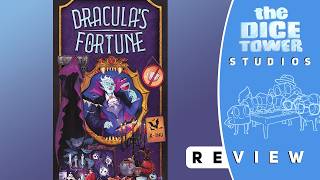

Dracula's Fortune Deep Dive
What the Community Thinks About Dracula's Fortune
Reviewers approach Dracula's Fortune with genuine enthusiasm for its core mechanism. The split-you-choose design is praised as elegant and underutilized in modern board games; reviewers say they rarely encounter a split-you-choose game they dislike. The tongue-in-cheek Halloween theme resonates strongly with the community, as reviewers appreciate that the game leans into whimsy rather than darkness. There is broad consensus that the game is a solid, playable experience that succeeds at what it sets out to do, though opinions differ on whether it rises above good to excellent. Most reviewers rate it around seven out of ten, viewing it as a fun seasonal addition to a collection rather than a must-have staple.
Core Mechanics That Define Dracula's Fortune
Dividing and Choosing
The heart of Dracula's Fortune is a streamlined version of the split-you-choose mechanism. Each round, one player divides a hand of four cards into two offer piles and presents them to an opponent, who selects their preference. The mechanism then rotates to another player for the next round. Reviewers consistently praise this approach as more manageable than older variants that required one splitter to create multiple offerings for a full table. The mechanism creates the core tension of the game: the dividing player must create offers attractive enough that the chooser doesn't feel cheated, while still hoping to secure cards they want from the rejected offer that returns to them. Reviewers note that this central mechanic doesn't get used enough and call it one of their favorite mechanisms in all of board gaming.
Set Collection
Players collect sets of cards across multiple rounds, scoring points for sets of matching curios, cloaks, cravats, candelabras, and other Victorian oddities. What sets Dracula's Fortune apart is the sacrifice layer: players can optionally tuck cards under their coffin to gain influence tokens that unlock additional endgame scoring. This creates a secondary strategic puzzle. A card tucked away is gone from your collection scoring but becomes leverage for final-round points. Reviewers highlight this feature as a clever safety valve that prevents dead-weight cards from ruining a round while preserving the theme of making tough trade-offs about what to keep and what to discard.
The Dracula's Fortune Experience
Tough Decision-Making at Every Step
From the moment cards hit the table, reviewers experience relentless decision friction. When dividing cards, players must balance multiple competing goals: offering something attractive to avoid telegraphing their preferences, positioning themselves to get strong cards back, and thinking several rounds ahead about which sets they're chasing. When choosing, players face the puzzle of whether to take the obvious strong offer or gamble on what the splitter didn't want. Reviewers describe the sensation as constantly asking how to make the other offer juicy enough that an opponent takes it, so the divider gets the cards they actually want. This creates a genuine puzzle space that keeps players engaged throughout the game's six rounds.
Back-and-Forth Tension
The alternating offers and choices create a rhythm of anticipation and reaction. Players must read each other's split decisions to infer which cards matter most to which opponents, then use that information to shape future offers. Reviewers note there is nice back and forth play and acknowledge that despite some rough cadence issues in execution, the push-and-pull of the mechanism works cleanly enough at the table. The game has built-in player interaction because every decision directly affects what your neighbors will see and choose.
What Makes Dracula's Fortune Stand Out
Tongue-in-Cheek Halloween Theme
Dracula's Fortune does not pretend to have a serious or scary theme. Instead, reviewers celebrate its commitment to whimsy: players are splitting Dracula's ridiculous possessions after his death, including rubber duckies, capes, cravats, and blood vials from famous historical figures and authors. The theme is light-hearted and silly rather than dark or thematic. Reviewers praise the approach because it could easily have been dark, but the designers chose levity instead. This makes Dracula's Fortune an ideal choice for Halloween game nights with groups who want seasonal flavor without horror elements. Reviewers call it a good October-type game and a solid choice for hosting a Halloween gathering specifically because it is not actually scary.
Clean Sacrifice Mechanic with Cascading Abilities
The sacrifice system is more elegant than reviewers initially expected. When a card is tucked under a player's coffin, any blood vial abilities trigger once before going away. Other cards simply disappear with no effects, which keeps the rules clean and prevents the mental overhead of tracking persistent board states. Reviewers emphasize that a tucked card does one thing and then goes away, a design choice that reduces cognitive load without undermining the mechanic's depth. This is highlighted as a thoughtful solution that prevents the sacrifice system from becoming a fiddly subsystem within an already complex game.
Potential Drawbacks
Significant Table Space Requirements
The split-you-choose execution takes up considerable table real estate. Players must maintain two visible offer piles, hold their own collection face-up and some cards face-down, and track multiple rounds of visible card accumulation. Over six rounds, the table footprint grows substantially. Reviewers note the game demands a lot of table space and that players need more room on the table than they might expect. While the split-you-choose mechanism itself is simpler than older variants, the physical presentation requires more space than many other card games of similar weight.
Too Many Special Abilities and Rough Cadence
Reviewers identify a slight complexity creep: some cards carry text-heavy abilities and unique interactions that require players to learn the deck across their first game or two. Reviewers suggest there may be just a little too much and that special abilities could have been dialed back. Additionally, the turn sequence, where one player splits, multiple players choose, and then cards return to the splitter before moving to the next player, creates what reviewers describe as a clutchy cadence. The game has to pause and reset between each offer, and with simultaneous selection phases, there is a moment of awkwardness as players untangle who has which cards and who goes next. Reviewers describe it as a little messy but say it ultimately works out well.
If You Enjoy Dracula's Fortune
Dracula's Fortune shares DNA with Sushi Go!, the classic set-collection and drafting game. Both games use hand-passing or split mechanics to create set-collection puzzles under time pressure. Fans of the satisfying combos and moment-to-moment decisions of Sushi Go! will find that Dracula's Fortune expands on that formula with the sacrifice mechanic and face-down card options. The game is also a good match for players who love split-you-choose games and want a lighter-weight entry in that genre. Because it leans into Halloween theming without requiring a specific season, it also appeals to groups that appreciate tongue-in-cheek humor and games that don't take themselves too seriously.
What Reviewers Are Saying
"The way they're going here is that it's silly. It's you're splitting these ridiculous things, little rubber duckies that belong to him, and his capes, and his cravats, and like also abominations, but there it's all kind of light-hearted. Which is good, cuz the theme doesn't make any sense."
— Zee Garcia, The Dice Tower
"I just I don't think there's been an issue you choose game that I haven't liked at this point. And so, you know, Dracula's Fortune obviously plays in 30 minutes or so, so it's a lighter weight, you know, quicker playing game. There's a set collection aspect to it. And so it always makes for a hard choice where you're like, how do I make this other thing juicy enough that they take it so I get the cards that I want?"
— Grant Lyon, Grant's GameRex
"It's interesting. It's kind of a table hog, but it's got some fun very tongue-in-cheek humor."
— Zee Garcia, The Dice Tower