Tiny Epic Dungeons Adventures review - One Stop Co-Op Shop
Transcript
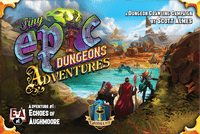
Yo, my peoples. What's up? Welcome to 5-minute 1 Stop Co-op Shop, where I go over five things you need to know about a game in about nine minutes-ish. Today, I'm taking a look at Tiny Epic Dungeon Adventures. This is the first big follow-up to Tiny Epic Dungeon, which is a super popular game as we see here on the 1 Stop Co-op Shop. This one adds an eight-adventure campaign with its story, new characters, new items, all the stuff that people want to see in terms of more content for Tiny Epic Dungeon. So, let's go to the videotape and break down everything you need to know about Tiny Epic Dungeon Adventures. Disclaimer, I was provided a review copy of this one from the publisher. My number five, a pro, is the fact that Tiny Epic Dungeon Adventures is its own set. You do not need the previous set in order to enjoy it. However, there is the option to take some of the elements, or as many as you want, and integrate them as you want.
So, I like the fact that there's that optionality. As a matter of fact, I suggest, especially if you're not totally into the world, don't combine the sets. They're very close to one another. So, as an example, here are some of the items. This is from the new set. Morningstar gives you a plus and some dice. Sunhammer gives you a plus and a slightly different bonus. We have another item over here. Gives you a plus and another slight little bonus. I mean, is it that meaningful that you really want to combine the sets for that variety? I get that instinct as a gamer, that completionist instinct, but my suggestion is if you want like a cleaner, less bloated experience, just go with the basic set. It's pretty good. My number four, a pro, which is that Tiny Epic Dungeon Adventures redoes the minions, the mobs in the new version. In this old version, you could see that there are different ones. There's a lot of mind space that is here for what is ultimately meant to be an annoyance and distract you from the main action, but I found it too distracting, at least how it's laid out here. Instead of different individual mobs, you get one mob that just kind of pops out again and again.
Uh that sounds boring on its own, but relative to the what I want to pay attention to, which is the bosses in the environment, uh this works out much better. And something I really appreciated that Dungeon of Dungeons does is the movable spawn point. Uh in the base game, uh you start at the stairs and then the goblins just kind of show up at the stairs like a Pez dispenser, uh which tethered uh characters to the central stairs. They couldn't go out and explore because you know, you're ignoring the goblins and they really uh make the game harder if you leave too many of them open. I just didn't like that, you know, so much of the game is about movement, uh but then you have this anchor in the middle. Here, uh very subtle change, you have a spawn point that moves. Uh so, as you go through the adventures, the spawn point's going to show up at different places and change the geometry. It's a subtle change, but given how uh much the the system depends on the goblins to kind of get you moving around, I like any little change in that area. And they did some good ones.
[clears throat] My number three, uh total mix this point, which is the symbol soup of the game. This is the back of the rule book with so many of the symbols. They also give you on the back of each character card. Some of the more commonly occurring symbols, uh it is uh quite overwhelming. The base game was this way. The the expansion changes nothing. Uh and still it even adds a couple of symbols uh along the way. So, I mean, that's just going to make or break your experience, so know that going in. Uh a frustration with me was that uh even as I was playing the game, the minute adventure I think four, uh I pulled a spell card called Terraform with a pink door. Woah. Where is the pink door? I was just I don't You should have seen the look on my face. I thought I had gotten all the symbols and I'm still seeing new symbols. Uh good lord. My advice, go to the Tycoon website, uh go to the page with Tiny Epic Dungeons & Adventures. They have PDFs, save them on your phone, or print them out. You're really going to need them to smooth out your experience. My number two, another mix is the layout of the dungeon across the eight adventures. So, in the base game you only have these map cards and that created the variability because you dealt the map cards in a different grid.
Here, the variability comes from the booklet with the spiral note. So, I'm not going to show spoilers, but there are eight different maps for the eight different adventures. That ended up a pro for me. I do like how different they felt. They know they had different layouts, different you know cut offs and everything, symbols, places of interaction. I've seen some people on the boards kind of complaining about the spiral, but I didn't mind so much and I got kind of got used to it and these lines that demarcate unpassable places are pretty clear. So, it wasn't bad in other adventures you got kind of pass by and it was nice. Some of the art is well done. I like the spiral book. On the more difficult side were the map cards. For most of the adventures you're going to be dealing from the same deck. So, you have to interact between the map cards and the deck. So, the maps were you know I felt like I was in a different place, but the map cards recurred from game to game.
So, if I'm in the first card and I encounter sewer and then I transport myself all eight adventures I've made it all this way, huge adventure, huge growth. I'm going through the boss and then sewer. Sewer, my old friend. I should not be saying my old friend about a card. That should be more of a story element. Kind of felt like in the BioWare games or Skyrim or some of these big open world games, those side quests just kept on recurring over and over again. Takes you out of the head space of being in a big adventure and they also they give you those rules and you have to kind of interact with it, distract you from the main game. It made me wish that each of the different maps had different cards themselves. I don't mind the cards, but the recurring nature of them, that was difficult. My number one, we're going to have to go con here, unfortunately, although it is really close to pro, is the a sequence of adventures and how they're structured.
So, Tiny Epic Dungeon Adventures really tries to go ambitious with giving you eight adventures that are very different from one another. Lots of different possibilities here, so you have escape and, you know, capture the flag and heist and tower defense and big boss battles. So, they try to play with the meta enough to give you those experiences across the eight adventures. It walks a really fine line between all that complexity adding to the experience and going over that line and becoming fiddly and boy, did it spike up and down along that line. So, on the positive end, there were some adventures that I liked and to the point where I wouldn't mind replaying them again. I don't think that this model lends itself towards replayability because they are woven together. But, you know, I do have had fun memories of especially like adventure six was one that really stood out to me. No spoilers. I hope that you guys enjoy that if you get to it. On the not so good side, again, with that complexity, sometimes it just became really frustrating. You're looking at the rulebook a lot. As an example, the game introduces mini bosses. These are between mobs and bosses. And they work differently in each of the different adventures and so you're looking stuff up. It didn't work that way the last time, etc., etc. I had a mixed experience with these. Some people they enjoyed it, some people didn't. Your mileage may vary. Where this goes over the line for me, it's a con territory.
You'll notice in the rulebook and different places, there's the quality control just as a product wasn't on point. Typos, missing word, etc., etc. And adventure number three in particular is missing a symbol, at least a symbol. In my opinion, this game this adventure itself came out broken. I had to make up rules in in to get through that adventure and get to the next one. I really can't believe that kind of got through quality control. I'm going to link in the show notes a thread in BGG that talks specifically about chapter three because I don't want to keep the spoilers out of this one, but I get the ambition of wanting to provide a new experience. There is some miles to go before it really delivers. So, as I'm recording this, there is no officially posted errata for Tiny Epic Dungeon Adventures.
The difficulty with the adventures in the rulebook and some of the lack of clarity still persists as far as I can see. By the time you watch this review, things may be totally different. There might be some satisfying errata that has come out. And if that does happen, then I can see this being a real draw for people in terms of a adventure that is cost effective. A lot of times these big adventures are 100+ dollars. This is not that and delivers a good amount of the punch that you would want, especially with those adventures being so varied. And I I really enjoyed that part I when it did work. This follow-up still leans into that symbol soupiness as I mentioned in the review. That is going to make or break the experience in my opinion. If that's just not something that you want to take on, it's like learning a new language basically. So, if you don't want to do that, that seems like a little bit heavy, then this one is going to be a pass. However, if you can grok the language, then it does unlock a really unique adventure in our space because of how much it packs into that little package. This is Jason with One Stop Co-op Shop reminding that we'll see you at the next stop.