Eternal Decks Review: Is This Burning An Eternal Deck?
Games in This Video
1 game is featured in this video — it unlocks as you watch.
Transcript
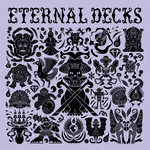
Hey there everybody. It's Mike Delisio and today we're going to be taking a look at Eternal Decks. This is coming from designer Hiroshian and publisher in Japan is TrickTakers Games. English localization and distribution is being handled by Portland Game Collective. Eternal Decks is a limited communication cooperative game where you are trying to achieve a series of uh accomplishments before losing conditions occur. So, what I'm going to do is going to head down to the table. I'm going to show you the basics of the opening stage. There are multiple ways to play the game just to give you an idea on how the core system works. Then, we'll come back here and I will let you know what I think. Eternal Decks can best be described as a game system where you're going to have kind of core elements that you are following throughout the game, but there's a whole bunch of cards in this box. And within this box, in addition to the fabric board and player aids and stage uh cards and things along those lines, as I said, are a lot of different types of cards. And you're not going to be using all the cards every time you play the game. What you're going to be doing is you're going to be choosing a particular stage. So, kind of the opening stage is this nature star. And I'll very briefly kind of go over how this works. But just know that depending upon what stage you're going to be playing, you're going to have some different rules. You're going to be
doing some different things. This book here lays out most of the rules for that stage A, but there's another whole book here for the different stages, and they get much more kind of complex as stages go through. There's stage C, the labyrinth, stage B, the ghost town. They show you how the differences uh play out in the game, the different cards you're going to be using. There's a huge uh solo section to it that involves uh you know, some other elements. So, just know that there's a whole lot that I'm not going to be able to show you in this overview. I'm just going to be giving you a basic idea on the core elements of the game, and you see a lot of those in that first stage. Eternal Decks is a cooperative game, and depending upon which uh stage you're playing, you're going to have different winning conditions. In this first stage, Nature Star, you're trying to get four stars.
There are six that are out here on the board, and you can get four of those six, you will win. The way you lose is if you cannot take one of the three types of actions on your turn. So, if you can't do either of these three things, you would lose. You're also going to lose if you flip over this game over card in this river area. And I'll talk about that in just a moment. Each player is going to have a player number, a color, I should say. They're going to have a deck of cards that are just one to five. Every player has the same cards. and they're going to have two communi communication discs in their color. This is a limited communication game. And the only real form of specific information you can give would be by using these discs. And it might be something like if you had uh a card that would be particularly good for this area here, which is the cave. This is saying that you want to be playing cards in descending order from highest to lowest.
So, let's say you had a five that you wanted to play because five would be the highest card you have in your starting deck. Maybe the blue player would put it there if it wasn't their turn. Signal to the other players that I really would like to play there. That's the type of thing you can talk about. Um, cards that you've already played and general ideas of strategy, maybe who you want to be the one to collect one of these eternals, which I'll talk about in a moment, but you can't give specific information about what's in your hand, things along those lines. And so once everyone has shuffled their decks, they'll each draw three cards as their opening hand. And then players will be doing one of these three things on their turn. They will either play a card, they will generate a jewel, or they will give a card to a teammate. Most often you'll be playing a card. So let's talk about that. You can play a card to the uh field, which are these three rows right here in the center of the board, or you can play down into the river. There's some specific uh placement rules that I already showed you in some of these areas, like the cave I showed you. You want to go in descending order here. You want to go in ascending order. in the camp. You don't have to follow one of those, but you do have to follow the common placement rules that is going to apply anywhere here in the field, which is that you cannot have two of the same number next to each other and you can't have two of the same color next to each other. Those restrictions don't apply down here in the river, but they do
apply here in the uh field area. So, let's say blue is the first player. They look at their cards. They've got a five, two, and a three. Well, what they might want to do is go ahead and play a card right here to the cave because they know it has to go in descending order. That's the highest card they can possibly get. That would simply be uh what they would do. They'd play that card. They would draw one card back to refill their hand up to three. Again, everyone has a starting deck of only five cards. And one of the ways that you can lose the game is by not being able to play a card or give a card to a teammate. So, how are you going to be getting more cards? The way that you'll be getting more cards is by completing these rows and choosing one of the three eternals that are at the end of those rows. So let's say that in later turns maybe green had played here, red had played here and then other cards have been played in other places. Maybe blue was down to just a couple of cards and so they would try to set it up so that blue would be the one to play the last card here because maybe they were down to zero or maybe that was even their last card.
Whichever player plays the last card in the row gets to choose one of those eternals that are at the end of the row. And what you can see on these eternals is the makeup of their deck. They've been shuffled, but these are the cards that are within the deck. So you can see the values that are in the deck, the colors of the cards that are in the deck, any special cards that are in the deck, and also it's going to tell you some curse that that eternal is going to bring. So for example, let's say the blue player had taken this. They would take these cards, they've already been shuffled during setup, and they would put them at the bottom of their deck. If it was the last card they had played, that would be the their their deck. They take the ghost and they place it in the leftmost spot here.
up in this area of the board. Okay. Now, what this is telling you is that you cannot play cards with values of five or seven here in the field from there on out until you find a way to break that curse. How can you break that curse? Well, you can break that curse by generating a jewel. All right? And the way you do that is by playing certain uh cards in your hand into this river area. All right? And there's kind of a a uh a formula for it here telling you which types of cards. This one is just basically saying if you play two cards into the river, you can take a jewel and then when you get a jewel, you place it over that curse. And now that curse no longer applies. So that's the second thing that you can do on your turn is you can play cards into the river area to generate a jewel. But again, you have to be able to fulfill three of the same color, three different colors, uh, three of the same number, two of the same number. If you get a 1, five, and nine that you're able to play out here, you not only get a jewel, but you get one of the four stars that you need to win the game. Other ways you can get stars is by filling these areas up with eternals.
Once you fill the third one there, there's one star. You can see you can get it two more times in that upper area. You can also get it by getting what's called the lap bonus at the end of this bottom row. And that means when you have completely cleared out all of the eternals and you fill it again, that would get you that uh bonus. The third thing you can do on your turn is to give a card to a teammate. You have to spend a heart to do so. All right? And these are the hearts over here. So you would spend a heart and then you can give a card to a teammate. And sometimes that's a way to keep the whole team from losing. If someone has run out of cards or is going to run out of cards on their next turn, you could potentially give a card to that teammate as cards are being played into the river. And remember here, you don't have to follow the common placement uh rule. So you can have two green cards next to next to each other. You can have two of the same value next to each other if you wanted to. So maybe we had this, which normally you couldn't do this, and then maybe you had this. Um, once this river has been filled up, then whoever plays the last card is going to get one of these rare cards into their deck. A rare card is one that can be played as any value or any color. So, as you can see, that can really kind of give you some flexibility. And it also will let you do things you normally couldn't do. So here what it's saying in this mountain is they're saying that if you had played a nine and there were still empty spots, you can continue to play rare cards
after them. That would be okay. Similarly here, if you had played a one in the cave and there were still a couple of extra spots, you could fill those spots with rare cards. Okay, after you've claimed these three rare cards and if it were to happen again, then that is one of the loss conditions as well. you would lose the game by going through that basically a fourth time. Again, the other way you lose the game is by not being able to take one of these three actions on your turn. And if you get four stars before either of those loss conditions happens, then you win the game. In the other stages, you're going to be going for keys, but you're still going to generally be doing the same types of things, playing cards. There will be different eternals that come out that have different uh types of effects. You notice some of these uh eternals will give you dual color cards.
And so in that case, you've got oops, sorry, something like this, which could be played as a blue or a yellow. You have to determine which color you're going to be playing it when you put it out there on the field. That should give you a general idea on how the game plays. There's a whole lot more to it, but just to give you a general idea, let's head back up and I'll let you know what I think.
Okay, so there was Eternal Decks. Just again keeping in mind that this is a game that has multiple different ways to play. Each stage is going to play out differently, have different objectives, things along those lines, but you got an idea of the core kind of system of the game, and then each stage is going to be an iteration upon that. So, uh, I want to talk about pros and cons in the game. And, uh, we're going to start off with the things I like because I'll just put it right out there. There are a lot of things I like about Eternal Decks. First off, I'll just talk about the production. Uh, for a card game, this is a very lavish production. Beautiful production. I love the art. Now, I do understand that this art may be divisive because it's very stylized. And often times in stylized art, you're going to have some people that it is attractive to and others that it is not. I absolutely love the look of this game.
The colors are vibrant and pop. You've got foiling on some of these cards and and um it really just looks striking on the table. Uh so really really fantastic job with the production there. I feel like this is a game that has incredible variety and depth of gameplay styles while using a relatively simple core game system. So, you know, in this game, the the main elements are uh hand management and uh deck building. Okay. Uh, but it's done in a way that feels so unique that I've played dozens and dozens of deck building games and dozens and dozens more of games where hand management is a huge element. Uh, but this game stands out from the others I've played because while they have those, you know, elements that I'm familiar with, they handle them in such unique uh, and just clever ways that it really does not feel like any other card game I've played. The other big element of this game is limited communication.
Now, I will tell you that that is not my favorite type of cooperative game. Um, I think it's very very hard often times to pull off limited communication in a cooperative game. Well, a lot of times it leads to some metagaming among the players where, you know, they they maybe are following the rules, but they're not following the spirit of of the game or there may be some ambiguities in the rule book about how limited communication should be done. Uh, I think it's handled very well in this game. I I don't think that they leave a lot of gray areas. It's pretty clear what you can and cannot communicate. And those tokens are really reinforcing that there's really only a couple of ways that you should be communicating with your fellow players, but it's not complete lack of communication. And they do a good job of pointing out these are the things you can talk about. You know, you can talk about cards that are already played. And often times by doing that it has inferences to things that cannot be said. And so I like that you know you can still utilize the information that is open and available to all the players to help guide maybe players on what might be a good course of action. Um you just can't give specific information about what cards you have in your hand. And I think that's easy enough to u to implement.
And so I think it does it well in a style that I'm not always uh most fond of. Um probably my favorite element of this game is this Eternals uh system. The way that you every player starts with a very small deck. You have five cards and very very quickly you're going to run out of cards and the way that you kind of deal with that is by unlocking these eternals. And each eternal has its own specific style, things that it is good at, particular types of cards, and also a curse that comes with it. And I just think that is brilliant because you need these eternals to be able to continue in the game to give you the better cards that you need to be able to maybe generate some of those jewels. But it also comes with a negative and you have to think about that. You have to think about what other eternals are in play. Does this curse even really bother us right now? And do we take this eternal first because we don't really need to worry about the cards that it eliminates until a different eternal is chosen. I think that is such a clever clever system. Brilliant. Honestly, and you know it gives you this kind of dual-edged sword. I really want these cards, but we have to deal with that curse and we have to do it in such a way that we are still keeping pace, keeping ahead of the eight-ball, making it so
that nobody is really going to run out of cards without being able to get their own deck of Eternals. And the more Eternals you unlock, the harder it gets to unlock more. And so, I really I I just think it's a brilliant, brilliant system that is unlike anything I've ever played before. The cons in the game are that really it's a massive table hog for a card game. It takes up a tremendous amount of space on the table. You saw that in the overview. The the the board such as it is that that kind of cloth mat. It's lovely and it's nice for the cards. It's nice to place the cards, pick up the cards from it. Um so I I think it has some function as well as form, but it is large. Very very large. And you know, I think the tradeoff is that, you know, you are taking up a lot of table space, but you have very clearly delineated areas where you play the cards. And I think that's very important. It helps with the visual kind of um noise that there would be if there were not clearly delineated spots for where the cards go. And you also get these beautiful full-size cards on your table. So, it is a con in the sense that it takes up a lot of table space, and you need to be aware of that. But there is also a positive element to it as well. And the other con that I can think of is that there is a fair amount of setup and tearown for each of the games that you're going to play because each stage has different cards that are going to be added, maybe different tokens,
different elements that will be a part of that particular stage and it can be a little bit arduous kind of sorting and resorting after the game is done. Uh so that is something that you you want to consider. That's a slight negative to it, but overall, I think the game is fantastic. I I think it is one of the best card games I've played in the last several years, and uh as such, I'm going to be giving Eternal Decks a 9.5 out of 10. This game really knocks me out. It really is an impressive design, a simple core mechanism that after a little bit of playing, people are going to get the hang of. But what a deep and robust game system you have here that can uh you know can can really lead to some hidden depths. It's not like you're going to play each of these stages once and be like, "Got it, I'm done with that one."
No, no, these are highly replayable and um the the kind of the order that you do things matter so much. So, it's a game that has a tremendous amount of depth and replayability within this box. And um you know, if it does well, I would not be surprised if there are more cards that are added to it. But just as it is, this game in and of itself is outstanding and one of the best card games I've played in a long while. So there you have it. That is Eternal Decks. I'm Mike Delisio and I'll see you on the next one.
Hey everybody, thanks for watching this video. If you like this review or whatever you just watched, wasn't it amazing? Uh, check out our channel, Dice Tower. We have all kinds of things. We review games, we do top 10s, we play games live. It's all about board games, but especially the people who play them. Check out Dice Tower YouTube channel.