How to play First in Flight
Games in This Video
1 game is featured in this video — it unlocks as you watch.
Transcript
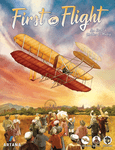
The bad news is I've broken my arm. And both of my legs. The good news is: there might be some money in it for me. Hi! It’s Ryan from Nights Around a Table. Here’s how to play First in Flight. You and your friends play real-life historical pilots during the early days of aeronautics. This was a time when any bozo with a dream in his heart and a spare collection of bicycle parts would strap home-made wings to his arms and jump off a cliff with the hope of being the first person to achieve heavier-than-air flight, sometimes not living to tell the tale. You and your opponents have that same dream in your hearts. And hopefully a little more engineering smarts! You’ll be taking experimental flights, weeding out engineering flaws to repair your rig in order to improve your flying machine, and sometimes pulling off death-defying mid-air manoeuvres, while enlisting the help of some notable friends in order to set a new flight record and become famous. When four years have passed, or when someone cracks a flight distance record of 40, which is more likely, all players get one final shot at setting the highest record.
Whoever sets the best record wins! TO THE SKIES! You’ll travel this track four times, representing four years in the life of a pioneering pilot. The actions you choose along the way help you improve your ability to fly ever farther, and without incident. You want to set the best possible record for heavier-than-air flight over a certain distance. Any time you land on this “Fly” space, it’s time to take to the air. Hopefully. This Fly action is central to understanding the rest of the game, so let’s go over it first. You all start with the same deck of nine cards that contains 4 glide cards with a distance value of 1 on them, an experience card, and four design flaw whammies that represent things going wrong with your flying machine. You’re not allowed to look at these four flaws at the beginning of the game, but you know they’re in there. You also have a special Descend card that you keep off to the side. Your deck starts out kind of crummy, but it will grow and improve as you play the game.
Shuffle your deck and hold on for dear life. You fly by turning over cards from your deck one by one. Each card with a number in the corner adds distance to your flight. This is a push-your-luck game, which means that any card you turn over risks crashing your plane; turn over four red flaw symbols - careful, cuz this card’s got a double-whammy - and your contraption will come crashing down to earth.When that happens, you’re done: your Fly action ends immediately, and your pawn goes down for the count. (“Ooeunghvv - i landed on my keys!”) So is that next card you draw going to prolong your flight, or prolong your stay in the hospital? At any point while drawing your flight cards, you can decide to try to land your plane, by placing your Descend card. But even after you decide to head down to terra firma, you still need to shuffle the remainder of your deck and draw two more cards to try to stick the landing. So you still have a chance of drawing extra design flaws and crashing your plane before the flight’s over. What’s more, these design flaws that you begin the game with have additional nasty surprises in store for you. One of your goals in the game is to patch up these problems by repairing these flaws and swapping the cards for these less serious Basic Flight Problem cards, so that your future flights can go off without as many hitches. But try as you might, you can never repair your plane to the point where it’s completely uncrashable.
Whether you land the plane successfully, crash before landing, or crash while landing, you add up the numbers on your flight cards with the hope that you’ve set a new personal best distance record. If you landed the plane without turning over 4 flaws, your Descend card counts for a distance of 5. You move your flight record tracker up the flight track to record your best attempt. If you crashed your plane while landing, you still add up the numbers and record your attempt, but your Descend card only counts for 2 distance, and you have to knock your pilot token over on its side. And if you were unlucky enough to reveal 4 flaws before descending, your plane crashes immediately! And your pilot keels over. You still get to record your flight distance because hey - you still technically flew. You crashed into farmer MacGregor’s barn and your body is shaped like a pretzel, but you still flew!
After every flight, you can take up to any two of the design flaws you revealed during your flight and put them in any order into any empty spaces in your garage, where you can potentially repair them on a later turn. We’ll see how that works shortly. This is the supply pile of various draw decks for the game. If you happen to turn over your Experience card while flying, you get to add one of these +1 Glide cards to your flight, prolonging your time in the air. This improves your flying machine just a little for the rest of the game, because now, that +1 glide card will always be shuffled back into your deck, and you might randomly draw it on future flights. But the game gives you different ways to upgrade, to add even better cards to your deck. We’ll look at that in a bit. MOVEMENT So that’s what flying looks like.
But First in Flight would be pretty dull if you couldn’t tinker with your plane and improve your flight record, so there’s all this other stuff on the board that helps with that. Let’s look at how you move around the loop in your quest to become a famous flier. If you’d like to nosedive right in and start playing, skip to the end of this video and i’ll show you how to set everything up. Each player is represented on the board by a little pilot token. The tokens are randomly lined up here, and the last player in line is always the active player. So in this instance, this player would take the next turn. If the board looked like this, it’d be this player, who’s farthest back. When you take a turn, you move your token ahead as many spaces as you like, to any unoccupied spot, and do the thing. So technically, on your turn, you could go all the way over here, but that’s probably not a good idea, because you’re missing a lot of opportunities by skipping over so many spaces. Put these two rules together, and it means that the farthest player back might get multiple turns in a row. So Grandpa Earl’s token is the farthest back, and he decides to go here and do the thing. Then, Grandpa is still the farthest back, so he gets to go again. He decides to go here and do the thing. Then, since Grandpa’s still last in line, Grandpa gets to go a third time. Come on, Grandpa Earl. You’re hogging the board game!
You can’t land on a space if you can’t take the action. So for example, if there’s a space that costs money, and you ain’t got any, you have to skip that space and move further along the circle. Sometimes, you’re given the option of paying either money or time to do a thing. So here, you can patch up your plane either with cash, or spend your time tinkering with it, just like in real life. If you choose to pay time for something, you move ahead the appropriate number of spaces along the clocks. Unlike a regular space, multiple players can occupy a time space together. If you move into a time space and there’s already one or more players there, you move to the front of the line on that space. So it’s like a “last in, last out” kind of thing. If your pilot is horizontal due to some bad luck on a past flight, you’re not allowed to take a regular action on your turn; you have to waste a turn by moving forward along two clock spaces to allow time for your spleen to heal up.
The last space you can move to is here, back at the beginning of the loop. If you’re the first to arrive, you take the leftmost spot, which means you’ll be the first person to take a turn when the year is finished and a new year begins. Everyone else fills in from left to right as they reach the end of the line. By the way, in board game parlance, this loop mechanic is called a “rondel.” Now let’s take a look at the individual actions you can take as you travel the rondel in search of fame and glory and an intact skeleton. THE ACTIONS We’ve already seen the Fly action, which is the heart of the game. You’ll be flying multiple times throughout First in Flight in order to set a better and better distance record. If you take a Fly action and you set a worse record than the one before, you don’t lose your past record: flight record tracker only goes up. Unlike your actual plane. Every time you finish flying and you sniff out one or more design flaws in your rig, you have to flip your Descend card on top of your deck to remind you that you have to shuffle these unrepaired design flaw cards back into your deck if you decide to go flying again without first fixing the problems on your plane. Just because the cards are in your garage and out of your deck for the moment, it doesn’t mean you’re rid of them forever. To get rid of them forever, you can land on the Repair space. This allows you to fix one design flaw you uncovered during a previous flight.
So you can only take this action if you’ve flown at least once, and if your garage has one or two design flaw cards in it. Pay the cost on the space — either in time or money, depending on the space — and then send one of your design flaw cards to the Design Flaw discard pile. If you choose to repair the flaw on the right side of your garage, you have to pay an extra buck to do so. And you only get to repair one flaw each time you land on the Repair action, even if you have two flaws in your garage. Every design flaw you weed out gets you some sort of perk that’s listed in the top corner. Make sure you don’t miss it! These icons will make more sense as we learn how to play the game. Now, you’ve removed a more serious flaw from your deck, but you have to replace the card with one of these Basic Flight Problem cards. That makes it so that your plane can still crash when you fly, but the flight will hopefully go much more smoothly than before, because you don’t have to deal with the extra badness that a Design Flaw brings.
Once you place Design Flaws in your garage, you’re not allowed to move them around, so you couldn’t decide to pull a switcheroo to make this card less expensive to repair. Your only option to dislodge these cards from their places is to either pay to make the repair, or choose Fly again and scoop these cards up into your deck to fly with them, and then put them back in your garage in a different order once the flight is over. The Upgrade Action gets you some dramatically improved Distance cards into your deck. This stack has flight cards with anywhere from a number 2 to a number 5 on them. To buy them into your deck, you need to pay at least 2 bucks, or 2 time. That gets you two of these cards, which you get to look at, and then shuffle into your deck. If you pay more than two bucks or 2 time, you get to look at more than two cards. So for example, if you pay as much five bucks or five time, you can look at 5 cards. You still only get to keep two cards for your deck, but of course, the advantage is that you get to grab the two best cards from the ones you draw. The ones you don’t keep get shuffled back into the Upgrade deck.
No matter how much money or time you pay and which two cards you gain when you take the Upgrade action, you always have to grab a face-down Design Flaw card and, without looking at it, shuffle it into your deck as well. You’ve improved your flying machine’s capacity for long distance flight, but you’ve also thrown another dangerous whammy card into the mix. If you see other cards or abilities with this icon on them, it means you get to grab a card from the upgrade deck, but you don’t have to add a Design Flaw like you would if you had taken the Upgrade action on the board. This space lets you add a free +1 glide card to your deck, or pay to add another experience card to your deck. The slash means “or.” Remember, an experience card adds a +1 glide card to your flight and, consequently, your deck, whenever you draw it while flying. Land on the Funding action to add the listed amount of cash to your coffers. Some of the action spaces let you gain blue, yellow, or green development cards. These are stacked along the sides of the board and represent influential friends, exciting new technologies, or mid-air manouevers you can pull off while you fly. Pay the required cost and grab either a face-up card of the appropriate colour, or take your chances and grab a face-down card from the deck. These cards are kind of a race to nab, beca use once the face up ones are taken, they aren’t replenished.
New development cards don’t get dealt out until the year is over and this marker moves ahead. Many of the development cards have this “turn” symbol on them: that means you have to turn the card to use its ability, and the card won’t get refreshed until the beginning of next year. So you can call in a favour from a friend at most once a year. The blue technology cards don’t need to be turned. They have permanent effects that last the whole game. And the green skill cards can only be turned while you’re flying. You can use them each once per flight, and when the flight’s over, you can refresh them all and use any or all of them again the next time you fly. Many of these green skill cards let you peek at and re-order your deck so you can squeeze the most mileage from your machine, like Wing Warping, which lets you look at the top 3 cards in your deck and put them back in any order. You’re not allowed to exhaust any cards- skills, pilots, and friends included - after you’ve played your descend card and are trying to land your plane. We won’t go over every single development card, but one of the blue Technologies you can gain is the Wheeled Landing Gear, which adds two +1 Glide cards and a basic flight problem to your deck. From now on, you’re allowed to draw an extra whammy symbol before crashing, but since it adds a design flaw card to your deck, it doesn’t make your plane magically uncrashable. One of the yellow friends you can make is Alexander Graham Bell, who you can exhaust to spend 2 time to add an upgraded card to your deck on your turn. Be careful, though: i hear this guy likes to charge for long distance.
Finally, there’s the Any space, which lets you take any action on the board. This Any space is free, but the others cost money if you want to use them. Additionally, you have to pay the usual cost of whichever other action you choose when you land here. End of the Year When all pilots have moved to the line-up to begin a new year, you award the Michelin Cup. Whichever pilot has marked the most impressive flight record on this track earns that year’s Michelin Cup award of 7 bucks. Michelin: it’s not just for car tires and overpriced restaurants. Second place gets 5 bucks, and third place gets 4 bucks. No matter how terrible your flight record is, you’ll always get a minimum of 4 bucks to take into the next year with you. If two players are tied, the first player who achieved the record gets the best prize — so if you wind up with a flight record that matches an opponent’s, put your plane on top of theirs to remind you that you were the second person to achieve it, and you’ll get the next prize down the list for being an also-ran during the Michelin Cup. Then, when the prizes are awarded, you move the year marker ahead one space.
You discard any face-up development cards that weren’t purchased this year, and deal new ones in each category: two friends, two technologies, and four skills. Everyone refreshes any exhausted cards they have, including their pilot if applicable. Then, it’s time to begin another race around the sun, beginning with the player farthest back in line. Fame Each player gets to play a unique pilot with a special ability. If at any point you manage to crack a flight record of 15, your pilot becomes famous. You get to flip the card over, where you’ll find a spruced-up version of your special ability. You Heh heh… Wright Brothers who? You also get an immediate perk from the top left of the card. So for example, Louis Bleriot gets a free skill card when he becomes famous.
If you become famous and your pilot’s already used their special ability this year, you flip the card and keep it sideways. You don’t get to refresh it until the year is over. That only counts for pilots you have to exhaust to use their powers - so for example, Wilbur and Orville’s ability remains viable after they become famous. Here are a couple of the pioneering pilots you can play: E. Lilan Todd lets you take the action space on the space immediately behind the space you landed on, whether it’s occupied or not. When she gets famous, she additionally gets a 2 dollar discount for using that space. Glenn Curtiss can pay 2 time to repair and/or gain a +1 glide card on his turn, even if he didn’t land on the Repair action. When he gets famous, instead of gaining a glide card, he gets one of the fancy upgraded cards into his deck. There are 10 pilots in all to discover while you play. Game End The end of the game is triggered when either the fourth year ends, or when someone achieves a flight record of 40 or more. Then, every player, including the player who triggered endgame by cracking 40 if that’s how it went down, gets to take one final flight to try to bump up their record. After that final test, whoever has the best record wins! If there’s a tie, and one of the players involved in the tie was the first to beat 40, then that player is the winner. If that condition doesn’t apply to anyone involved in the tie, then all tied players share in the victory. 2-Player Games
You can play First in Flight solo against a pair of robot opponents, but i won’t cover that here. You can also play with only two players, which i will cover here. In order to make the action spaces more crowded for a 2-player game, you add an extra pawn to the board and call him Gustave, so-named for early aeronautics pioneer Gustave Whitehead, who presumably had really bad acne. Any time Gustave gets a turn, he moves to the next available action space. If it’s a Fly action, you move Gustave’s flight record up by 3, or by 4 if you want to make the game trickier. If Gustave lands on a development card action, you remove the bottommost available face-up card of that colour. On the space where he gets to choose between friends and technologies, he’ll always choose technologies over friends. Puh - that’s so Gustave. On any other action space Gustave lands on, he doesn’t take the action. But he does get in your way.
At the end of every year, you automatically bump Gustave’s flight record by 4, or by 6 if you want it tricky. He’s in the running for the Michelin Cup just like you and your opponent, but you don’t actually have to give him any coins. If, at any point, Gustave cracks 40, he triggers the endgame. Everyone gets one final chance to fly, including Gustave, who gets another 3 or 4 points added to his total. If Gustave wins the game by getting the highest flight record, the human players have to compete with each other for shameful second place. SETUP To set up the game, lay out the board on the appropriate side for your player count. Deal out two friends, two technologies, and four skill cards to the sides of the board. Pop the +1 Glide cards here and the basic flight problem cards here. The deck of Experience cards goes in the middle. Shuffle the deck of upgraded cards — the ones with distances 2-5 on them — and put it up here. Likewise, shuffle the design flaw cards — the nasty ones — and put them here. Leave room in the middle for discarded design flaws that players can remove by repairing their machines.
Each player picks a colour and gets a player board, a Descend card, a pilot token, a flight record tracker, and a deck comprised of 4 of these, 4 of these drawn randomly (no peeking), and 1 of these, which you should shuffle together without looking. Shake up the pilot tokens and place them in these spaces, which randomly decides turn order. Remember, the farthest player back always goes first. Add the flight record trackers down here. Put the coins… i dunno. Somewhere. Shuffle up player count plus one pilot cards and let everyone choose their pilot by doing a draft: the player who’s last in turn order gets to look at all the cards first, and chooses one. Then, pass the deck to the second-last player, and so on, until you reach the player who gets to go first, who gets the lousiest pick. Put your pilot on your player board, non-famous side up.
The start player gets 6 coins to start, with each other player in turn order starting with one more coin than the last. Ladies and gentlemen, please return your seat backs and table trays to their upright and locked positions, and hold on to your butts, because now, you’re ready to play First in Flight.