/pic7518155.png)
















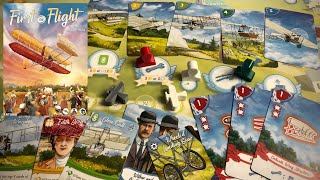
First in Flight Deep Dive
What the Community Thinks About First in Flight
First in Flight arrives as an intriguing push-your-luck deck builder set in the dawn of aviation, letting players embody the Wright Brothers and other early flight pioneers. The game has sparked notably mixed reactions within the board gaming community. Some reviewers find it a thematic delight with clever mechanical layering, while others feel its execution falls short of more refined push-your-luck experiences. The historical setting and deck-building progression resonate strongly with those seeking strategic depth, yet the game's downtime dynamics divide opinion considerably.
Core Mechanics That Define First in Flight
Push-Your-Luck Flight System
At the heart of First in Flight sits a blackjack-style drawing mechanic where players attempt to fly their aircraft as far as possible without drawing four fault cards and busting. You reshuffle your deck, draw cards in sequence, and track your distance on the flight record. The tension comes from deciding when to stop pushing and land safely, knowing that each additional card could send you crashing. What distinguishes this from simpler push-your-luck games is that successful flights lock in your best distance for the game, creating moments of genuine accomplishment when you land safely and set a new personal record.
Deck Building and Engine Development
Between flights, players visit various action spaces on the time track to acquire and upgrade cards. You spend money to add improved flight cards, purchase character upgrades that provide special abilities, and repair major faults in your workshop before they sabotage future flights. This deck refinement loop creates satisfying moments as you see your carefully constructed deck translate into longer, more reliable flights. The interplay between having the right cards in hand and the randomness of the shuffle creates a dynamic where preparation matters but luck always plays a role.
The First in Flight Experience
Historical Immersion
The game weaves together real aviation history with compelling thematic elements. Players encounter names and accomplishments of actual pioneers from aviation's early days, creating a window into one of humanity's most daring endeavors. Reading through the rulebook or character abilities reminds players of the genuine risks these pioneers took, grounding the mechanical systems in historical context. This thematic layer elevates what could be a dry engine-building experience into something that feels like celebrating human achievement.
Tension and Risk Management
Every flight decision carries weight. Do you test your aircraft early in the round, potentially fixing problems before the critical late-game moment? Or do you prepare meticulously, hoping the flight action appears late and gives you one final chance to establish your longest distance? The game's push-your-luck core generates moments of genuine tension, especially when you draw the third fault card and must decide whether this next card will be the fourth that grounds your aircraft forever or a safe flight card that extends your record.
What Makes First in Flight Stand Out
The Time Track's Dual Purpose
Rather than having all players act simultaneously, the one-way time track creates natural pacing incentives. Moving far ahead on the track lets you grab the next flight action before opponents can, but it also means you sit idle longer while they take their turns. This clever tension between efficiency and downtime management rewards both strategic thinking and social awareness. Players who understand the pace of the table can make informed decisions about how far to jump, turning what could be a simple racing mechanic into a nuanced strategic element.
Workshop Repair Mechanism
Major faults don't simply disappear from your deck, they get lodged in your workshop until you spend resources to repair them. This system prevents downward spirals where bad luck compounds catastrophically, while still penalizing careless flight attempts. Unlike games where misfortune is purely random, the workshop lets skilled players mitigate damage and plan recoveries. It reflects the historical reality of iterative aircraft design, where failures became lessons rather than permanent obstacles.
Potential Drawbacks
Downtime During Flight Actions
The single-player flight mechanic creates extended periods where other players have nothing to do. While one person draws cards, manipulates their deck, reshuffles, and tracks distance, everyone else watches. With special character abilities and card interactions, a flight can become quite lengthy, particularly if a player is methodical in their approach. This contrasts sharply with simultaneous push-your-luck games like Quacks of Quedlinburg, where everyone engages in the core tension simultaneously. The downtime grows more pronounced at higher player counts, making the game feel better suited to two or three players.
Imbalanced Card Economics
Some upgradeable cards appear significantly stronger than others despite having identical costs. This creates situations where optimal play becomes obvious, removing interesting choice points. Players who understand these power differentials will always prioritize certain upgrades, leaving less desirable options unpicked. A more carefully balanced economic system where stronger abilities commanded higher prices would have created more strategic nuance and made each upgrade decision feel genuinely consequential.
If You Enjoy First in Flight
Consider exploring Quacks of Quedlinburg for simultaneous push-your-luck that keeps everyone engaged throughout. Heat offers similar deck evolution in a racing context with even tighter systems. Living Forest provides push-your-luck mechanics married to set collection and tableau building. For those who love the historical theme combined with game design, Coliseum offers a best-flight-only scoring system that rewards building toward peak performance moments. Finally, Wingspan delivers similar educational historical content with satisfying engine-building, though in a very different mechanical space.
What Reviewers Are Saying
"The deck building mechanic is particularly enjoyable, as adding new flight cards to my deck allowed me to reach new heights and distances. The inclusion of development cards is a nice touch. Having the right combination can truly be a game-changer, helping players go the long distance. I appreciate how the game publisher weaves educational elements into their titles, and First in Flight is no exception. The historical theme is fantastic, featuring characters that played significant roles in early aviation."
— Board Games With B7
"The time track system is generally something I enjoy in board gaming and I think this game does a reasonably good job of giving you the incentive to go further because what I normally don't like in time track games is when everybody's going along at a snail's pace visiting every single action. In this one the flight actions are not that common on the board, so you're incentivized to jump really far to get to it or to stop other players from getting another flight."
— Chairman of the Board
"I think the one thing that this does that differentiates itself from some of the other games is that you turn around and go back the other way. I really like that this core thing that you're building up to is a choice as to when you do it because you're trying to do it early in the round and have time to repair and upgrade from when things didn't go well, or do you build up the entire round and wait until near the end hoping a flight action is available."
— Stonemaier Games