Kinfire Delve: Scorn's Stockade (review)
Games in This Video
1 game is featured in this video — it unlocks as you watch.
Transcript
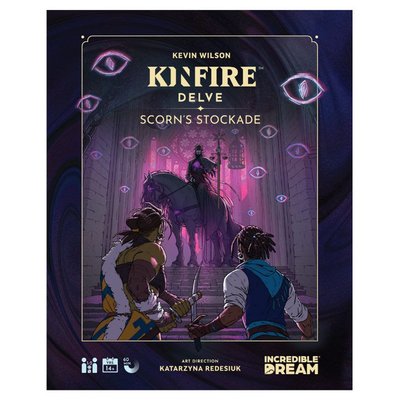
Hey folks, welcome back to the dungeon dive. Daniel here. I hope you're doing well and if you're not, I hope you are soon. Okay, on today's video, we are taking a look at Kinfire Delve, Scorn Stade, and this is a game that is uh designed by Kevin Wilson with art design by Katarina Reduceek. I believe that's how they say their name or maybe I just butchered it. I am sorry, but I wanted to really call that out because one of the best things about this game is the art design and the quality of the components, especially when you consider the price. These games can be picked up on Amazon for about $25.
And there are three different versions of these small Kinfire Delve uh games. Now, of course, there is the Kinfire Chronicles, I believe it's called. That's kind of like the big boss battler. I have that game, but I still have yet to play it. And uh these little delve games are pretty interesting. Uh they are very very challenging. Uh this game, if you just buy one set, you can play solo or with two players. If you buy multiple sets, you can play up to four players by combining the different heroes from the different sets. And then you can choose a boss. You can choose a delve that you want to go on. So this says, "How deep will you delve? You are seekers sent to vanquish the malevolent entity Scorn." So Scorn is the main uh bad guy that you are trying to kill at the end of this dive into this deep well, this kind of hellish well where all of these traps and obstacles and monsters are. survive an onslaught of illusions and mind games to reach Scorn's final gauntlet and banish their spirit back to the beyond, a tactical and cooperative card game for one to two players. So, in the last video on the dungeon dive, we took a look at Legends of Expedition: The Crumbling Pyramid, and that was a thematic dice game.
Kinfire Delve is a thematic card game where you are trying you're basically playing a card game trying to match suits using different powers on your suits to overcome uh these different challenges. But man, the component quality in this game is just amazing. Even the box, the box is really sturdy. This is one of the sturdiest boxes. I love this box. It's nice and small. This is a great small game, a pretty good travel game. Uh just very, very high quality. You get some tokens that you will use to keep track of your progress because each of the challenges that you're trying to overcome needs a certain number of progress tokens added to it before you can remove it. You will get a small rule book. Now on BG there is an FAQ and uh some questions and some Marada. So I do recommend reading that because it does answer some questions that I don't think are answered very well in the rule book. And the font in the rule book is very, very tiny, but hey, it's a small box game with a small rule book, so that's kind of to be expected. You will get four of these custom D6, and you will use those to add successes to your challenges. You will get a D10, and this is used to represent your health. Now, what's interesting in this game is that all of the players share the same health pool. And so, that is one of the things that kind of balances the game for different player counts. So, you will start that with 10.
And then you will get these absolutely gorgeous cards. Some of the nicest cards that I have ever seen in a card game. Uh these are the well cards. And man, these cards are so high quality. just really really nice. But this basically represents the dungeon, the deep well that you are delving into. And you will have to deal with all of the cards in this deck. As you progress deeper into the well, you will discard cards from the top, working your way towards the bottom. Once you reach the bottom, you will fight the boss. As you retreat in the dungeon, you will add cards to your uh well deck. So kind of it does have a good representation of progress, but all of these are different types of challenges. So we have things like traps like this obiet and this trap needs 15 progress. You will play cards that are matching the suit. The suits are colors or for colorblind people. The suits are represented by these little tiny shapes.
I think they could have made the shapes a little bigger just to help with that accessibility, but they did think of that. So, there are basically three different suits. We have blue, green, and red. And your uh your as a player, you will have a hand of cards with different powers that match those colors. But we have traps here. We will have some flavor text that you can read that adds just some spice to the game. It gives you maybe a little feeling of the atmosphere, of the setting, of the theme. And then anything in bold is a rule that is in place while that card is on the table. For instance, this trap here says the value of each action is reduced by one. So every card you play as an action will have its value towards that progress reduced by one. We have things like puzzles. Now, the different types of challenges, those can be made harder or easier depending on the types of actions you take. You might have an action that is really good against puzzles or really good against traps or really good against obstacles or perhaps also really good against combat. So, this is a puzzle, the trial of the heart. It needs seven progress to defeat. When you do defeat it, you can delve seven. So, that would mean removing seven cards from the top of your well deck. If you fail that challenge, then you would take uh on this challenge, you would take a point of damage. On this challenge, if failed, discard your hand and attach this card
to Scorn, the boss that you are trying to kill. And you really don't want to discard your hand. It's very challenging to get more cards in this game. It's kind of also has a resource management style uh system to it where you have to take a a a disability. You have to take an infliction, I should say, an affliction in order to draw more cards in your hand. Some of the powers that the different heroes have will also allow them to draw more cards. And then combat here, this is a pretty beastly dude here with it needs 12 progress. And when this guy comes out, if you fail to do all of that in one turn, then all of the other challenges are flipped over. And then you have to uh focus solely on the living Bastile until you overcome that challenge. So there are a ton of different challenges. There are also events. And events you don't have to pay progress to progress through. You just have to choose when you want to encounter that event. You draw the card, you do what it says, and then you discard it. So, there's a lot of variety in the challenge deck. And again, these cards are just gorgeous. Really, really beautiful. Really great art, good design, good writing, and pretty clear iconography. I think the overall the visual design, the UI in this game is really, really well done. And then we have these four gauntlet cards. These will come out when you get to the final
boss. And when you first face the boss, they are actually immune to all four of the colors. But as you defeat these various gauntlet creatures and and obstacles, then that boss might become vulnerable to one of the suits. This game is damn hard. I mean, super super challenging. I have yet to come anywhere close to winning this game and I kind of doubt I ever will just because I'm usually pretty bad at these kinds of games of of seeing the optimal move. I think maybe this game suffers from a little bit of uh of analysis paralysis for people who like to have those perfect turns. And so I don't know if I would want to play this with four players who are all really good and really suffer from analysis paralysis because there are a lot of really crucial choices, really crucial decisions to be made. But if you like a challenging game, then this might be a game for you. This game also uh travels well and it doesn't take up a lot of table space and it does play really well solo. So these are the affliction cards.
What's the actual name for these cards? I can't remember. Exhausted cards. So, when you want to draw a new hand of cards, your character becomes exhausted. And there are different types of exhaustion that you can get. And if you ever get a set, like for instance, if you have regretful, discarded, and traumatized, you lose the game. And each of the sets has some different mechanisms associated with these exhausted cards. And so, the the different sets do play differently. I have another set coming because I did like this game enough that I wanted two sets so I can kind of mix and match heroes and maybe play with a threeplayer game using some of the heroes from the other sets. And then each set also comes with two heroes or seekers. And once again, just the card design is absolutely gorgeous. Uh these are the bosses. We'll take a look at those in a minute. But you will have your main character card. But just look at that that embossing on the card and the gold leaf and just the cards feel so nice. I again I I just can't overstate how well the design of this game is in terms of the component quality, especially for the price. Just a real a real bargain. But your character will have a special power. So here we have Fang Longstride, the bard of destiny. So that is his power there. Each character will have their own lantern which is kind of an ultimate ability that gets charged up and then you can flip it over and then you can take advantage of that
special ability. And then each of the characters also has a deck of I believe 18 different cards associated with those three suits. Some of the cards are multi-uit cards. So here we have a blue green card here. Another blue green. Here we have a red, blue, and these are all different powers, different actions that you can take on your turn. So, this would be a flank action, which would add one progress. However, each of the cards can also be used to boost other cards that are played. If you're playing solo, you can boost yourself up to twice. If you're playing with other uh players, you can boost their actions up to twice. And the uh the the boost card has to match the suit. And some of the cards also have an additional ability that you can take advantage of if you play that as an action. If you play it for its boost value, you cannot take advantage of that additional action. So that's Fain Long Stride there. And then the other character we get here is a is an orc and that is Nas of the Wind Strikes. She's a tactician. So, there is um the special power for Nas. There is Nas's lantern.
And then here are all of Nas's cards. Again, really, really cool. So, I I do enjoy this game. It's just man, this game is so so challenging for me and I haven't come close to winning. And then we have the three different versions of the boss. So, every time you play the game, you will randomize one of these. The boss is always scorn, but scorn will have different abilities and uh different bonuses. And also from 15 to 25 progress. So we will uh let's randomize that. We will place that scorn aside. We will take our well deck and let's give that a very quick shuffle here. We will discard the top three cards. So we've made a little bit of progress.
Place the well there. We will place scorn in the center of the table. And then we will populate our dungeon with the first floor where as we are trying to go down by drawing four cards and placing those around scorn. So we have obstacle. This is Harmony's Plaza. This will take seven progress in order to defeat this card. When we defeat it, we can delve down three, removing three cards from the top of the well. If we fail to uh add enough progress on a single turn, we will take one point of damage. Also, if failed, suffer three uh damage for every combat in play. So, if we have combat cards, this harmony's plaza will become more dangerous. There are a lot of interactions with the cards, a lot of things that you have to look at to see, okay, so I have this card here and this card here. Those cards interact in a way that makes the challenge more difficult. And then this also says, "Stay out of the plaza, stranger. Its stones are stained with death." So that's the first challenge there. The next one here, we have combat with an empty priest. Empty words come from empty things. If you fail this challenge, fail all other copies of empty priest in play. For every card you cannot discard, suffer three health.
Very deadly. If we fail, we have to discard a card. If we succeed with a seven, we can go down two. We also have a puzzle trial of the heart. What weighs so heavily upon your heart, prisoner, if failed, discard your hand and attach this card to scorn. So scorn will be boosted by cards that get attached to them. That's kind of their main mechanism. If we defeat the trial of the heart, we can delve seven and then if failed, that is the consequence there. And then our final card here is another red card. It's an obstacle. So it's our second obstacle. This is the Pale Cathedral. All cards named Empty Priest gain plus eight to their difficulty. Wow. So this is actually a 15 difficulty. So we definitely want to take care of this pale cathedral before we even think about attempting to overcome the empty priest. This says that only the empty priests leave this place. All right. So if we defeat the pale cathedral, we can go delve five. If we fail to do that, we will take two damage. Okay. So let's play with Nause here. So Nause's power is at the start of each of your turns, I can move one progress from any challenge to another.
So if there was progress here, I can move that to another place. Let's kind of push this off to the side here. Okay, so here is Nausea's lantern. It starts the game unpowered. her ultimate ability. And her ultimate ability is attack the balance. It's an alter fates trick. If completed, attach the challenge you're attempting to this card. Copies of any challenges attached to this card are immediately discarded from play. This is pretty cool. So, let's say that we defeated the Empty Priest using our lantern. That would flip back over, but we would attach the Empty Priest to our lantern. There are multiple copies of a lot of the cards in this well deck. Anytime we run across another empty priest, we can discard that into the discarded wells uh uh pile. It doesn't count as an overcome challenge. We don't get to add it. We don't get to take it away. So, there is a chance where if we retreat, if we add cards back into our well deck, that we will have to come across them again.
But, I think that's really cool. That's a neat power. All right, then we'll shuffle our deck up here. Now, another way that this game balances for multiple players is your starting hand. And as a solo player, you get eight cards in your starting hand. And that's shown on this little table here. Two players, seven cards, three players, six cards, four players, five cards each. So, we'll take our deck. We'll draw our hand of eight. 1 2 3 4 5 6 7 eight. Now, we'll take a look at our cards. And here comes the hard part because, man, there are there's just so much to do. And like I've said before, my brain just doesn't handle these kinds of games very well. I like games where you just kind of move, draw a card, and face the consequences.
But this game here requires very careful consideration of what's on the table, how they interact with each other, how your cards interact with them, how your when you boost a card, how that interacts. So, there's a lot of interactions. There are a lot of intricacies to think about while you're playing this game. And for those of you who like really challenging games and games where you get to think a lot and you kind of pride yourself in putting together cool combos, I think you'll get probably more out of this game than I do. Even though I do enjoy this game. I mean, I enjoyed it enough to order an additional set. And I'll probably be done with Kinfire Delve with just two sets, but I think it's pretty cool. Okay, so we have a red card for a three attack. Discard if you would be reduced to zero health. So this can protect you.
Gives you an extra chance to survive. If you go down to zero health and this card is your in your hand, you can discard it. You can boost a red or blue card for plus one. This is a two power surround plus two. If this action is boosted, this can boost a blue for two. The whites are wild. They can be played on any suit. So this is wind mastery. After this action, you may return this card to your hand by discarding any other cards. You can kind of keep this low, relatively low powered but highly advantageous wild card in your hand. We have tidal force which is a two power. Discard at the start of any turn to redistribute progress between cards. So, that kind of seems to be one of Nas's things that she does is distribute power, distribute progress from one card to another. The Duel of Honor. This card cannot be boosted. It's a green card for four progress. Probe. While this card is on top of your discard pile, any played action gains plus one to their value.
So, you do need to also keep track of what's in your discard for certain powers. Quick thinking. If you fail a puzzle, ignore the penalty. We do have a puzzle here. So, we could apply that to the trial of the heart and we wouldn't have to discard our hand. That's pretty cool. And this as a boost will give you a plus three to a puzzle. And then finally, we have knockout. This is a red card for three progress. Before this action, you may discard a challenge with progress on it. So, if a challenge already has progress, we can just knock it out and discard it. But we don't get to keep that card, removing it from the potential of having to re-encounter it if we retreat. And some of the cards will have retreating for a penalty. And on the back of the rule book, we do have a very handy kind of manifest here of all of the icons. So once you kind of learn the game, basically you'll just be looking at this as reminders.
So uh yeah, let's see. Let's make our first mistake here because I probably am going to pick the most or I definitely won't pick the most u optimum uh play here because I almost never do. But um let's see. We do want to try to take out this pale cathedral before we attempt the empty priest. If failed, suffer a plus three for every combat in play. And we have one combat. So that would be four damage. If we can't do seven damage to that obstacle in one turn, we will have to take four damage. And man, that uh we only start with 10 health. So, that takes us down really quickly. Uh generating I will probably need something that will prevent me from taking damage from an obstacle.
Uh we do have this puzzle here. Let's see. If you fail a puzzle, ignore. So, I'm going to play this for an action. So that is two. So I will add two progress to trial of the heart. And that is actually I can't that's a green. See already I'm already making a mistake. That's a green. That's a red puzzle. So I this is a green or a blue card. So I can't use that. Okay. Well there goes that plan. Yeah. Let's go ahead and do this red knockout. So I will play a red knockout on the Pale Cathedral. That will allow me to place three progress towards that pale cathedral. Do I want to boost it? That is an obstacle. Do I have anything that will help me boost obstacles? No.
Um, I don't think I'll boost. I will keep these cards in my hand. We also forgot my favorite part, the dice. We also get to roll dice that might potentially add more uh progress to this card here. So this is a red card. So we are looking for red and we did get a wild. We got two greens and a blue. So we will get to add one more progress to that. So that is that turn. This goes to my discard pile. Now because we didn't complete this challenge, we have to take the penalty. So we will lose two health going down to eight. But uh as you can see, yeah, this game is really really difficult. I've only made it about three quarters of the way through my well deck. But yeah, like I said, very, very hard and I'm often kind of paralyzed when I'm playing this game because I feel like I'm always making the wrong choice. And knowing when to boost, you know, if you go through all of your cards, you can't draw any other cards into your hand until you take an exhausted card. And if you ever get a set of three of those different exhaustion cards, you lose the game. Uh, one of the cool things with the bard character is the bard character does seem to have quite a few more abilities that will allow them to add cards back into their hand to draw more cards.
But um, all right, let's so let's play another turn here. I probably want to keep going towards this obstacle here. So I think I only have one red card though. I think I will play this three here. So that will allow me to add three to that. So now we are at 3 4 5 6 7. So if we can roll three reds or maybe that that wild and we Oh, just barely. Okay, so we've got that that. So we can add two more. Now, I could have boosted that card with something, maybe using that wild. If I chose to boost it, then we would have added another. So, that would have overcome that challenge. Then, we could remove this, removing it from the game, adding it to our tableau as an overcome challenge, and then we would add an additional card. Additionally, we would get to delve down five. So, one, two, three, four, five. And so, that's basically how the game plays. It is.
Yeah, like I said, I have a very, very difficult time playing it, but I have greatly enjoyed my time with it. And I think a lot of that enjoyment does come from the small box, does come from the well-designed box, which holds everything very nicely. It's a very sturdy box. The cards are gorgeous. The art is gorgeous. The design of everything is really nice. I like the flavor text. I like the way the different ways that these cards uh work together to make things much more difficult for you. There is some luck involved, especially with uh when you roll those dice. Sometimes this uh d6 here will have the wild sign and the wild symbol that will add bonuses for you. And it'll also have this darkness symbol and that will often make things really bad. And also for scorn, each time you choose not to play an action, you have to roll one of these uh roll this wild dice. If you roll the black symbol, then you have to also take an exhaustion. And so that is another very very quick way you can lose. It's very difficult to gain health back in this game. The opportunities to heal are incredibly rare. Your health ticks down very, very quickly. And yeah, so if you guys have any tips on how to be really good at this game, uh, I probably just have to be a lot better at games to be good at this game. I can imagine
somebody who's really good at analyzing all of the possibilities and looking at at each turn in an optimal manner will do much, much better than I am in this game. But I can recommend this game, especially if you're looking for something small, you're looking for something that doesn't take a long time, a good travel game, you're looking for something with good art design and good components, and you want something that is affordable, and that is something that is increasingly rare these days. If you don't like games that are overly challenging, and you don't want to feel like you're constantly getting beat up on every turn, this may not be a game for you. But hey, Kevin Wilson, he seems to like those kinds of games. I mean, Arkham Horror Second Edition, anyone?
So, all right. I hope you enjoyed taking a look at Kinfire Delve Scorn Stockade. We will talk to you later. Bye-bye.