





Kinfire Delve: Scorn's Stockade Deep Dive
What the Community Thinks About Kinfire Delve: Scorn's Stockade
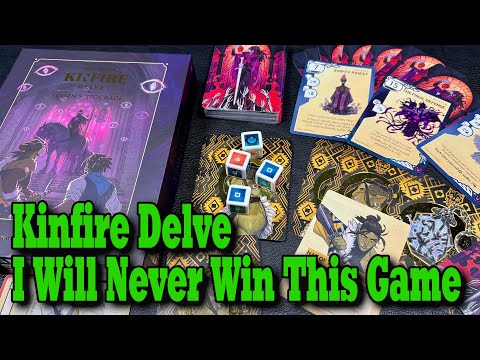
Reviewers describe Kinfire Delve: Scorn's Stockade as a compact, demanding cooperative card game that delivers far more production quality than its modest price suggests. The Stockade is the purple-box entry in a small-box series designed by Kevin Wilson, and the one-to-two player game asks a group to delve through a hellish well and finally confront Scorn at the bottom. Daniel of Dungeon Dive opens with the component quality and calls the game very challenging, with a win still out of reach. Tabletop Yogi, in a first-impressions roundup of nine new games, praises the dice mitigation and the cooperative boosting. Monique of Before You Play walks through a full two-player session and shows how quickly a run can swing between near-collapse and a lucky, unexpectedly clean kill.
Core Mechanics That Define Kinfire Delve: Scorn's Stockade
Color-Matched Hands and Cooperative Boosting
Every challenge in the well is tied to one of three suits, shown as colors and as small shapes that help colorblind players. Daniel explains that a seeker's hand holds action cards in those suits, and that white cards are wild and can be played on any suit. Each action can be strengthened by other seekers playing their own cards as boosts, up to two per action when playing with a partner, although the boost must match the suit. Monique notes that boosting is optional and often a poor trade early in a run, because a boost card is usually weaker than the same card played as an action. Tabletop Yogi singles out this interplay as the feature they love most, since a card played for a teammate can turn a failed challenge into a success.
Dice Mitigation and Push-Your-Luck Rolls
Resolution happens through four custom six-sided dice, three of which add progress when they match the challenge's suit, while the fourth shows a light or dark face. Tabletop Yogi compares the system to the dice in Ghost Stories, where a base power sets the expected outcome and a few extra dice nudge the result either way. Monique describes the dark face as always bad, and Daniel notes that it can make things really bad, while a wild symbol can help a roll. Monique's session shows the risk clearly, with the team needing one more success on a roll and landing it at the last moment. Tabletop Yogi describes the outcome as a little push-your-luck and risk-reward layer that suits the game's difficulty and creates memorable moments.
The Kinfire Delve: Scorn's Stockade Experience
Cooperative Table Talk Under Pressure
Monique's playthrough makes the cooperative nature of the game feel active. The partners discuss who should go first, whether a card should be boosted or saved, and which challenge is worth attacking before a dangerous one is revealed. Monique describes the game as fully cooperative so that players can talk through everything in their hands, and that openness turns each turn into a shared puzzle. The conversation also reveals how much each choice affects the other player, since a boost given away can be the difference between a clean finish and a costly failure. Reviewers who enjoy group decisions tend to find this the most rewarding part of the experience.
A Shrinking Well and the Dread of Exhaustion
The tension steadily rises as the well thins out. Monique remarks on how low the well is getting and how the cards keep pressing on the players, while Daniel says their health ticks down very quickly. Running out of cards forces an exhaustion draw, and the exhaustion cards can end the game when certain combinations appear together. Monique's team drew two such cards that could each end the game when combined with a card already in play, and they had to plan around that risk. Reviewers describe this dread as a constant companion that keeps every decision feeling heavy.
What Makes Kinfire Delve: Scorn's Stockade Stand Out
Component Quality That Punches Above Its Price
Daniel is emphatic that the production is the first thing to praise. The box is described as one of the sturdiest in the collection, the well cards are called some of the nicest cards they have ever seen in a card game, and the hero cards feature embossing and gold leaf. Daniel points out that the game can be found for roughly $25 and calls it a real bargain, especially for a title with this level of art and iconography. Daniel also praises the clarity of the icons and the overall user interface, which keeps the heavy text readable in play.
A Small Footprint With Strong Solo and Travel Play
Tabletop Yogi notes that the game is built from little more than a deck of cards and a few dice, which keeps setup and teardown minimal compared with many modern dungeon crawlers. Daniel reports that the game travels well, takes up little table space, and plays especially well solo. Players who buy a second set can mix heroes across boxes to reach three or four players, which Daniel presents as a practical benefit of the series. Reviewers who want a challenging game they can carry easily will find this compact design a major attraction.
Potential Drawbacks
Relentless Difficulty and Analysis Paralysis
All three reviewers describe the game as challenging, and Daniel is the most blunt about it. Daniel calls it very, very challenging and admits to having yet to come anywhere close to winning, partly because they struggle to find the optimal move. Daniel also suggests that the game can induce analysis paralysis for players who want the perfect turn, and that a table of four strong, decision-heavy players may find the wait painful. Daniel also describes feeling paralyzed mid-turn because the choice always seems wrong. Players who dislike being beaten up every round are likely to find the game frustrating.
A Tiny Rulebook Font and Rare Healing
Daniel points out that the rulebook font is very, very tiny, although the reviewer accepts that a small-box game with a small rulebook is to be expected. They recommend checking the online FAQ, which answers questions the rulebook leaves unclear. Healing is another frequent complaint, as Daniel states that opportunities to recover health are incredibly rare, so the starting health pool of ten is easily spent. Monique's session echoes this, with the team losing health repeatedly over a few turns as failed challenges stacked up.
If You Enjoy Kinfire Delve: Scorn's Stockade
Daniel draws the most direct comparison to the other titles in the series, especially Kinfire Chronicles, which Daniel describes as the bigger boss battler and which the reviewer owns but has not yet played. Tabletop Yogi's dice comparison points to Ghost Stories for players who enjoy a base power modified by a few extra dice. Daniel jokes that the designer seems to favor hard games, pointing to Arkham Horror Second Edition as the obvious reference point for players who appreciate thematic, hard-edged cooperative challenges. Legends of Expedition: The Crumbling Pyramid, which Daniel covers as a thematic dice game in an earlier video, is a further option for players who want a cooperative theme driven by dice. Taken together, reviewers suggest that Kinfire Delve is best for groups who relish tough decisions, cooperative planning, and a game that rewards careful combos.
What Reviewers Are Saying
"Some of the nicest cards that I have ever seen in a card game."
— Daniel of Dungeon Dive
"So there is a little bit of push your luck, risk reward in there that I think plays really nicely with how challenging the game is and makes for some really fun moments."
— Tabletop Yogi
"The penalty here is not too bad. You just delve back upwards, you basically take a card from the discard back on top, so it's not, you don't lose any health."
— Before You Play