Lightning Train Board Game Review
Games in This Video
1 game is featured in this video — it unlocks as you watch.
Transcript
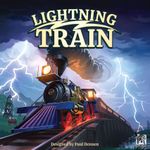
Miniature Market has thousands of board games at discounted prices. Click the direct link below to see all those discounted games. Hello my friends. Today it's all about the lightning. But no, not the lightning in the sky. We're talking about lightning on the ground because we're also talking about trains going across the country railto rail delivering things at different stations in different cities. We're talking about lightning train. This is from Direwolf. This is a bagu train game designed by Paul Denon, the same one that did Clank, uh, Doom Imperium and things like that. And Wild Tiled West, his most underrated game. So, let me show you at a very high level the main concepts of the game, and I'll tell you what I think on the other side.
Now, this is a baguild train game, and each player is going to have their own company like Continental Rudagga. You're going to have your board and each round you're going to be drawing chits out of a bag because it's a bag builder. You have some that are starting out and these are your options during your turn to be able to do what you want to do. Now, the borders of the United States with different regions like Midwest, Southwest, South. And the game starts with a semi- random setup with some stations at different places that want certain goods and certain goods laid out everywhere. Also, almost each round, cards are going to come out at the beginning of round that's going to add goods to different places like some oil in Calgary. Now, let's say this was actually our first poll. And you can do many different things on your turn. This is lightning train, the name of the game. Every time you pull one of those, you get a train from your supply and place it here that you're on the lightning that you're able to use that you must use this round. So, I've already used this. I'll have some money we can spend later. We'll talk about, but I also have three trains that I'm going to be able to possibly use this round. And I have a contract in the northeast or sort of the the Atlantic area there. One of the things you can do is build stations. There's too large and too small available every round. Let's say I wanted to build this one. And let's say I wanted to build it in uh you know just out inside of Boston here. So I would place it just like this, but it costs two trains in order to build that.
So essentially I would take two of my trains. I would use them for a build station action that you can only do once per turn. They're kind of used there. They'll move off the board at the end of the turn, but this is sort of tracking what I have left to use. Now in order to build anything like a station or rails, you need to have a contract for that area. And so this one was northeast. It's colorized. as it says northeast or the Atlantic region. So, I use this contract in order to do that. If I didn't have that, um, you can get sort of a wild contract. If I had extra trains here, I could put two here and secure a contract. This is like a using a wild contract for one round. So, if you don't draw the right contract, you can use trains, but it's very punishing in a currency way. Now, because I have this contract that allowed you to build a station, and if you can, you can also build uh a some trains. And I do have one left thanks to my lightning train. And when you build trains, you could got you have to start either at a city that has one of the suns on the east or come from one of your uh stations or connect to one of your other rails. Now, when building from a station, you actually get one free train. So, this one would actually come from my supply, not from the board that I had just sort of almost took from. Now, normally in order to deliver, you would have need to have had a chit that you pulled with a delivery icon on it. But everyone starts with a couple of these or certain amount of these depending on where you are in player order. That is like a one-time use. I can deliver. So, let's show you how something delivers. So, the they want passengers here. Here it is.
They're going to deliver here. They're going to deliver it. And everything can only get delivered once each game uh to each spot like that. So, that is delivered. Those passengers cannot be delivered to Boston anymore. This game, it got a point for each segment. So, purple gets a point and purple gets a point here because it was delivered to their thing. You're not always using your own trains. You can be using anyone's trains, but anything that goes over, those players are getting points for sections of trains and stations. So, I got two points there, and you're getting points up on things like this on the score track. Now, as you move up on the score track, you're going to be able to unlock extra abilities, extra chits, get extra action cards, and things like that as your points go up. And so now, there'll still be one passenger here left, but it can't go to boss. It's going to have to go somewhere else. Now, when building rails like this one, you'd have to actually have two to place here. You can't just build it halfway. Some of these need tunnels, which means you need to use explosives to get through there.
And sometimes when you build trains, you'll get points. Like this one has two. You'll get two points for building this entire line. One for this one, for example, and things like that. So most of your points going be from making trains, putting trains down, and making deliveries. Now, since that was from a station, I got to use a free train. I still have one left, but I can't really do a whole lot with it. You can put it in line storage. This means I can use this for another train uh section later for future. Um, and so I've used the contract. Now, this is a starting contract, so it's a special one. Actually gets discarded if I use it, but I have three money to spend. Now, there's always six chits available to buy. There's they start out at certain spots depending on what they are. And things get like money and deliveries or uh having a Southwest contract and a conductor. Conductors, they get you uh some locomotives when you get them, but if you get two conductors, you actually get a lightning train. So, it's a way to get more trains. Sometimes they give you money in deliveries or lightning trains and deliveries or conductors and points and or two lightning trains, all different things. And as you buy these, they get refilled right away. And so, it shows you the cost of these. This is the sort of bag building aspect of this.
Now, the pieces that you use that weren't getting trashed, like that starter contract goes to your warehouse. And when you you'll pull from your bag, and if you don't have enough, then you'll pull from your warehouse and put them in your bag like a normal bag builder would be. Now, also, as you're drawing tokens, I told you that conductors get you locomotives. They act as normal trains, but they also have a plus sign. Many tokens that you'll buy will have plus signs, and they don't fill up your five spot. They actually give you some extra spots. So, sometimes you can have more than five, up to seven by default. However, if you end up putting two trains here during an action, you get to flip this to industrialize. Now, you have a requirement of having two stations out in the board when you do this. But now you've got more. If you have lots of chits with pluses, this gives you more that you could pull per turn. If you end up putting three trains here after having two stations, you can go public. And now when you make a deliver, every time you you have a delivery, you get a lightning train. Anytime you generate seven income, you get two points. This is how you get the explosions to go into the tunnels. Also gives you an additional rail build. We've talked about the wild secure contract. And as you go up on that score track until you can unlock other chits, these are more powerful ones. I call power chips. They go into your warehouse and they eventually cycle back in your bag. They give you money and different things like deliveries, wild contracts, conductors, uh, and you know, doing the tunnels.
Now, as you put out stations, you're using these cubes. And again, as you do that, you'll be getting different things like action cards and, uh, trashing things and possibly getting points. Everyone starts with two mogul cards. These sometimes are goals like hey at the end of the game if you have a certain amount of uh connected cities in the certain region you'll get a certain amount of points or sometimes they're upgrades like if you have four stations then you'll get a lightning train each turn. There's also action cards you can get and they do all sorts of different things like hey this can act as a rubber stamp just like a a wild contract throughout the game. You just use it once once you know one time and it's gone. Or sometimes they do things like hey take a chip from the market that costs three or less and put it right into your bag. Now, one of the main aspects of this game is player interaction. Because let's say the green player had built these trains in this station, and they want to do a delivery. They can. They can deliver this last passenger. It's going to go through this, through this, and through this.
Now, it went through purple's thing, so they'll get a point. It went through green, so they'll get one point. And it went to a green station, so green's going to get two points, and purple is going to get one point. So, sometimes you're going to be giving points to your opponents in order to get points for yourself. And so, the player interaction and doing things like that is a big part of the game. And you'll continue doing this, building your bag, building your engine, taking actions, and you'll be doing this for a maximum of 12 rounds, or if faster, the transcontinental railroad is made from New York uh city to San Francisco, and you'll play one more round in that case. And tell her things up by doing some final deliveries and things like that. Whoever has the most points in the end is the winner. All right. Yeah, that was just a very highlevel sort of conceptual overview of the different concepts in the game. There's a lot more little rules going on in the game. I didn't cover and procedures and such, but I want to give you an idea of what the game was like.
Now, this game made my top 10 most anticipated games for Gen Con. So, let's talk about what I liked about it and then things that didn't hit me quite as well as I was hoping. Uh, the Lightning Train, first of all, player interaction is what this is about. This is a train game. You're going to be going around making rails, but using other players rails and lines to deliver things. It it it adds a lot of player interaction. You saw that example I showed at the end where it's like, hey, I'm going to get two points. You're going to get one point. It's probably worth it for me to do that maybe because I want to deliver that thing right then, right now. It also, you know, it's maybe moves me up on the track to get something unlocked from my board from the from the scoring spot that I'll be on and things like that. So, that that plays into it as well. There's also a lot of interactions that you'll learn after playing the game multiple times that you can, you know, if someone has a decently long line and they've been setting up to make a long delivery that might score them five points, maybe even more. Well, you can make a station that's clo that's pretty close and attached to that same good and deliver it. Maybe you only get one point, maybe you only get two points, but maybe you get one point and even the person that had the long train gets one point. But guess what? that good since they can only be delivered once per game to that station. Well, that that good's gone and maybe there maybe that was the last good from that spot and maybe now they're not even going to be able to deliver it from the big thing. So, sometimes you're trying to do things and you help with other players possibly to stop other players from making lawn deliveries. So, there's a lot of the player interaction here is is is the best part of the game, I believe. Not
necessarily even the bag building aspect. However, people love baguilders, you know, here's another one that does things differently. I like that you can place trains on your board for future planning. I don't have enough trains this turn. I can store one train. Great. Store train there. And I could use it for only building trains. Okay. U but you could also place uh you know things on like to build a station, but you don't have to build this round. Maybe you put two trains there, but you need three, right? So you can do that in a future round. I like that you have an option to do that. We'll talk more about storage and and and and things like that a little bit later, but I do like that you have options to plan a little bit ahead for things that you want to do given the resources that you're given that round. I like the mogul cards give you endgame strategies, uh sometimes ongoing benefits. Those are really powerful cards and you can actually get some more of those as the game goes off.
You go up high enough on that score track. Uh I like that you're getting bonuses at those different thresholds on the score track like getting the action cards or the uh your power chips uh and things like that. that's going to let let you build things up as you score points. It sort of like entices you to go out there and score little points here and there at the beginning of the game uh to move up the track to unlock other things as opposed to just trying to make this one huge thing before you do anything before you get any points. So, I like that kind of keeps the game moving from a p uh you know scoring perspective there. I like that the game has a randomized setup. There's I didn't show this in the in the thing, but I told you had a semi- random setup. There's a bunch of different cards. You select one, it tells you where the starting stations are. the starting goods start everywhere, but then every round the you're getting new goods out that come in different orders every game. And three of those cards don't get used every game. So that's going to be different. Some some places that get that that have a spot on the board that going to get goods might not get goods that turn. It happened in my in my first play. I was building in the southwest. I was building a rail. I was hoping to get some I had a station for oil and there was a spa space near there that was supposed to produce oil, but it never came up that game. So you can't you can't always plan for things to come.
This game is has some long-term strategy, but it also is very tactical. You a lot of times are going to have to do the best thing you can right now with that turn with what you've drawn from that bag right then. And it might not be the plan that you've wanted. Uh, and that might not be great for people. If you like to plan things out and have your plan come to fruition and plan three turns ahead and boom, I got everything lined up. This isn't really that game. This is a game where you can try to plan for things, but you're at the mercy of what you pull that round from your bag. And then you basically have to go, well, let's make lemon out of lemonade. this wasn't the pull I was hoping. Uh, let me do something else. You need to be able to pivot your strategies in this game from turn to turn. If you don't like doing that, this might not be the game for you. I like that the uh that the the the even though the goods might come out in may or may not come out uh on on the board that they do come out in different orders.
Again, you can try to plan, but it's mostly tactical. So, let me talk about some of the things that I I may or may not that you may or may not like about it. Things that I personally didn't like. Now, I want to preface this by saying that I am the type of player that when I play a a game that that you're using resources and such, I don't necessarily like super tight resource management aspects. I like to have things a little bit more plentiful, have lots of options, I can do many different things, but what thing do I want to do? What thing will I do next? I don't typically like games where I'm feeling like, "Oh my gosh, this game is so tight resource." Some players love that. Some players love tight resource games. If you like games that are very tight on resources, very tight on on what you can do on a turn and and and and and possibly not being able to plan a couple turns ahead, then this might be the game for you. Now, that game can be punishing for new players because if you don't focus on getting more trains with the lightning train or conductor icons, you're going to find yourself being short of trains. And the trains run everything in this game. You're they're used to put on the board. They're used to pay for stations. They're used to you get those ones back, the ones for the stations, but you know, your most coveted resource are trains. And every time you build them, you now have less in your bag. So, you have to continually be building yourself out trains if you want to do anything well in this game.
Uh, and if you don't know that in your first turn, you're going to be thin on trains and your engine's never really going to get going until the very, very end. It's going to be frustrating. So, new players, focus on lightning trains, focus on conductors, focus on building up a lot of trains. that's going to give you all the options and then fine-tune those with contracts and deliveries and things like that. So, it can be punishing to new players. Um, for me, the biggest issue personally that I have with the game was I felt it was restrictive with not really able to store things for future use. Sure, you can store one train on your on your board that you can use uh later to build a rail with. You can't do it for any other actions. It can just be build a rail. That's good. I like that. However, I found that often times I would pull almost everything I needed to do what I wanted to do that I had planned. You know, my my big plan I wanted to do this. I've been working on this. I pull these things. I've got the trains maybe, but maybe I don't have the contract.
Well, you can use two trains to secure a contract. Yeah, but if I use those, then I won't have enough trains to build. Well, you could have used two trains before and put them on the secure contract space and then this train you would. That's right. But who has that many trains floating around if they haven't actually already used to get points to move up the track to get their engine building? So you are trying to use them and build as you're getting them. So I felt that without having a spot I wish there was like a little spot on the board or on a little mini board that allowed you to store one or two even just one or two chits that you pulled out of that bag that you you pulled that turn that you did not want to use that turn. You could store them to use them on a future turn for whatever action you want to use them for. that would have opened up the game, I think, so much. Now, again, the design was probably supposed to try to make it really tight. I personally feeling I didn't like it. And that's why I say if you're a person that likes really tight resources that gets down to the nitty-gritty, you might like that. For me, I didn't, especially with the randomness of pulling from the bag, you never know what you're going to get.
You're hoping for the best. And often I found myself being like one chit short of what I needed to do. I had the contract, but I didn't have the trains. Or I had the trains, but I didn't have the contract. I didn't have enough trains to do the contract and the train with the with the wild contract. Um, I had not I was one train short of just, you know, being able to build the the station. And again, I could have put trains there on previous turns to help plan for this, but that means I wouldn't have had I have less trains. That train is stuck there. And that's the other part of this is like if you put a train on secure contract, you can't get those trains back off unless you take that action. So now I have to go build something using that contract. I can't just be like, h, I don't want to use those. Let me just push in my warehouse. They're stuck. That was very punishing. It can be very punishing for you to know that you and you have no options of not using your trains. If you have trains that you have not used, you must put them somewhere on your board. Now, there's some places that you have requirements like I might not have two stations. I don't have to put it there.
But if I have two stations built and I have an extra train and I don't really want to use it this round. I'd love to store it and I already have my storage my one storage spot full. I have to put it somewhere and I can't get that back until I use that action. I found myself in one game getting stuck that way where I had it I was forced to put them on a on a secure contract. I later pulled the contract that I needed but now I didn't have the trains because they were stuck there. It can be frustrating. Um I felt also that the getting the engine going uh happens but it it happens like too close towards the end of the game and then the game ends. Like I've bu I've spent the whole game building this engine. I got like what I got. I've got like one or two turns left. Also the two-player game requires dummy players. So this game is absolutely best with three or four players. So, if you see on the box that it's one to four, it's really a three or four play if you want to play with all humans. Now, with all this being said, if you like baguilders or you like train games, I think this is an interesting thing you should you should at least try because if you like train games, you haven't played a lot of baguilders, it's going to make you think in a different way. If you've played baguilders, but you're not huge into train games, this is going to make you think in bag building in a different way. Um, and again, if you like tight resource management, if you don't mind randomness of pulls and not being able to plan and and if you like the aspect of, hey, I'm just going to deal with I get deal with I drew this turn and I have to just figure out what the best thing is to do here, maybe I can try to plan for ahead, but resources are going to be tight. If you like that, then I think this is going to be the game for you. Like for me personally, I like things to be a little bit more plentiful, have more options and have more different ways that I can go as opposed to feeling as restricted as I
did. So overall, there's a lot of unique things. I think you should at least definitely check it out if you like bag building or train building uh or train games. This has been the Game Boy Geek breaking down barriers, growing relationship through board games, helping you find the next one you love. Game Toppers upgrades every game you play being the one table to rule them all with game toppers, leg kits, dining covers, premium game mats, and more. In their 5.0 Kickstarter, they found a way to deflate prices to prepandemic levels without sacrificing their quality brand and in some cases by $200, plus dropping the shipping price as much as 50%, saving another $100. Go to gametoerslc.com to late pledge now.