All about the interaction! - Ayar Board Game Review
Games in This Video
1 game is featured in this video — it unlocks as you watch.
Transcript
Hello everyone. This is Johannes
and this is Cinema
and you are watching Board Gaming Ramblings
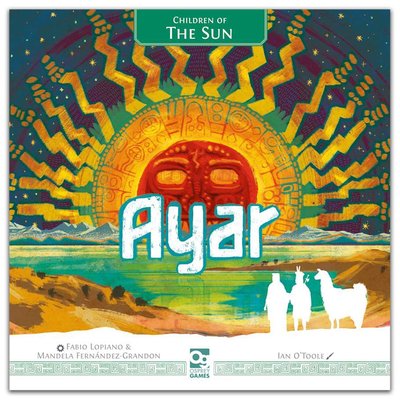
and today we are taking a look at Ayara Children of the Sun.
We are this is an upcoming spiel release and it was sent to us from the publisher. So thank you so much for that. If you are going to Spiel, we are also going to spiel and we would love to see you there. If you do see us then give us the secret sign. And if you want to make sure to find us, we will be at the Allian Apora and Shilia Fox area on Saturday from 10 to 14 and on Sunday from 13 to 17. So come around and say hi to us. That would be amazing. But today it's going to be all about IR. This is kind of the third game in the trilogy. It is a trilogy of games from Fabiano and the two last one also uh from the other person. I don't remember the name. He is called Mandela Fernandez Grandon. Yes, thank you. There's so many names. I don't remember them all. But we enjoyed the both of the two first. MV and Sor.
This one is different.
I will say that this is a very unique game in many ways and we're going to talk about it. First, we're going to do a little overview which looks something like this. In this game, you're going to move on tracks, but they're not your own tracks. It's four tracks that looks like this. They have different colors on them. And on my turn, what I'm going to do is that I'm going to place one of these. In this example, I just place everything. But let's just say I place this person down here. I'm going to move the purple track once. Most of the time when you're playing a four-player game, you're going to move once and there's two places where you move twice because there's two arrows. After I've done that, I'm going to take a house from that row or column that I just placed in, placing it on one of the actions that are available behind the person on the track. Then I'm going to do that action. The actions are very simple. One of them lets you move these, which are mice, which is corn, but they're making it look like the same word as almost a Norwegian one. And you get to place it out here, which helps you in different ways. Basically, it helps you to get points because in this game, you want to get two different kind of points. You're going to basically thematically you're appeasing two different gods, the night god and the sun god and the moon god, I'm thinking.
And the sun god is giving you points on this track which you're going to score every single round. So, if you get three points on this track in the first round, that is going to be 12 points because there's four rounds in the game. And the uh moon points are going to be instant points. At the end of the game, you're going to get win or get the points you have are the track you have or the points you have the least of. Kind of in a Ronicia-ish way, but in a in a more dense way than usually it is in those kind of games. So, the actions are very simple. Removing things here to uncover suns that might give you sun points or moons that might give you moon points. Nothing just gives you point in this game. You can get pottery by taking pots in different colors and you try to get many pots to get sun points and you try to get the same color to get more moon points. You can do weavery which is basically a very simple tile laying puzzle. I'm saying puzzle tile laying thing. You place the tiles and you try to fill in these columns to possibly score night points and to match up distance to possibly score points. And the last action is moving up here on this track, which then lets you build out these hoses, which will give you possible ways to get some points and possible ways to get moon points.
We're not going to go very deeply into it, but basically the two main ways of getting these kind of points is when these move on a track over here, for example, this set tells you that you're going to score sun for the boats. So everybody playing in the game, everybody who's playing, not somebody just looking at it. Everyone who's playing is looking at how many suns they have and they move off on this sun track. And that is going to happen then it's going to flip around. It's going to be a bit harder to get the llama bonus. And if another one manage to get there, they will also score that for everyone. The moon you're scoring mostly by getting temples, which you get by placing out the quadrant of houses. And also at the end of each round, one of these tracks are going to go out of the game. So let's say we are at the end of the round right now. I can see that the purple track is the track that has been removed the least on. So the purple is getting out of the game.
And then at the end of the round, this purple piece doesn't really help you anymore. So you're going to choose one of your moon scorings to score for that. That is also when you will score the temples. If you have placed a temple over there, this feels like wingspan because every round you're getting fewer and fewer actions to do. In the beginning, you think a game is going to be very long and then it's suddenly very short because every round you have less actions to do. And at the end of the game, there's only going to be one track left. At the end of that round, that one last one is also going to retire out of the game. And the player who has the most points is the winner. You can use this law mouse h depending on this track up here or like on this conversion to move on the two tracks to try to make them as close as possible so that you get the most points as possible. That was a bit of a convoluted and long overview, but this game is kind of weird. So, I wanted to make sure that you hopefully understand a little bit about it before we talk about the game.
Do you want to talk about the game? Yeah,
let's do it.
Um because the actions that you do are actually very simple. Yes.
Um or Yes. It's basically I have this amount of power. Yes.
I want to do that action where I place my house. It has this symbol. I take whatever I can afford with those points and I put it there and I don't get anything really. I I I make myself able to get something later. It's very very simple. What is interesting about this game is how the the game unfolds when people interact with each other. And I must say also that it's a theme that I enjoy. I I really like the Incan um I don't know lore, history, culture. And I thought I haven't seen that. Most games um is like about Aztecs or like in some other groups. I thought it was cool to have like an inking theme for a game.
Mhm. There is really not a lot to say about the actions in the game. As you said, they're very simple and very straightforward. What there is to say about is these two kind of points and especially the timing of it because I can focus on something because it's like this kind of games. I get better when I do things. It's not not the same action, but then I do like the same kind of thing. I get better and better. So, I want to make my best actions count. And the thing is that sometimes in the game, I will look at these and I will see, okay, the next two scorings are probably going to be pottery, for example, and I haven't done anything in pottery. And let's just say that's over here. And I know now
that corn or mice is going to be soon scored probably two times before this round ends. I haven't done anything in that category. Then I have to think is that worth it just to get a few sun points in the beginning of the game. It's going to be probably yes. So the timing of that let's say I manage to to get do like a double double that action and this goes up. I maybe get two and then this goes up and maybe I got all the way to three and I even then get two llamas for those two actions. So even though that wasn't kind of my plan to do it is a way that gets me a lot of points. And what I mean to say is that without interaction,
this game is kind of nothing.
Yeah.
Because what we do like we play a lot of games where there is a system
and the things around them or like the actions are there just to make the system make sense. I don't think I ever played a game where that is more true than here.
Yeah, I agree. And also what you said, it's more to look at the the scorings that are nearest. So you'll be like, "Okay, I probably this is going to be scored pretty fast, so I'm going to focus here first." But the tension in how because each round each of these are going to vanish and you have a kind of a say in which it does. Oh yeah.
So you kind of want to um push for the tracks that has scorings that you can see, okay, I want to focus there. Then this piece needs to stay in the game so it can get to that scoring. So I can do that and to see if people are heavily working against your plan because that can happen is a little nailbiting sometimes.
Yeah. Because
I play this game two players. You play this game two players
and it works like it functions.
It's not you manage to play from the beginning to the end and you do things.
We played it one time two player and I played it another time two player with another person. After that, I was like, there's no reason to play this game two player. And there really isn't because what you're doing, and this is I'm going to I'm going to say this, but don't like quote me on this. What you're doing is not that interesting. Like what you're doing, the actions you're doing, this is what is interesting. Moving on this track, the timing of it and and then trying to move the specific uh track when you trigger your tempo because you have to place it on that. And maybe I'm thinking I'm actually going for this. then I want that to not go out. Like for example, last time we played, I think that you gave me a lot of extra points. Thank you. Not on purpose, but because you hadn't played the game like that many times to see all the nuances. You had a choice between moving this purple and moving this this brown. And basically, I already had a temple on the brown track, which was
the thing I was obviously going for. So, if you had scored that, then it would have been a problem for me. It ended up not being a problem because I end up not doing that thing any else in the rest of the game. But that was not imposs possible for you to see. So a lot of these interactions is is the game. And compared to Sankor, for example, this is a pretty I'm going to say it's it's it's a lighter game. It's not I'm going to say compared to Sangor, it's a pretty light game.
Yeah. And compared to Sou, it's also a very much more tactical game. You can have like a plan for, for example, you said, okay, I'm going heavy for this category in the game. I'm going heavy for, for example, moving on this uh water track and you're placing out a temple and you don't want to score it yet, for example. And that's the thing about this game. You want to save kind of the things that you're doing for lost because you're scoring a category each night for getting the moon points. So, you know that in some category, you might also score pretty poorly. So you can either like try and even it out or try to do like a crazy good scoring at the end of the game. And but mostly what I find cool with this game is the tactical decisions between like okay
you moved there now. Usually it looks the way we set up here. This is set up for like a two-player game. Well, let's say usually when you're playing for example a four player game, it will look like for example this.
I will move them to directions.
Yes, please. Thank you. And you see that already there is pretty limited possibilities for which actions you could do. So sometimes I want to move this for example. Yeah.
H I want to place it here because then I get the power I need. Then I also get to move the blue two spaces. But wait a minute, I don't want to do any of these actions. I want to do something else. So, it's not that you have like the freedom to do whatever you want. You are limited what possibility is actually on the track that you want to move on.
There are also some special abilities you can unlock throughout the game when you get these little mask tokens. When you get the mask tokens, you will place them on one of the nine different abilities. And when you have enough of them, which is marked on the side here, you will flip one of them around to say that you've got that. Some of them are instant. All of these are getting better at these actions and some of them are pretty good. Some of them feel like they are a very good late game. For example, this one where you will get like a bunch of sun points if you work for that. But if you get this one pretty early, which gives you another sun point every time you get a sun point, you will play differently because you will try to get a few points here and there to just ramp those points up. I will say that the variability of this game is not super high, but it's one of those games where the interaction is what makes the game.
So, you need four people, I will say, to play this game the best way it's meant to play it. It It makes it the tightest. It makes it the most interesting and also makes like the everything you do make more sense than if you play with less players. So, who do you think is going to like IR?
Um, I think if you like these tactical decisions and also you have to be okay with changing plans. That's tactical decisions. I just said the same thing over again. And also like tactical things.
Yeah. And and it can be a um not a direct conflict game, but I can be like, "Oh, you're going for without scoring. I'm going to score that before you do the next thing that you're about to do." And it's a game that I think is most fun when you play it kind of that way. But you have to be fine with somebody doing something that completely ruins your tactical plan. So to turn things upside down, I'm going to start doing the final thoughts today just because I felt like it if it's okay with you.
Of course,
your is very unique. I think that that is its biggest strength. I think that I have never played a game like this where you're basically betting on these four tracks and trying to manipulate them in a way that is the best for you. And when things go sour, you need to be able to pivot and be able to do other things. And because these are not linked to actions, the actions is what are available. It's not super hard to pivot as well because doing if you did a couple of things with this one action, but now you can do a power four action and and an action you haven't done before, you are suddenly not that behind on that action anyways. I enjoy this. the things I'm doing in the game. If it wasn't for this, I already said it wouldn't be anything because doing this, placing these here and placing them adjacent to each other, not very interesting. Moving on this track, placing these out, not very interesting.
Moving cubes from here over here,
it's a majority over there.
Very interesting. I love that. and and placing things over here like none of that is is is is interesting but because of playing it with the interaction the tension makes it for the timing of which thing should I do now what should I do after that for me I would not play this at two I would not recommend getting this if you are playing at two three is good four is what makes this game this game because the interaction is the game the the the timing as you said the the the the not the conflict, but the oh, you're going for that. Let's see if I can do something with that that is good for me, but also not making it better for you. That is what the game is. With that said, I don't love it, but I do enjoy it and I I I really appreciate it for doing something this completely different.
That is my main positive about this game. I'm going to land on a 7.5. I think it's a good game. I am happy to keep it because it's doing things as I already said very differently and that I appreciate it for and would love to play it more for that reason.
I agree. I think uh you made some great points. I can say I just agree with you. But I also want to add that I really enjoy this puzzle. It reminds me of the puzzle from Marv. And I really enjoy that. Sometimes I have placed a a um token in a space where I want to do more stuff later. So then I the next thing I have to do is move that guy away and then I can do what I what I had planned. And sometimes that makes the board shift and I didn't have the opportunities that I thought I would have when it was my turn again. Sometimes I'm be like, "Oh, I really need to do that action before that scores. I don't have time or possibility to do it right now. I hope that it isn't scored before it's my turn." Oh, yes, it was. Okay. Usually goes like that. And also enjoy that it's a game that where you don't really see who's winning until the very end because you have these two um point trackers that you are trying to balance and also you have the llamas that you can use to um what you call it. Yeah, just the points at the end because they can be either the sun or the moon. And I agree with you. It's very unique and very interactive, but as you said, the action in itself is it's just there basically.
I'm going to give it a seven. I think it's a good game.
And that's going to be the end. We hope to see you at a spiel. If you go in there, give us the secret sign. And thank you for watching. If you haven't yet, you can
subscribe
because it's
fun
and free.
Yay. See you soon. Thank you so much for watching. I'm Johannes and you've been watching Board Gaming Ramblings. And bye-bye.