Timber Town - 2-Player Beaver Battle at Gen Con!
Games in This Video
1 game is featured in this video — it unlocks as you watch.
Transcript
We have a special treat at the table today. And it's not just this game that we're playing. This game is a great game.
Timber called Timbertown. Um, but we have Emily here.
Hi.
Welcome back, Emily. If you watch the channel, you're like, "Wait a minute. What is Emily back?" Well, she is back for Gen Con.
For Gen Con.
This is of course part of our Road to Gen Con or at least while we're at Gen Con coverage. And we are talking about Timbertown. We did include this. Ryan and I talked about this in our most anticipated list.
Um, admittedly, he and I didn't know much about the game. He had uh seen it or heard about it, so we put it on the list. It looked intriguing. What we didn't know until we got it just today is that it's a two-player game.
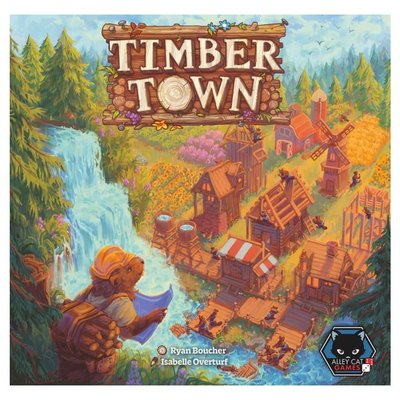
Head-to-head. And it's for for a very specific reason. Just to give you an overview, Timbertown is kind of like uh River Valley Glass Works in in that things are moving down this sort of river and you're taking them as you can, but these aren't gems that you're collecting. These are these little sort of village tiles that you're taking.
The interesting thing in here is that the way you're set up, you're meant to play this across from each other. We played it like this, but we've got the boards associated such that it would work. There's these little slivers of river tiles. There's four of them. And you're going to fill those with tiles. And when you take a tile on your turn, the column from which you take it has to go in the column on your board. So if I took in this first column, it's got to go in my first column. So that makes it really unique. Now, there are some ways to break those rules. That's effectively what you're doing on your turn is simply taking one of those tiles. And there are some free actions you can take. and it's mainly about the tile placement. And then the second thing is also going to be the boardwalks, right? So you also need to make sure that all the boardwalks are connecting in a legal way to another boardwalk. So it's like, is it in the right column, and is it the right boardwalk? And then from there, you're thinking about, okay, there are seven different ways these different types of tiles are going to score. So how can I place it in that way that it will score, the ones next to it will score, and in the end, I'll be happy and won't mess anything up.
Yeah, there aren't seven different scoring cards that we have out now. We're using the ones they recommend for the be, you know, first time you play, but there's a whole bunch of different scoring cards and my assumption is you can probably shuffle up each deck and you take one of each color that's associated with the different tiles that you're going to get. So, each game can be different. Um, certainly different combinations. There's probably I don't know what the math is behind that, but there's going to be a lot of different combinations of scoring. There's also these little tokens that can come into play when you take a tile. Some of them will come with a to a token like there's a crane token, there are beaver tokens, there's a dam. Uh and then there's these little rafts and everyone starts each player starts with their own raft. But these rafts are twocolored depending on who takes them. You can use these to do a number of different little things mostly associated with the bonus actions, the free actions that you can take. Or you can use them like Emily was saying, you need those boardwalks to match up. Well, you can scuttle one of these. And what that means is that you can take a tile and place it somewhat illegally using one of those construction pieces in between the tiles as though there is a boardwalk there.
Right. The other big thing that the rafts are going to let you do is so on your turn you're either taking a tile or you're using a raft to reserve a tile which is cool because as this river comes down like I take I reserve it here and I'm thinking to myself I actually don't want this tile until it gets to the very end. But if I reserve it now, I can plan ahead there. And then once it gets to the end, I can use a free action to just take it and put it where I want it knowing that I will have it and David will not have stolen it from me.
Yeah, that's one of the ways you can get around some of those rules. Um, it's not really breaking rule, but like Emily said, it's sort of calling your shots and waiting for it to come down the river. On the flip side, for instance, you can use those cranes and take one of the tiles and place it in any column, but you're discarding the crane to do so. So, there's a lot of little things you can do. The beavers are going to come with certain tiles, and the beavers, at least in our game, wanted to be able to make it away, make their way across the board. So, they needed to get from one end of town to the other end of town,
all the way to the right, connected by boardwalks. I think you were the only one that had a beaver.
I had a beaver. He was able to make it across town. He took a little bit of a circuitous route.
Do tell. What does that word mean? This is an inside joke. Uh, if you know what? We're not going to tell you, but if you genuinely know what circuitous means, let us know in the comments below.
In the comments below,
it's a little poll that we'll take and then depending on the results, we will roast Ryan, who happens to think that circuitous is a quote very common word. Anyway, we digress. It's been a while since Emily and I have caught up. So, you're tuning in partly to see this game, but also tuning in just to see an Emily and I catch up. Uh, but that is effectively what you're doing. You're doing this until everyone has filled their board. The first player to fill their board, and you can get out of sync based on some of the things we just talked about. The first player is going to get this fivepoint guy. It's another little beaver with a hard hat on. So, they're going to get an extra five points. And then the other player will just continue to play the game until they filled their board. And then you score up according to all the cards. Comes with this nice little scoring pad.
I don't think we need to talk about today's score.
Ours was so close. So close. You'll never guess how it turned out.
So, there are one, two, three, I don't know how many categories here. I'm just going to tell you one of the categories. I scored 30 points and she scored zero.
At that point, it was kind of close and I was like,
had a lot of confidence
when that happened. I was like, I feel pretty good. Um, but the end score was 77 to 75, which again, I feel I feel pretty good. It's nice when you can do this where you build a whole town and you're like, "Oh, wow. It was really back and forth. It was really close." And I like the fact, too, that these cards, there are different ones for it. So, we could play it again and do whole different ones and be like, it feel very different as a game.
Yeah, it's a really, really clever little game. I think it's going to feel uh if you're into tile placement, you'll like it. The big twist, well, it is two players, but the big twist is the way those tiles come out. The way they kind of like get, you know, if they come off the end of the board, they're taken out of the game. So you got to get them while they last. And the other interesting thing is when you fill this board to begin with, you only fill the first column. So in that first round,
you're taking from that column and putting in your first column or reserving, which I think is what you did.
I did reserve.
Um, so there's some interesting twists to the formula, but this is a very chill sort of game. This would be sort of the perfect game. And we said this about a couple other Gen Con releases,
playing with your partner over coffee,
you can just knock this out. All you're doing is taking one of these tiles and putting it back at the top
and you probably won't hate each other by the end. So,
no, I don't think you'll hate each other too much. I mean, I hate Emily. Two points worth of hate.
Um, if we tied, that would have been nice. I don't know if there's a tiebreaker. We'll have to check that out. I'll put it in the comments below. And speaking of which, if you have any questions about the game, please put those in the comments below. We'll get down there and answer whatever we can. Until next time, make sure everyone has fun at the ta table. And say hi to Emily, too, in the comments. and we'll see you then.