My City First Impressions | What Did We Think (and How Does it Rank with Other Knizia Games?)
Games in This Video
1 game is featured in this video — it unlocks as you watch.
Transcript
hey everyone dylan here from aycb i'm carlo and today we're going to be giving you our first impressions on my city now this is a little bit of a different format normally it's just one of us on camera and we're just kind of speaking to you we thought we'd change it up and this time we don't have a full review for you yet uh that's something that's gonna be forthcoming i'll have for you as soon as we play through the entire legacy component uh but for now we thought we would just get on camera the two of us and have a conversation and let you guys be a part of it and kind of give you what we think of the game so far how how it's playing for us and uh and just bringing into that conversation with us we're gonna be trying some more of these videos going forward so hopefully you guys enjoy it let us know in the comments if you do if you have any other suggestions we're completely open to it this is our first time delving into this so yeah my city um this uh this was a game that obviously i'm a huge reiner kenichi fan i know carlo you are too um and you know i have i have lost cities which is a huge favorite of mine um and el dorado which is another really big favorite of mine so i had a lot of high hopes coming into this one just from the name uh the the designer alone um but the fact that it's a legacy a legacy game um and with sort of i don't want to say simple like simplistic i don't want to downplay i want to just be like this is a super simplistic game but it's it's a very it's not like you're going into pandemic legacy where it's this overarching story and all these different aspects and things it's just bare bones concept that sort of built itself as you go which i think is so interesting it's it's we had we had a discussion we were sort of um debating you know how did they how
did they come up with the idea of this what was it was it the full game is what you end up with and they came up with that first and then they deconstructed it into all the chapters so it's like they took their full concept deconstructed it down to the very bare bones and had that be where you start or did they come up with the the bare bones concept first and say how can we how can we take it one step further how can we take it one step further um and we talked about that a lot just because that alone is is super interesting um to think how how they crafted it but um i don't know i don't know how you felt uh about it i'll let you speak to that but like my first impressions on this having you know played the i think we played 10 10 scenarios 10 out of the 24. 10 out of 24 um there's it's spread across uh i don't know how many chapters is it seven chapters eight chapters spread across eight chapters carla's gonna be my my fact checker i'm just gonna constantly be double checking with them uh so eight chapters and there's multiple games in each chapter um so we've played through 10 of them which is almost half so again we're about halfway through to giving our full review because we want to play everything my first impressions are i cannot anytime i think about playing a board game it's the first thing in my mind that i want to go back to now that we're like right in the middle of this i find it super super fun super super intriguing the i'm a huge uh fan of polyaminos as it is i know we both are we have tons of different games like patchwork and spring meadow um and isle of cats you have as well that have this aspect so i think we're a big fan of that as it is um but the way that my city does it is so simple but you're always
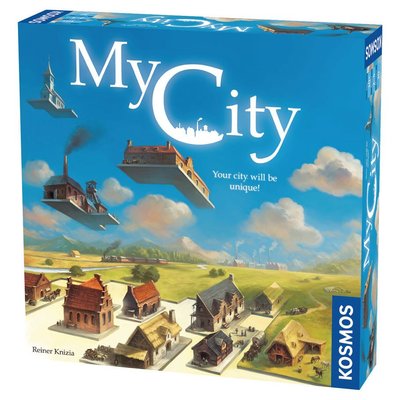
you're always i don't even know the best way to describe it it's it's simple and yet there's so much depth there in terms of what you can do what you can accomplish and how would you decide well it feels like any of the reiner kinica games i've played which is where it's really simple rule set your kind of maybe just a couple pages of rules once you learn the rules you'll probably never forget them again but every game it's like every single decision you make feels like there's a lot of weight to it i still even knowing kind of the pedigree he has for those types of games i still didn't know what to expect i'm still expecting something a little lighter because it is basically i don't know if it's necessarily build this way but i've heard it you know before we got it sounded kind of like a gateway or family style legacy game a way to have like you know it kind of comes at the perfect time with uh with cobit obviously there's a lot of people kind of just being able to play games just at home with their family um so i was expecting something that was maybe gonna be more on the accessible side but maybe on the lighter side than we'd like especially when you like i saw these pictures online it's just a board with these yellow red and blue polyamino shaped pieces and it just looked so simple and bare but it was like okay so it's his first polyamido game and his first legacy game and i kept hoping like i hope it's not one of those ones where i just feel like i'm being you know strung along for for the ride to like well what's gonna happen later in the legacy but not enjoying it as much but like for us in this like from the very first game i i loved it um totally caught me off guard one of the things i want to talk about is the fact that it's it kind of has an aspect that reminds
you of kind of a roll and right game where so because the way the game works is essentially each player has a board you're going to be flipping there's a deck of of cards that basically um at the start of a return you'll flip a card and both players will take that tile from their reserve and place it on their board somewhere so each player has the same 24 tiles i think it is right there's three colors and eight of each so it's the same eight tiles in three different colors but there's only one of each of these cards in the deck so we're playing simultaneously we flip over the same card we both have to place the same tile i remember at first we're looking at each other's boards to be like was that the best place for mine why did he place his there okay whatever and you know after a few turns you start seeing the boards kind of diverge from themselves and i i going back to the the roll and right comparison i was making in a roll and right you're rolling the dice doing something you might get the same result it's totally luck-based you can't really expect what numbers you're going to roll throughout the whole game but because of this you have the deck you know exactly which 24 cards are in there and how many of each type of tile there is right so you can kind of plan a little bit more because it's not like you're going to get the same tile over and over once you've used it once you know okay i only have two of those same shapes left and now they're in different colors yeah because you you know without spoiling much but there's like you know different rewards for matching up colors or where you put stuff together so um i just like that aspect of the kind of there's a bit of the randomness of not knowing what order they're coming up in but you can still set a long-term plan because ultimately you know what you're dealing with and let's say you use all three of your same shape tile you know you don't have any
more of those left or if you're leaving spaces you're looking at okay i've got how many that can even fit in there later so i just really like that aspect of being able to plan ahead yeah and i should mention as well uh obviously with this being a legacy game there are spoiler elements we won't get into any that we might allude to or touch on some things that if you're really looking to go in 100 blind um keep in mind you might get little hints we're not going to blatantly say oh in chapter four we you unlock this so don't worry we're not going to spoil anything for you one thing i would want to mention is the first time we played i don't know if you had this feeling as well um the the concept is very simple like carlo's saying so you're you're literally flipping over a card and it is saying place this tile and both players are placed in the same tile on their board and i remember thinking you know it's in that way almost similar to kind of second chance where you flip over you flip over i think two options in that one and you can draw one right but it felt like it was even more strict than that i i remember thinking you know where's the where's the variety going to come from like what are we we are both playing the exact same thing where there's no divergences we could end up just playing like it seemed like there was barely anything to go off and i remember thinking okay i know i'm i'm not going to worry it's a random kenitsu game i'm going to get drawn in by something i just have to understand what it is and you definitely do it's definitely not like it's that simple to start but it really is just the foundation of what this game has to offer that it's introducing to you and then it's really just opening the doors wide for you to explore all kinds of things um but i think that's what's so genius about it is the games that
tend to draw me in or be super successful in joining me and and remain in my collection long term and i want to keep playing are the ones that can take such a simple concept in terms of teaching it in terms of learning um the game in terms of um you know just execution getting a game done in 15 minutes whatever but there's the entire other layer that you either learn right from the start or you learn through multiple plays that all of a sudden there's tons of strategy and now you can you can you know pull off that amazing move that just really swings the game and stuff like that like that all exists here but you're gonna be able to sit down and basically learn how to play and even play a game all within an hour easily you know and after the first play you're gonna be game through games sometimes in 20 to 30 minutes and i think that that's the thing that caught my attention like that's what made us want to keep playing every time we've sat down to play this i mean how many games have we played like two separate sessions the first session it was obviously learning the game the first time we got through four scenarios i think and then the next time we played six in the span of like maybe two hours yeah so it feels like for a legacy game i mean i've only played as far as other legacy games go would be i guess gloomhaven and charterstone before this i know you've played right pandemic uh season one or legacy season one as well as tainted grail yeah there might be might be some others but of the ones i've played this definitely feels like the least amount of time of like of any legacy game i've played where like the least amount of time spent doing setup or reading rules or that kind of thing it's like you finish one you know one game and then it's like unless you're starting a new chapter it's basically just like okay what's the
new scoring condition for this game okay take the clear the pieces shuffle the deck we're ready to play again yeah and even the chapter it's like you open an envelope read a couple maybe new rules or something that's going to happen for those three scenarios but overall it really feels like it keeps moving surprisingly quick for for a legacy game and that's definitely one of the most impressive things about it yeah and the fact that it you know like the the tiles come in three different colors like carlo mentioned with the exact same shapes for each color and you'll start off and it they have different names like you know one one represents residential one represents commercial things like that um but it doesn't really come into play at the start and again without spoiling anything everything eventually matters the colors of the tiles matter the the items that are on the boards matter you're going to be sticking things on to your boards to change you're allowed to now make your board uniquely different than your opponents which means you guys are tackling things a little bit differently so that's where the genius comes in it takes this very this very simple concept um and it just elaborates on it it says okay you understand that we'll now understand that in this framework oh and you think you understand that well now here's a rule that's going to apply for three games only that's going to drastically change the way you think about it and then we'll get you back to what you're like it's just that's the genius of it is not only do you not know what to expect with the whole legacy element but never it never really feels like the things that's thrown at you are just for the sake of like oh let's surprise them with legacy it feels like every chapter we are in it almost could have each one could have been its individual an individual game if the game if the game had been released just as chapter two it would have felt like a complete game
if it had been released just as chapter four it would have felt like a complete game absolutely right and i think that that's what i like so much about it is that nothing feels tacked on nothing feels like it's there just as a gimmick it feels like these are all legitimate gameplay elements that are just changing your understanding of the the rules of the game right i also like it's not i have a question for you after that comes after this but basically i like how it's not that you're the game's not getting more complex every time it's not just like oh now there's a new rule that we're adding like it's changing scoring conditions or sometimes it's even simplified like we've had one without spoiling anything again it just made it a shorter simpler game where we didn't use many tiles and it almost felt like a step back in a way but it was cool to have that because it made you second guess the way you played the la or not second guess but you kind of had a pattern of the last two three games maybe of amping up and taking up more and more space on the board and now suddenly there's this wrench thrown in where we're only using a certain part of the board or something where suddenly there's a restriction it didn't just feel like here's a new rule to add on here's a new rule to add on it kind of sometimes felt like it was restricting us and making us play it completely differently yeah and what i want to ask you about that is so out of the 10 scenarios we've played do you think that you've enjoyed all 10 of them individually like if they were like you said like this is a game chapter one it's on its own set of rules if they're boxed in the store as ten separate games right or expansions or whatever exactly do you look back on them and think like well i don't know if i'd play those ones again or did you think they were all good is there one specifically without saying what it was but yeah are there ones that stand out or does it feel like
they're ten there hasn't been any i've disliked which i think is is a testament to what we what my i'll speak for myself what i think of the game so far is that i haven't i haven't disliked any of them sure there's been ones that i enjoyed more and i think i noticed that more is not like oh that one was worse i've noticed it more as this one was so much fun but even the ones that i remember thinking and again i'm going to be careful in how i say this i don't spoil it but even the one i remember thinking the one that ended up making the game a lot shorter i remember thinking as we were starting this is going to make it less interesting or these ones might feel not as interesting to me at face value that's something i remember thinking going into but like i was optimistic and positive but i remember afterwards thinking that was almost the most interesting yeah because it it was so restrictive compared to what i was used to and it ended up being more fun trying to work within those restrictions and all of a sudden a lot of strategies you were it's hard to it's hard to be careful not to spoil things yeah yeah we should have picked a game that we didn't have to have to be careful with anything um but i remember thinking that like the way i had built my strategy and i'll say this and i'm going to allude to something but i'm hopefully not giving anything away but the game functions at the start that basically you can expect to get through every single card in the deck or pretty much every card in the deck so part of your strategy can be at some point this shape is going to come up and at some point i'm going to fit that shape into this spot i'm leaving open
at some point when the game restricts itself that strategy doesn't work anymore and all of a sudden there's a very good chance you are not going to get through the whole deck and so now your strategy of saying i'm going to leave this gap open becomes a gamble of should i leave it open and bank on that piece coming up and potentially lose a bunch of points by leaving this empty or do i find some other way and then you know kick myself when that shape does come up later and that added that is what made those games so interesting right what i thought was going to be restrictive and take away a lot of the fun by how much they were restricting us ended up being something that just was the exact curveball i think we needed at that point after having played you know six games with it a certain way um and i'm excited with still having 12 games left what other curveballs are coming that are going to subvert that formula and just really make us look at this board it's it's you're looking at a board and a rule set and having to change your strategy something we haven't touched on yet that we should um just because it's such a key part of the game i we kind of both overlooked it but is the the aspect of the scoring in each scenario basically so and this isn't a spoiler because this is a rule that's in the very first one and it goes on at least for the first 10 we've played but you basically start with 10 points at the beginning of the scenario and anytime if you don't want to place the tile that comes up in the deck of cards you can basically lose a point and set that tile aside meaning you won't get to place it for the rest of the game but you're not out of the game if at any point you don't want to lose a point or you can't
build anything anymore you're out and you're basically done building so the other player can keep going so when dylan was talking about that restriction of basically playing with rules that maybe don't allow you to place all your pieces or something sometimes you're trying to make that decision of is it worth placing this like you have some big awkward shaped piece you can place it early on you have tons of room on your board but you think is it worth it maybe i'll just lose a point and stay more flexible for later but we've had games both of us where we like lose a point lose a point lose another point and then we're like maybe we should have placed those ones before like what are we doing here yeah and it's that that tough decision of where do you want to sacrifice something to hold off for something else that may or may not come up and even even thinking like yeah if i sacrifice a point i might get that tile but if that tile's not one of the next three or four that i draw then that lost point was for nothing and i might not even get the one i need anyways and i might be out before i get to play so it's like every decision you try to make feels like there's a rabbit hole you can go down of like but if i do this and then that but then i got these ones left so it's just always again for just a board with some polyamino shapes it looks so simple but like just that little thing with the scoring and sacrificing your points and the shifted rules every time makes it yeah i i just so impressed with what it does with so little totally um so we're going to wrap this up because obviously we're going to have a full review coming but before we do um i'm going to just put you on the spot and put myself in the spot as well obviously we're not going to give a score for this yet this is our first impressions i'll have that on the full review but just based on what you've played so far um where do you think it would rank in your out of the kenichi games that
you've played where do you think would rank i'll just say is it one of the great canizia games is it a good canadian game or is it an okay canadian game if you had to put it into those three categories yeah let's let's keep it simple because we got to save some for the room okay okay okay well if you want to tell me it's your favorite ninja game of all time you can throw that out there too but no it's definitely not my favorite of all time but again there's there's so many of his sort of highly acclaimed classics that i haven't played i would definitely still put it in the probably in the higher category but even maybe in the medium one just because of some of those like lost cities is so good and and battle line and blue lagoon which i got recently which i've been loving but um honestly considering it's his first polyamino and legs i'd put it in the higher category it's definitely one of the better but it wouldn't be the best kanitsu game i've played but it's definitely one yeah i agree it's not it's not my favorite kunitsu game but it's definitely in the in definitely my top three i'll put it that way um from what i've played so far um i haven't played all of this obviously and i'm sure that if i had this would be a lot tougher for me to decide but you know i love games like el dorado um and lost cities um i think both of us love those two games a lot so those are definitely in there but this one for me is just one that like i cannot stop thinking about in terms of you know i love polyamo polyamino games i love the simplistic games that that extra layer of strategic depth um this hits all the right notes for me um so that's that's my tease for the review is it's gonna be a good review it's just a matter of after playing the last 12 hopefully it can keep up the momentum yeah hopefully it doesn't fizzle yeah we don't want to we don't want to have 10 great games then you know 12 that just go downhill which i don't think we're going to get but we do have to play them all before we
review it um so yeah those are our early impressions on my city i hope you enjoyed them hope you enjoyed the format um if you liked this video give it a like give it a subscribe let us know what you think about the formula we're gonna we're gonna be doing a lot more of these conversational pieces and just us kind of talking more and then bringing up that side for you guys so let us know what you think and if you have any feedback leave it in the comments otherwise thank you so much for watching and we will see you next time thanks take care you