Gutenberg Review - Chairman of the Board
Games in This Video
1 game is featured in this video — it unlocks as you watch.
Transcript
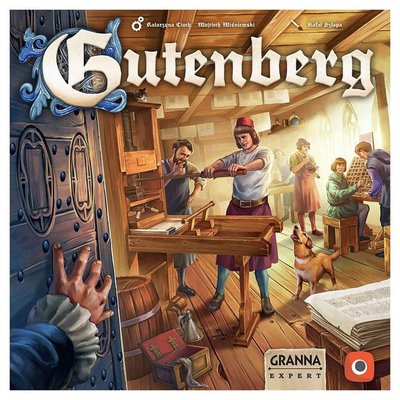
Hi everyone, today I'm taking a look at Gutenberg, which is a Euro strategy board game released in 2021 by Granna. This one takes around 90 minutes to play and accommodates one to four players. Before I get into my review of Gutenberg, I want to give a shout out to the show's sponsor, keyenda.co.uk. If you buy board games and you live in the UK, then Keyenda is definitely the place to go. And if you use my discount code in the show notes, you can get 5% off your first order. But let's get into Gutenberg. So the main board for Gutenberg is going to look like this once it's set up. And essentially this board is divided up into five different rows, all of which represent a different aspect of the game. So you have the contracts part at the top here, then you have the inks, then you have the specialty cards, then you have these gears, and finally you have these patronage cards at the bottom. Of course, this isn't going to mean anything to you at the moment, but I'll explain the relevance shortly.
You're also going to have all these spare cards and gears ready to be used to replenish the board later. You have a bag which is where the inks are stored, where you again use to replenish from. And more importantly, you have your own personal player board, which is going to look a bit like this. We have the option to store up to three gears at any time. You have a track here, or four different tracks, all depicting a different specialty. So you've got like your chisels here, you've got your your leather work and stuff. And you're going to be using these to monitor how far you've climbed up in each of those specialties. And you also have a little kind of bonus track here as well. And we can get little bonuses as you climb these other tracks. You can store four contracts at any time, which is represented by these little notches in your player board. And you're going to have a number of different sundry things such as these used gear tokens. You've got a spare cube here, which can be used on the main board. And you're going to have a number of these black cubes depending on the player order. And your little programming board here, which is a big mechanism in the game. And then you've got your other bits and bobs such as money, and these types, which are these very nice little wooden printing pieces.
And then you got your like again your money and spare types and even a player screen, um but I won't be using the player screen because um obviously I don't need it for this video. Each game of Gutenberg is going to play out over six rounds, and by the end of those six round the player with the most victory points, of course, will be the winner. The first thing you do every single round, apart from the first one, is to rotate any gears that you have on your board. So, you might have more than others. You have the capacity to keep up to three. Um but again, the first thing you do is you're going to rotate it as the arrow suggests into the next third of each gear, which will by default rotate all the other ones as well. And that what that will mean is that that's going to change the bonus actions you can take um throughout the round cuz you can basically activate these anytime by placing one of these used markers on it, which might give you a little boon as you go. After that's done, you are going to go into the programming phase, where you are going to allocate all these different cubes that you get given at the start of the round uh onto the different actions that you can take. And if you place more cubes than your opponent, and bearing in mind this is all done secretly and simultaneously behind an action screen, then um you are going to break the tie.
So, let's just say let's without thinking too much here, I put all these different cubes like this. Um bearing in mind that I might really want a specific contract, so I go quite heavily on that one. Um and maybe I also really want a gear, so I go really heavy on this one. But I am not so fussed about doing a patronage, so I don't put anything on that one. So, once everyone's happy with what they've programmed, they're going to reveal it simultaneously, and then you're going to go through all the different phases of the round. So, starting with the top and working down, you're going to basically resolve them. Now, if you ever program the exact same as somebody else on a region, then that is going to get broken or determined in player order. So, the first thing you're programming is the ability to take one of these contracts. And these contracts actually come in two parts. You have the basic part here, which is basically all you need is these certain types in order to fulfill it. So you can see here I need an A and an I, one of these pieces.
And if I did that by the end of the round when it comes to the contract fulfillment part, you're going to get the reward at the bottom. So you can see here you get a number of different money depending on how difficult that is to achieve. But also you come with these embellishment cards, which are basically an improved version of the basic contract. So let's just say for example I ended up taking these two cards. And once you take them they're going to get locked in with each other for the rest of the game. But what that means is that if I ended up doing this contract here, but also cashing a blue ink and a yellow ink, I'd get an additional four points. And if I did that at the same time I had a level six on my ink track, then I'd get another another four points. And if I did all of them together, I'd get an additional two money on top of that. So again, you have these two different tiers or even three different tiers on what you want to do.
You can do the basic level, the basic level with one embellishment, or the basic level with two embellishments to get the additional reward. Once the contracts have been taken, you're going to go into the inks phase. And in this section you are going to claim one of these three or four different segments depending on the player count, and um take a number of inks from that segment. So let's just say I really wanted a red ink, I might say I'll take this one here. Now the first one is going to be free, but anyone after that you have to start paying for. So you can end up taking all three of them for three money, or maybe you can just take two of them for one money. However, you cannot jump the queue, so I can't go straight in and buy this one for two. I have to do them in order. Now if somebody else who goes after me in the ink phase, they can also follow by taking the same section, but of course they'll only be able to start from where I left off. The next phase is the specialty phase, and where you're going to claim one of these specialty cards and climb up the corresponding amount on your player board. So let's just say I broke the tie, I went really heavy on one of these, so I ended up taking these chisel um specialty, then I'd climb up twice on that um on that chisel track like so.
Now, whenever you your first um specialty reaches a certain level, as you can see here, as soon as I reach level two, I will move this one up to the next one and take an ink of my choice from the bag. The same applies when it goes to level four. When it goes to level five, you can take a free contract. And when it goes to level six, you can take a type of your choice. Additionally, at the end of the game, depending on how high you climb up these tracks, you can get a bonus amount of victory points. The next phase is the ability to take these gears and add them onto your player board. So, you can either put them in an empty space or you can replace an existing one. So, let's just say, for example, I ended up taking uh let's say this one here. I put it on my player board any way I like. Um let's say I did that. Like I say, putting it in the highlighted area. And again, that will give me the bonus ability to do that when I like um anytime during the round. Now, additionally, if I ended up putting at least one cube in the gear section, then I can actually just take one of my um one of my gears that I haven't used yet and rotate it any orientation I like to maybe keep using the same ability, but of course, that is going to take one of those bidding cubes in order to do that.
And these gears give you lots of different bonuses such as being able to buy types at a discount. And whenever you complete a contract with a certain type in it, then you get a um a few bonus points. Um you know, climbing up tracks on your specialties, um getting bonus points when you fulfill certain contracts with the um specialties on them, and so on. And the final segment is the patronage board at the bottom here, uh where you can have the option to do two different things. So, the first thing is to take one of these bonuses here. Now, when you do that, you are simply going to put your action cube on one of these spots, which will either be to take a new contract, to climb up a track of your choice, to gain three coins from the bank, or to take two inks of your choice. But additionally, as the game goes on, when you get to round three, you can start claiming these patronage cards, which are basically more elaborate contracts or more difficult contracts to complete. So, you can see here, if I get my or this symbol on my specialty track up to level four and I cash in two red inks, then I can take this card here. And these cards are going to be worth eight points each at the end of the round. So, they are quite powerful um and a good way of gaining points. Now, when you have the types on them or the or the specialty numbers on them, then you do not actually have to cash anything in. You just need to have them.
However, when you have the inks, you do need to actually physically um discard them in order to complete that patronage card. So, once all those five different phases have been resolved and you've used any bonus actions that you want to on your gears again by placing one of these use markers on them, then you're going to go into the kind of contract fulfillment part, where you can allocate all the different resources you've collected onto the different contracts. So, again, if you have all the type faces, you can shove them on here to try and again get them completed and discarding inks and stuff. Now, what is important though at any time during the round, you can spend money to get new types cuz of course you want to get more types to get the more difficult contracts and the bigger rewarded contracts complete. And to do that, it's going to cost you a number of coins depending on how many of these types you already have. So, in order to buy say your fifth um type, you are going to have to spend five coins and then six type six coins and so on. So, it gets more and more expensive um the more of these types that you collect.
And you can also see here that these contracts don't only offer you points and coins. They can also give you bonuses such as gaining new contracts or gaining bonus inks. And as I said earlier, after the end of six rounds, uh the player who's gained the most victory points either from completed contracts, um from these patronage cards and from any points during the round will be declared the winner. Okay, so let's share some thoughts on Gutenberg, which I have to say was definitely one of my most anticipated games of 2021. Um, I really like the idea and premise of this game and there's certainly some features that stood out to me and that piqued my interest. Um, one thing I was somewhat apprehensive about was the contract fulfillment part because generally, um, I'm not a huge fan of that mechanism. I think it's a bit done to death, you know, collect this and cash it in for X reward. Um, but I like this idea and I was definitely willing to look past that because of this two or three, um, tier reward system where you could do it basically, you know, just do a quick grab or leave the basic contract and get a quick points grab or money's, uh, money grab or you could invest a bit in your ability to do these to a higher level. You know, are you going to collect the inks and get this amount of rewards or these bonus points or are you going to wait until you've climbed up these tracks to fill in the contract to get those rewards or do them both for the additional bonus or reward. That's really cool. Um, that's a really good idea to spice up the whole contract thing. Um, however, I do have to say that from my experience, um, it always seems like people will play the contracts to the maximum reward anyway.
I don't think it even happened once where players took a basic, um, cash out and they always went all in on their contracts. Now, maybe that's not an optimal strategy. It's just something I noticed, um, when I played this one. Now, I suppose the rest of the game is pretty straightforward, you know, grabbing the inks. However, it does have that idea of, "Oh, am I going to buy up to here and leave this one vulnerable to somebody else to take? Am I going to go all in and grab them all?" Um, and these ones as well are just basic track climbing. However, there will often be times where you were really desperate to climb a certain track quicker because you have a, you know, a really viable contract just sat there waiting to be cashed in but you're just not quite high enough, high enough up on that track. So, there will might be a really big desire to grab that. Additionally, you want to climb up these tracks quicker because you can get these bonuses as well. Um, and the earlier you do them, of course, the better because you get like a free typeface and stuff.
And also, um to get the dividends from climbing the tracks and the end game scoring. Now, the gear part of the game was certainly one of the factors that piqued my interest the most about this because I really do feel like gears are a massively unexplored area of gaming. There's just so much you could do there, and I think there's still so much more room for creativity. Um however, I do feel like this game wasn't terribly interesting in the way that these gears were used because most of the abilities are pretty minor. Don't get me wrong, they are certainly useful, and you can obviously trigger them at any time. And doing it at the best time is um you know, if you do it carefully, that can pull you ahead. But I just thought that the the way these interlocked and things could have been taken to a another level. I never really felt that puzzle of having to line things up carefully to get the maximum out of them. It just kind of felt like, "Well, this is the area in the highlighted area, so I'll just use it when I use it." Again, I didn't really feel like I needed to, you know, stress over lining it up to be optimal as possible.
And the bottom part of the board here is pretty standard stuff. Um there is actually quite a good competition to get to the get to here, especially in the earlier part of the game. Um because getting two inks of your choice or climbing up any track, um that's quite a nice little bonus to have. And of course, the desperation to get these done because these are, you know, a good offering of points. Um but you need to beat your opponents to the punch. And that all ties back to this programming system, which I have to say is definitely by far my favorite part of the game. Um the idea that you have to very carefully plan things out. You What are people going to go for? How much do I need to bid in order to beat people to the punch? And um you know, be first player in that particular part of the game. You know, maybe I really want a um a certain gear. Maybe I really want a blue ink, and there's only one up there.
So I need to make sure I got a lot of cubes in there to do that. However, to do something, I'm going to have to forsake something else. And I really do think that the designers have done a great job here of offering players the right amount of cubes in order to play with. Because again, if you want to go heavy on it in on one, then you might even have to go without anything at all in one of the action pools. So, yeah, I really like the way that's done. You have to get into your opponent's head. Um you want to try and win it, but not overbid because that definitely happened a few times. You know, you're thinking that everybody wants the same ink you do. You end up putting a bunch of cubes in that area, and nobody went for the ink section at all, essentially meaning that you've wasted all those programming actions. So, yeah, although it's a very simple game in all of the different kind of elements of it, the way it's tied together with this really clever system.
Um yeah, I think that's a very good move. It seemed to me that the game is pretty well-balanced. You are you going to full-on spam the contract as much as you can, or are you going to build towards the um you know, the patronage cards? Um really didn't seem like there's an optimal way to play there, which is nice. And and there's even some cool benefits you can get from the gears such as um when you trigger them, they'll give you an amount of points based on the round um that you're in. I think the time investment for Gutenberg is generally okay. I mean, you are going to get this done quite comfortably under 90 minutes or 90 minutes or under with two or three players. You might be looking at a little bit longer than that when you are playing with the full four players, which does feel a little bit overkill um for me because it's not a terribly involved or complex game. And if you are starting to, you know, go beyond 90 minutes, you might want a little bit more meat on the bones than what Gutenberg offers.
But despite that, you are generally involved in the gameplay most of the time. Um you know, after the programming phase, which is done simultaneously anyway, yes, some people might take you longer than others, but it's not going to be too bad. Um all the different segments of the game um are resolved quite quickly. You know, just grab a few contracts, um you know, choose which um specialty card you want, choose what gear cards you want. There really isn't that, you know, potential to have long drawn out turns and it generally does tick along at quite a good pace. One of my biggest concerns about the game is the lack of replayability. You're pretty much going to do the same thing game after game here. Yes, the patronage cards are going to change ever so slightly. There's going to be a different array of cards on display, different contracts to work towards, but generally you are going to feel like you're doing the same thing. There's only, you know, a few paths to victory.
Um yeah, there are little ways you could spice the game up um by using these player powers to make you different from the other players, but still I don't think that's going to be enough to There is some good degree of player interaction here, mostly because of this programming system. That's certainly the interaction I enjoy the most in the game. Um however, there is some good competition in terms of, you know, getting your upgrades as quick as possible to try and claim these patronage cards um and stuff like that, but generally, yeah, the best bit of interaction for me is the way that you program your own board. I'm very happy with the production for this game. I think it looks great when it's on the table. I think the board looks really good with all this kind of paper and tools um draped all over it. Nice clear iconography, like crystal clear. No complaints there at all. Um all the cardboard pieces are good and the gears fit on the board quite nicely. Um you do have to use a bit of force to force these little um wooden cylinders into the player board, but that's no real big issue. Um the cards are a little bit flimsy, but they are this long type, so it's not really an issue.
Um but yeah, generally speaking, I'm happy with the production, especially when it comes to these um wooden types that you can collect. These These are great to handle. They're very tactile and they just add a bit more to the atmosphere of the game. It's also a nice touch that the game does offer these nice little um kind of uh component pots to store all your different bits and bobs in. The game also scales pretty well and you know, with three players you're going to have a spot here that's not used um to keep things tighter. And when you play with two players, you do play on the reverse side of the board to uh again limit the amount of spaces available. Um but, you know, because of that the um the programming bit still does come through, but I do prefer it when it's three players really because you do have to think again an extra layer and not just beat one person in terms of your bids.
Okay, so let's go into my final thoughts for Gutenberg. And I have to be completely honest here, and maybe this is due to lack of research on my part, but this is a way more straightforward and simple uh lighter game than I was expecting it to be. Now, I'm not going to say that's a negative thing because I certainly don't have anything against um lighter games. Um I have a lot of them. Um however, when you are wanting a simple, you know, light contract fulfillment game like Gutenberg is, I probably want it to be 45 to 60 minutes in length. This one you are looking at 90 minutes to 120 minutes at the full player count. And I do I do think that's a little bit long um for what this game offers uh in return for that. I also think that there's some good ideas here, and I also think there's some missed opportunities.
The gear system was a little bit lacking for me. I didn't find the rewards terribly interesting. Um and the two-tiered system, maybe they could have gone an extra layer with that in terms of, you know, the the pairing of the contracts, but I don't I certainly don't think that's a negative thing. I think it's a nice touch. Um but, without a doubt, my favorite part of the game is this programming thing. It's such a creative way to determine player order, and, you know, kind of racking your brain over what you're going to prioritize, what do I need as an essential, what can I neglect this round? That is definitely the part of the game that I enjoyed the most. And I'm not even uh upset that the rest of the game is so simple because um often I like simple games when they are tied together with a clever mechanism holding it all together. And I think this game almost pulls it off. But, um I think the overall experience and the takeaway, the strategy, and the depth of the game is just a little bit less than what I'm looking for uh right now for my own collection. Now, if If taking objectively and I'm want to kind of introduce people to a lot of, you know, Eurogame mechanisms, take that contract level or contract fulfillment to the next level, then I would say, you know, give Gutenberg a go, cuz it's certainly a a decent game.
It's, um, you know, mechanically everything works as it should. Um, there's some good decisions here. Um, but there's not those great crunchy, um, paralyzing decisions that I tend to like. I would get it especially when it comes to a game that's leaning towards or above 90 minutes to play. Um, so yeah, sadly, it's not going to be one for my collection. So, it's not going to be sticking around. Um, however, you know, under the right circumstances, I would, um, say, you know, give this game a go if you do play this kind of next level, um, gateway plus games. Um, this is certainly a a decent one that I can't really, um, you know, I can't really fault in that respect. Um, so a nice production here, um, a cool theme, love the way everything looks. But yeah, the gameplay itself is just not quite right for me, um, at this time, which is a shame because this was certainly, um, one that I was hotly, uh, anticipating and eager to play for a long time. So, those are my final thoughts on Gutenberg.