Six Sojourns Review: Eight Minutes Later...
Games in This Video
1 game is featured in this video — it unlocks as you watch.
Transcript
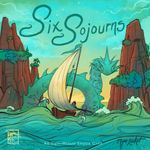
Hey y'all, and welcome back to the Dice Tower. I'm Camilla, and today I'm going to be taking a look at Six Sojourns. Now, on the bottom of the box here, it says an 8-minute Empire game, and that is because 8-minute Empire is a previous game released by Red Raven, Ryan Laukat, the same designer, and this is a new iteration of that game. Mainly, what it's going to bring is a bunch of modules to 8-minute Empire that are going to kind of increase the player interaction, maybe change the way scoring happens, put some pressure on the players. Different elements of the game are going to be heightened or challenged by these different 13 modules that are introduced. These modules are interchangeable. You can use any of them together, as many as you want, as few as you want. And it also is going to offer a little campaign to kind of walk you through I hesitate to say a story, but we'll come back to that when I actually give you my thoughts. But if you want to play a sequential number of games, kind of changing up which modules you're going to use when. So, let's take a look first at a brief overview of how you're going to play the base game of Six Sojourns, and then we'll take a quick look at the different modules that come in, the 13 different modules, and kind of how they change it. So, the base game here is really going to be 8-minute Empire, and we can go over that pretty quickly. To start the game, all players are going to start on one space on the board, and it's important to note that this is the only time in the game that there is going to be houses of different players in the same land
here. So, on your turn, you're going to choose one of the cards available. There's always going to be five cards available, and they're going to be worth a certain number of much gold as annotated on the board here. So, you're going to pick a card you want to purchase, pay that money to the bank, and then take the actions. So, let's just look at some of the actions here. Let's say I take this card for free. This card is going to allow me to place down two people and then have a total of three movement. When you place people, they have to go where you have a house, and when you move, you can do that movement in any order that you want. For example, I could move two people, then put people down, then move again to take my last movement, or I could do all my movement first, then place any any order that you want. So, in this case, because I only have one house, let's just say that I put my people here, and now I can take up to three movement. Movement is any number of people from one land to an adjacent land. So, in this case, let's say that I want to start moving over this way. I would maybe go take three of these people, and that's going to be one, and then maybe I leave one there and go two, and let's say that I just want to take them uh let's say I went there, too. One more, I'd take them both up here.
Something like that. That would have been my one, two, three movement points. Um I now also have a new ability here. It says, "You may place new people where you have people." So, before, like I had said, I could only have put those people down where I already have a house. This ability would allow me to break that rule. I would put that into my player area, and that is going to be one of my nine turns of the game. The cards will all shift down, and we will refill from the top, and it would be the next player's turn. Uh rather than going through a lot of turns here, let's just look at some of the other actions you can take, because really, you're just going to take nine turns and then move into scoring. Anytime you see the ship icon, you can place one of your ships onto one of the ocean boards here, and they are going to be delineated by these uh dotted lines on the board. So, for example, this is all one ocean space here, and now I have a ship there. Why does that matter?
Because now I can cross this body of water. If I have people here and I want to go over here, that would be one uh movement point. If a different player wants to move across and come over here as well, they can do that, but they have to pay me a coin to use my ship. So, that's going to be the ship icon. If you have a house, then you get to put one of your house down somewhere that you have a person. And then we already covered movement. And in the base game, those are going to be the four things that you do. Uh placing new people, placing houses, placing ships, and then moving. Those are going to be your four actions. You'll notice now these cards also have symbols on the side, and that's going to be for set collection at the end of the game, and may go into why you're choosing those cards as well.
Uh some of the cards are going to have end game scoring opportunities. So, for example, this one, two points if you have five or more people on one space. And then some of them, like we already saw, are going to give you ongoing abilities. You can get You may move one each turn. So, so a lot of different things happening with the cards. Once you take your nine turns, then you're going to go into your end game scoring here. The number of spaces that you have control or ownership in are going to be one point each. For example, in this space here, if it was looking like this, I would have The red player would have two, three, four, and the yellow player would have one, two. So, the red is said to be controlling the space. In this one, there'd be two for yellow, two, three for red, and two, three, four for white. So, white would be controlling this space. Each space that you control is going to be worth one. And that does include the ocean spaces as well.
Islands are going to be worth one point as well. So, if this was the end board, which it would not, it would be a lot more going on, but let's just say that that this is, then um red is going to be controlling one space, and white is going to be controlling one space, so nobody would score for this big island here. This one here, red would score one point because they have the majority of the spaces. So, just whoever controls the majority of the spaces on each of the nine islands will receive a point for each. Then we're going to go into the trades, which is going to be this chart I spoke about over here. And these are going to relate to the symbols on the side of the cards. The number of symbols is going to change depending on their rarity, how many you have to have. So, for example, if you're able to collect four map symbols, then you would score four points. If you have If you have five of them, then you get seven points. And so on for all the different symbols.
And then lastly, you're going to get the points as indicated on the cards if you meet their scoring objectives, then you would receive those as well. Highest points are going to win. Now, that is going to be the very base way to play, but even in the rulebook, it does recommend that you start with at least a places module. So, let's go over a couple of the different modules that come in here. And there are 13 total. So, the places is going to be the the most basic one and it is going to add a little bit of pressure on certain locations. So, these cards are going to award points if you own certain spots at the end of the game. So, if you control the northern island cave, which is pictured right here, so you can find it, then you would score the three points. So, this is going to put pressure on specific locations on the board.
Then you have trade tokens. Those are going to come out and they are going to if you give you additional icons for that end game scoring we talked about if you control a location with it. There's going to be some sea serpents as well, which you can place those on the board and whoever has a ship there when you place that, they have to pay you a coin. They're also going to be end-game scoring. There's going to be different feuds for contested places, lots of different things here that are going to kind of shift and vary the way that you're going to play here. Going to be increasing that player interaction in different ways. There also comes with a campaign mode, which kind of dictates which ones you should play at which point if you want to play games, um, consecutively, or you can just mix mix and match some of your favorites. But, that's going to be briefly how to play Six Soldiers and a Couple of the modules that comes in it. Let's go back up top.
So, if you're familiar with Red Raven Games or any of Ryan Laukat's other designs, one thing that stuck out immediately to me is how theme-less this one is. And even in the rulebook when you first open it, it doesn't give you any sort of overview on what's happening. It is set in the Arzium world that Ryan Laukat has created. So, in this we see Above and Below, Near and Far, um, some of his other titles, um, in in this world that he's created, right? You even Creature Caravan is part of it. Um, but there is no theme or it's just a setting in this game. There's no like background going into it. And like I said, even in the rulebook, it like just starts out exactly mechanically, this is what you're going to be doing in the game. So, really the setting is what is driving this Arzium feel of the game.
So, if you love that theme and want the story elements of Above and Below or Near and Far, Now and Never, you're not going to have it in this one, but it does still feel like an Arzium game. And I am grateful for that. It doesn't feel like it's it's uh, Eight-Minute Empire kind of felt like a separate, uh, product. This does not. And so, I do appreciate that. This is one that is extremely easy to jump into. Like you saw in the overview there, there's only five different symbols, and those are so very clearly different on the board from the other side of the table, you can see what every card does. I really, really appreciate it. I appreciate how easy and fluid the movement is in this. Uh you can't cross a a ocean space unless there's a ship in it. And if it's your ship, it's free. You can move as many people from one area to an adjacent land, and that is one movement point.
So, you really feel like you can get across the board well. And then, there's different modules that are going to increase not even really that complexity, but really challenge the game. So, for example, if you have the airships module, that's going to help you jump around the board quicker. Or you have the mountain terrain, which makes movement harder. So, you can kind of flex in and out of that, but ultimately, you're not changing the base game and taking it all of a sudden from a simple game that you can play with your family all the way up to a heavy game. I really appreciate that. Um now, with that, I do think that the modules are pretty necessary for this game. Without any modules in the game, it quickly becomes a just spread out as much as you can game, especially if it's a low player count. If you're playing with two players, there's not a lot of pressure on the board, so you're just trying to move, move, move, move, and get people out there just to rack up those one points at a time. Um more players does add to the pressure of the game in those spaces and and have more um contests and things on the different spaces. However, on a four-player game, so the other end of the spectrum, the board gets really busy, and some of these spaces are pretty small. So, it does feel like there is maybe too much pressure on some of those spaces, and it visually can get to be a little bit of a mess. There have been times, especially if it's your first or second time on playing uh one of the two maps that come included, you're like, "Is this its own space? Hold on, is that just a cliff, or
is that a space? What's going on here?" Um and so so that can get a little crowded as well at a four-player game. So, for me ultimately this is a three-player game. I really did find that to be the sweet spot. So, the modules I think absolutely not just change the way the game plays, but kind of shift and give you focus on how you're going to play as well. The trades module for example, which really makes you focus on that trading element and collecting the different resource types, um, you know, whether it be the pottery or the maps or the rings and jewelry, makes you focus on those things, which drastically changes the way you're playing cuz all of a sudden now you're not just trying to go out and and scrap up one point here and one point there, but you're really thinking about which card ultimately is going to help you make those trades um, with the most efficiency the most efficient po- the most efficient way possible. And I really appreciate that. I think that is where this game is going to shine and where it definitely outshines Eight-Minute Empire, the previous title.
Uh, so with that, we'll just jump into my final thoughts here. I come down at a 7.5 on this one. I think without the modules in it, this game would probably be a six. It's not bad. I'd happily play it, but there's just not a lot of oomph behind it. The modules really surprisingly open this game up and take it to new levels where all of a sudden you're thinking about what you're doing, why you're doing it, and you're really in itching out every turn to get the most points possible. Am I going to spend this turn spreading out? Am I going to take this card just because the power? Because in this game, money's going to be really, really tight, and having that card where I'm generating income each turn is going to be huge. Or are we going more into the trades? Are we going to sea serpents? You know, whichever it may be, I really like the way it shifts the focus of the game and I think it absolutely elevates it. Um so my problems with the games, I have trouble at two players it feeling like there's a whole lot of pressure. You have to play aggressively if you want to have that player interaction and if both players aren't on board with that, it just kind of feels like a beat down. Um so you do have to shift the way you're playing depending on the other player you're playing with and that just kind of feels out of the spirit of the game.
In a four-player game, it's kind of the opposite problem especially if two people, you know, start going at really fighting over one area or one land or something like that, then you're like, "All right, then I'm just going to go over here and spread out, you know?" And so I I just I think three players is absolutely the way to play. I think that it absolutely nails the play time as well. This is one that you can set up in in under 5 minutes, well under 5 minutes actually, and you can play in 30, maybe 40 minutes depending on your player count. So all in all, set up in and tear down of this game, you're under an hour and it feels like a more robust play experience than just a hour game. So for me, it's going to be a 7.5. That is going to be six sojourns. Thanks for joining me here today on the Dice Tower.
I'm Camilla and we'll see you next time.
Hey folks, thanks for watching another one of our videos. If you like our videos, if you like our channel, you would love to game with us at one of our conventions. Check out Dice Tower Cruise, Dice Tower East, then Dice Tower West. Fantastic conventions where we play games with wonderful people, a humongous library, and lots of other events and stuff. Also, don't forget to check out our channel, like and subscribe. I'm Tom Vasel.