Trinket Trove | How to Play | Learn to Play in 5 Minutes!
Games in This Video
1 game is featured in this video — it unlocks as you watch.
Transcript
Hello everybody. My name is Ilia
and my name is Tyler. Together make up Cray, a couple that loves to play board games.
And today we'll be teaching you how to play Trinket Trove.
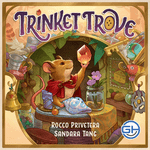
Trinket Trove is a two to six player game designed by Roco Privetera with Paul Solomon. Its art is done by Sundara Tang and it's published by Game Head, who helps sponsor this video.
Let's go to the table and let's learn how to play. As always, you'll begin by setting up. You'll shuffle the deck and deal each player four cards for their starting hand. If anyone has a mirror card, they must instead draw a new card and return the mirror card to the deck. Next, you'll create a timer deck, which reminds you how many rounds you'll play. You'll do this by dealing out six cards from the deck and placing them into a pile to the right. If you're playing with five or six players, you'll make this pile 10 cards instead. Next, you'll place the first and last tokens on the left and right sides of the play area. The space between these tokens is called the turn order row. You'll place a deck of cards in the timer deck at the top of the play area, making sure to leave space for cards to be placed in the center of the table. Finally, each player will select a character to play, collecting the corresponding tile.
You'll randomly place the character tiles to set the initial turn order, and you're now ready to play. Trinket Trove is played in six rounds or five rounds in a five or six player game. Your aim is to collect the most points by acquiring a curated collection of trinkets. You'll do this by trading and offering up trinkets you've collected in order to skillfully outweigh your opponents and collect new ones. After the last round, you'll score your hand of trinkets, and the player with the best trove will win. Let's dive into the specifics. Each round will have three phases: round setup, bidding, and drafting. Let's go over them. Round setup. From the deck, you'll reveal one card per player face up in the center of the table. Each card or pile of cards is considered to be a separate lot that can be claimed by players during the drafting phase. Additionally, you'll add a card from the timer deck to the first lot face up. In a five or six player game, you'll add a card to the first two lots. Now, onto the bidding phase. In this phase, each player will offer cards from their hand to decide who picks first. You'll take turns bidding based on the position of your character tiles in the turn order row from left to right. On your turn, you'll choose any amount of cards from your hand and place them into the bid row with your character tile on top of the stack, staking your claim for that round. If you want, you can choose to offer zero cards from your hand, in which case you'll draw the top card of the deck and place your character tile on top with a
zero side face up. As bids are added to the table, you'll adjust their order. The amount of cards will always be the first aspect you'll check. The more cards you offer, the better priority you'll have. If you bid the same amount of cards as another player, then you'll check the total value of each of your cards with a higher value having priority. If you bid zero cards, your bid will technically be zero cards with a value of zero. Now, if tied, the most recent bid will take priority. After everyone has placed their bid, you're now ready for the drafting phase. You'll slide everyone's turn order tokens down beneath your bid. This shows the order in which players get to claim cards from their table, left to right, as before. On your turn, you'll claim two lots of trinketing cards and add them to your hand. You can choose any lot in the top row, the ones drawn for the round, or you can choose any of the bids other players have made. You cannot choose your own lot unless you're the last in turn order and it's the last option available. Once all players have claimed their lots and added them to their hand, it's time to move on to the next round.
You'll keep playing, making bids and collecting a glorious trove of trinkets until the game comes to an end in six or five rounds, depending on your player count. You'll know the game is over if the timer deck is empty at the end of the drafting phase. It's now time to score. You'll arrange the cards in your hand into groups of the same name. If you have a mirror card in your hand, you may add it to any one set of trinkets. You'll now score points based on how many cards you've collected in each set of trinkets. An easy way to visualize this is to lay out your cards like this. You'll tally up and compare your points. The player with the highest score wins the game. In the case of a tie, the player who's closest to first in the turn order row wins. If you're playing with only two players, you'll throw Nimbus into the mix. Nimbus will not score any points and will bid with cards from the deck. When it's Nimbus' turn to bid, they always bid two cards from the deck. When it's their turn to claim trinkets, they'll claim the two lots with the highest bid strength and set them aside into the discard pile. If there is a tie in the piles, the player closest to first in the current churn order will break the tie and choose which law Nimbus takes. And that's Trinket Trove. Do you have any questions? You can leave them in the comments down below and we'll get back to you as soon as we can.
And of course, if you found this video helpful, make sure you hit that thumbs up button, hit that subscribe button if you're new here, cuz we love talking and teaching board games.
And hit that little bell cuz then you know when the next video comes out and we can all partake in the joy of board gaming. Now for our question of the day. If you had a little critter, what would a little critter be?
Cute. One that fit in the palm of your hand.
Yep. There you go.
Or your shoulder. A familiar.
Familiar on your shoulder.
Well, thank you so much for watching
and we'll catch you in the next one. Bye.