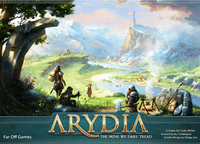
Is Arydia the Next Board Game Superhit?
Games in This Video
1 game is featured in this video — it unlocks as you watch.
Transcript
There's a mechanism in Arydia that asks you to roleplay the various characters you meet whilst adventuring. Say you decide to talk to 'Guild Leader Thades', your first quest giver. One player will draw his card and familiarise themselves with the roleplay prompts. Thades is gruff, he rubs his hands, and the picture displays a middle-aged man with a moustache. I don't know how I'll ever be able to roleplay him(!) Armed with these acting tools, the responsible player reads out the conversational prompt. The text contains bolded words, which are things the other players can ask about. If they do, the player who is Thades flips over the card and reads the appropriate response. But what if they don't? What if they ask about something else? Well, to maintain the illusion of actual conversation, there is a catch-all response.
[As Thades] "Hmm, that seems to fall outside my recollection" So now I want you to imagine how this will actually play out in your games of Arydia and, to assist with the imagination, I'll show you how it went down in ours. [Efka, as Thades] "If you want a little warmup before you go hunting squills you can fight the practice dummy one more time." "Let me know when you're ready to leave." [Elaine] I'm kind of new to this this area... It's nice to meet you by the way, what was did you say your name was? [Efka, as Thades] Hmm, that seems to fall outside my recollection. [Elaine] I see. Uh I'm kind of new to this place, I was just wondering like what time does sun set? 'cos this is really pretty, I just want to see the sun set. What time does it set?
[Efka, as Thades] Hmm that seems to fall outside my recollection. [Elaine] I'm kind of hungry also, is there anywhere good for, like, fishing? [Efka, as Thades] Hmm that seems to fall outside my recollection. [Elaine] Okay. Well, what about, like, carrots? [Efka, as Thades] Hmm that seems to fall outside my recollection. [Elaine] What about those colourful... [Efka, as Thades, frustrated] Hmm that seems to fall outside my recollection. [Elaine] Chantenay carrots? [Efka, frustrated, sing-songy] Hmm that seems to fall outside my recollection. [Elaine] Mini carrots? Baby carrots? Carrot sticks? [Efka, as Thades, calmer] Hmm that seems to fall outside... Not going to lie, I love this. Everything Arydia gets right is distilled in this one ridiculous mechanism. But this isn't the only mechanism in this, illustration A, Miniature Schnauzer-sized box.
There's one or two more things going on. Here's illustration two. [Jazzy Music] ARGH! The price is so big! The box is 'gigantique'! This is terrifying! To paraphrase Lady Lamb: I want to cry out my sockets, and *it* begs for affection. Look, this is a lot, and I have the price of eggs to worry about. So let's take a look at why it's this and whether it really needs to be this. The gist of Arydia, like many board games of its type, is that it wants to be an RPG campaign in a box. But not just any RPG campaign, it specifically wants to simulate the CRPG, or computer RPG, experience in tabletop form.
Okay cool, but what kind of CRPG? There's everything from Baldur's Gate, to Skyrim, to Mass Effect. Which one is it trying to be? So, um... Pokémon. It, it wants to be Pokémon. Now Arydia fans, before you get out your pitchforks and start yelling at me that "There's no Pokémon in this box! And the closest thing it has to taming mythical creatures with a magical ball is killing some rats in the basement!" I need you to understand I don't mean Pokémon in the premise, I mean Pokémon in the style and core gameplay loop. Trope-wise, aesthetics-wise, it's trying to be DnD, but how the game actually shakes out, how it feels, is more akin to the escapades of Ash Ketchum.
Again, I know Ash was not in the Pokémon video games, don't come at me. Like in many of these games, you'll make a character by choosing a path and also... character. And by that I don't mean your character 'cos you're already making your character. I mean your character, as in your species? Great terminology choice, no notes. Anywho, you'll pick your path and your... character, equip some items, get some abilities, and get your first quest. I'm going to talk about the story now which means very minor early game sort of spoilers, but if you want to skip them here's your time stamp. The premise here is that you are an exile, meaning that you're sort of an outcast. But also maybe you're not because being an exile in the world of Arydia means doing community time, which you can also do voluntarily.
Perchance you've been good, perhaps you've been bad, who knows? The world is your oyster, except as an exile you obviously don't get oysters. Maybe some Oyster crackers or an empty Oyster card. So there's your quest. Go and get squills - wooden tokens that are handed to you by citizens for doing a good deed. The game even includes one as a tchotchke. Collect more than other exiles, and you've upgraded yourself to upstanding citizens. Basically the Pokémon are squills, and the Poké balls are jobs. The rest is virtually identical. So what do I mean when I say Pokémon? Well, I mean the style of world building, mood, vibes, encounters - and how you interact with all of that, how the story is presented to you, and to an extent even the combat system.
Although that last one might not be as obvious. Much like in the saga of catching them all, the plot is thread bear and basic. You go to a village, find someone in need of help, and this triggers a story vignette which usually follows very standard beats. Someone's shipment has gone missing, there's a big animal terrorising things, bandits are banditing. You go and deal with it, get your squill, move on to the next one. These story vignettes are so basic you could probably get a fish to follow along, but the reason it works in Arydia's favour is because it arms each and every one of these with plucky charm and a bit of panache. Some of this is thanks to those role-playing prompts, because let's face it, the experience of your partner trying to act out a toothless old man might be burned into your memory forever. But also the whole game is like that.
There's things in Arydia that would make Werner Herzog giggle. In one of the early quests you encounter what is clearly your personal nemesis, again, like in Pokémon. And when I found out that his name is Irky Ferts, I might have died a little. No really what other board game has a character called Irky Ferts? And not just a character, one of the antagonists. Come on, you got to give Arydia some style points for that. And whilst we're on style, it would be a sin not to spend a few minutes gushing about how lavishly Arydia presents itself to you. One of the first choices you'll make in the game is picking a path aka class. When you do, you get a tuck box and also this slipcase. Ooh! What's inside?
Just three personal dashboards customised towards your path, including your inventory, load out, and skill tree. Remember the Diablo inventory screen? Or any other CRPG inventory screen? Does this not feel familiar? You even physically insert your items into their corresponding slots. Look Ma! I'm putting on my armour! I'm doing the thing I've done in video games in the real world! And that's why this game is £240. The entire box is rammed with stuff like this. Would you like a character customisation step? Well, check out these prepainted headless miniatures. Simply pick a desirable head, presumably the one that corresponds to your character...
again why did they call the species character?! ... and wedge it into your miniature! That sort of like character customisation, right? Is this silly? Oh my yes! But remember, Irky Ferts and "Hmm, that seems to fall outside my recollection" - Arydia worships at the altar of silly. And let's face it, if there's one thing that's synonymous with video games, it's Advent calendars. Go to the top sellers page on Steam right now and it's "Advent Calendar Simulator", "Championship Calendar Manager", "Time To Rogue Christmas", and all these other Advent calendar games. And that is why Arydia is full of Advent calendars too. When you get into a fight, you won't just pull a miniature out of a bag like a peasant, you'll engage in that satisfying...
[pop] Ahhh! as the imperfectly perforated cardboard releases some pre-painted plastic onto your table. And it's not just miniatures. There's extra rules, and other things hidden behind various cardboard dispersal systems. Like a map that makes you physically flip hexagons when you explore a region. And also this dossier with secret things hidden inside of it, and that's one third of the box right there. So, let's put it all together and talk gameplay. The broad strokes of Arydia can be split into three sections: World Exploration, Adventure Mode, and Combat Mode. And each sequentially nests into the other. On top, you have the World Exploration, which is where you travel on this map from location to location.
When you actually decide to visit a location, this ports you into Adventure Mode, where you'll wander around on various square grid maps finding events, points of interest NPCs, treasure, and even foes. Each can be optionally, or is in the case of events and foes mandatorily, engaged with. If you engage a foe, you'll still use the same map, but now fighting. Which is where you get out your dice, items, special abilities, and let's not forget the Advent calendars. When the fight is over, you pop back into Adventure Mode. When you're done exploring the location, back to World Exploration. Go to next location, do another fight, and so on. Let's break this down further. In World Exploration, your party is represented by this tiny metal octagon. Whenever I wish to go somewhere, I'll first place it in between the hex I left and the one I'm traveling to.
Then, I'll draw a card from the Travel Deck, check the applicable terrain, and resolve the result. Most of the time, especially at the beginning of the game, either nothing happens or I get tired and have to pay one stamina. Running out of stamina means having to flip these tokens, which means I'm prevented from exploring undiscovered locations. But, and this is true for all the myriads of different decks in Arydia, the Travel Deck is mutable - it evolves based on things you've done, people you've met. New cards get added, old ones removed, suddenly you're meeting new characters or running into old ones you've met in previous quests. And of course, after you're done, if you're traveling to somewhere you haven't been to before you get the satisfaction of - [pop] I'm not going to lie, never going to get tired of doing that.
The hexes themselves have two kinds of things - either maps which lead you into Adventure Mode, or pois. And by that I don't mean the French word for peas, I mean points of interest. They serve a different purpose in Adventure Mode but in World Exploration pois are various town services like shops, repairs, inns etc. Which are all so abstracted that they fit onto a single card. Allow me a grump. The way shops work is that when you encounter a shop for the first time, you'll draw some universal items that benefit all characters from this chest. Like a real life actual chest! And then you will place them on the shop section of the card. You can buy them or you can sell some items you've already had, also placing them on the card, but then what happens when you go away?
Generally, when you stop interacting with a card - be it an event, NPC, or a pea, you file it away in its holder in numerical order. But because Arydia wants to simulate a sort of consistency between what items are available in which shops, it asks you to shove those items together with the card into the holder, so that when you encounter it again same items pop back. Just one problem. WHY? Why did you do this?!! There seem to be physical components to accommodate consistency for almost everything else in this game. Slip cases for your chunky dual character sheets, hexes that flip back to undiscovered mode if you want to reset the game etc. Why is this a reasonable experience?!
And I feel like the answer is so simple. If you don't want to make another component to accommodate this mechanism, which is very understandable, just abstract it away. Compromise on your vision for literal accessibility. I can't get this thing out(!) A few words on Adventure Mode before we chat combat rules. I've already explained how NPCs work. There's also events, and they pretty much work in the same way. So that, and combat, is mostly what you encounter on these maps. But the maps themselves also kind of work like cards, even changing states. Let's say a meteor falls onto this teeeeeent...bfffff! It's giant right?! That would get you to fetch a new version of this map and permanently file away this old version, so that when you come back to this location again - not a tent anymore just a Poké Ball apparently.
Arydia as a production is almost exclusively focused on maintaining this fluid state of things changing. And it's impressive, shops aside, how much of that it manages to pull off without enormous amounts of faff. It's just a shame that the rest of the game doesn't employ the same amount of imagination. Oh no! You wanted combat rules? Nuh-uh, we're going to take this game to task instead. Sort of. I can't really talk combat without discussing the oh so many things I found annoying about Arydia, so it's time to drop the pretense and fess up. I got about halfway through Arydia's campaign until I had to say "Enough. I really don't want to do this anymore." Remember our last video about arousal?
So I made a little arousal chart of my own, in relation to how I felt about Arydia. Opening the box was high arousal because I had to do that on camera. If you want to see that, or understand why I keep saying the word arousal, watch that video - it's very good. Then immediate plummet for the first 3 hours, because I had to learn the game from a learn-as-you-play tutorial, which took so many missteps I'm surprised it didn't fall off a cliff. I'll give credit where it's due - it did teach me to play. I still had to read the rule book afterwards, which is structured poorly, but it did give me a broad understanding of its systems and how to do things. But it took so long to do it, and it offered no actual play. We would constantly try to go off script but there is no "Hmm, that seems to fall outside my recollection" option for the tutorial.
Step by step, you have to trudge through the word swamp following instructions. And the worst part is the combat tutorial. Whereas before we were forced to read and learn communally, to understand the ins and outs of fisticuffs, we're each given our own separate mini tutorial based on the class that we've chosen. And thus whilst learning together, we are split into our own individual corners of the table, during our own separate tutorial. Silently. Together in the same room, but not interacting. The silver lining is that we get to pop out an adorable practice dummy miniature out of our Advent calendar. But only one. One person gets to play with the toy, the others get the cardboard chit.
To decide who gets the miniature, you have to enter a king of the hill style arena, armed with a crowbar and your dominant hand tied behind your back. Whoever has the most teeth at the end - yours or your opponents' - gets the mini. Or you can just roll a die. Then when we've all finished our individual reading and moving of the mini/token, we reconvene to do that same combat encounter again, to share the skills we've learned and utilised. And I'm actually not complaining about that. Because at this one point the tutorial let me play the board game. But, you will notice that there is no spike in the arousal chart because it lasted all of 10 minutes. Followed by another hour of step-by-step instructions. I hated everything about this, especially realising afterwards that if I had just read through it myself, I could have run Elaine through it in like a third of the time.
I don't think that a good learn-as-you-play tutorial is impossible, and anything that makes games more approachable is worth exploring. And there's a few that I've been partial to, but most of them are not fun and considering that publishers include them to reduce the time it takes to get the game to the table, I think it is extra miserable that they specifically extend the time of not being able to play. Because the way that this has been created is not play, it's just communal learning. Which neither I nor literally anyone I've ever talked to enjoys. I am being very serious. If you're a publisher, and you're thinking of doing a tutorial specifically like this for your game, don't. It's abominable.
But look! The graph is going up now! That's because, at this point, I actually got to enjoy playing the game. And enjoy I did. For the first 5 hours I was reveling in opening boxes, interacting with NPCs, discovering new locations, fighting goons, all these things that I've been talking about. I felt like there was a promise of a fun chill adventure time hardcoded into Arydia's DNA, and I was here for it. But then for the rest of my time the graph's trajectory was on a constant decline and it never recovered. So then combat, which is quite simple. Every turn, first you draw from the enemy deck, which then tells you which kind of enemies to activate or potentially not activate, but give them threat, which makes their future actions more deadly.
After you're done with getting hit in the face, it's your turn to go. You get one minor action and two action actions. Your minor is movement - which also generates a combo point - or drinking a potion, or any kind of special ability that specifically requires a minor action to activate. Your action actions are everything else, including minor actions if you want to. So if I want to shoot my bow, I put the action token on the bow, D20 see if I hit and how well I hit, and apply damage to the enemy. Different weapons have different attack patterns, and damage to monsters is applied in a visual grid. My bow applies damage from the top down. If I rolled really well, I can do two damage - all of it traveling in this one direction. If I travel over a crit spot, I apply an extra damage in the direction shown by the crit arrow.
Logistically this feels like a pandemic baby. Based on the presentation of this mechanism alone, I would not recommend playing Arydia with more than two players. If a monster in a standard crawler just has hit points, you put some tokens on it or move a cube, anyone can reference that information. Can you reference this from where you're sitting? No you can't, because of the camera focusing. But if you're sitting at this table you still couldn't 'cos this is too small. This positional distribution of damage on a grid has tactical information that is important to access by all players at all times, and it is just this tiny card that you cannot move because it has cubes on it. So if I had four players at a table big enough to support this component glut, where do I place this card so that everyone can constantly reference it without getting up all the time?
It's impossible. Which is something they would have caught if they had not been play testing this on tabletop simulator, which I don't know if they did, but that's my educated guess. But otherwise this is a nice little system. It's easy to explain and visually intuitive. Plus, it encourages cooperation with other players to see how you can most effectively draw up damage lines between different weapons with different attack patterns. It's also fun to slowly ratchet up combo points so that the right player at the right time can blow them all on a key special ability that changes the course of the fight from "We're not winning" to "We're not...not winning." In fact, this whole dashboard thing reminds me very much of the combat system we maligned in our review of Stars of Akarios.
This is effectively a console with some buttons. Most of the time you'll be pressing the same button - the standard Pokémon attack. When you build up a bit, you get to press a more fun button - your Pokémon Special. Thus you'll cycle between players pressing a more fun or a less fun button, rolling D20s and generally having a time reducing hit points. Unlike Stars of Akarios, the system isn't impeded by convoluted movement rules or confusing enemy targeting. It's smooth, it chugs along at a brisk pace, and every once in a while you'll feel threatened too. My problem isn't so much with the mechanisms, aside for not scaling very well for player account, my problem is that the scrapes you get yourself into and the nincompoops you take down don't evolve into anything particularly interesting.
As the game progresses, the enemies you encounter do have different mechanisms, but they're all fairly predictable Dungeon Crawler fair. Think of the very standard enemies you'll find in DnD. These are the sort of things you'll be fighting here. Anything more exotic is a rare occasion. So rare, I half encountered it once myself. And this frugality for the unexpected extends to Arydia's storytelling as well. In fact, it is as much a defining feature as the lavishness of production. Calling Arydia a mundane world would be heaping it with praise. Style it has. Interest...hmph. The quests are structured as vignettes, meaning that there's not much interconnectedness between what you do and the game's main plot.
I say that but after having played half of the campaign, I'm still not really sure what the game's main plot is aside from do community service, collect squills. It feels like there are no stakes, no overarching reason for us to be in this world, apart from slice of life. That, I wouldn't have so much of a problem with. Games I really like, like Sleeping Gods, and ones I like less but still like, like Lands of Galzyr, do this as well. But unlike those, Arydia never offers anything I haven't seen a hundred times before. A Brandon Sanderson novel is less by the book than this. Sorry Sanderson fans. Think of your most bog standard starting quest in any CRPG. Baldur's Gate, Dragon's Age, Elder Scrolls, Pillars of Eternity... Think of the very first quest you got in that game, and they're all here.
And for all my time in this world, that is literally all I did. But wait. What if it could get more boring? As a general rule, when finishing a quest that leads you to discovering a new monster, the game offers you jobs, which are like side quests that earn you a bit of money. Which you need to buy up armor, maintain repairs, etc. And jobs are opportunities for you to fight the monster you've already fought... But this time... ...again(!) On a generic terrain map. Not all jobs are like this, but the ones that aren't, you're either gathering herbs or playing this 'protect the wagon' mini game, which I've done once and I'm okay. Honestly, I don't want to do another job. Hey! It's just like the real world! The full title of Arydia is: 'Arydia: The Paths We Dare Tread".
And the path it dares to tread is to recycle all the fantasy tropes we know and love. This isn't damnable, but it is definitely faint praise. Not gonna lie, things aren't looking great for Arydia. It isn't bad-ia, it's not exactly good-ia either. It could be better-ia. But it all depends on what your audience and expectations are. Honestly, if you never played a role-playing style campaign game, if you're not familiar with DnD tropes, I think this could be amazing. Parents, if you have a 10-year-old and above, and you're willing to walk them through this, this could be the best £240 present you ever bought them. Not to mention quality family time. I know this is coming across like a negative review, and for what it's worth, Elaine really liked this game.
She just enjoyed bumbling around, doing a quest, having a nice time. But when I asked her, "Would you rather play this, or Gloom Haven, Sleeping Gods, Oathsworn, Kinfire, Earthborne Rangers, Fate Forge..?" I'll stop the list here to save Arydia some face, she didn't pick this once. Many of those are cheaper too. Not as stylish, not as smooth, but cheaper. And, in my opinion, more fun. I feel like Arydia is a game with a vision. It wants to be smooth, and accessible, and whimsical. Which are all good things, and I think it succeeds at all of that. And just because of the novelty and the presentation, I think this game is going to be something that a lot of people are going to enjoy. But whilst I'm picking it apart, there's just this one last thing that keeps bothering me.
It feels like, and maybe this is just me, but it feels as if Arydia has that vision of style, not as a game piece but as a product. And everything it does, it does to exist as that product. Again, if you watched our last video, you'll have noted that science says that opening boxes is fun - or at least that was the common wisdom up until now. So the game is structured in this way where you get to do maximum openings per minute. OPM. Need a miniature? Open it! Need some map? Reveal it! Fog of War? Do the hex pop! Everything is being opened all the time. But, and if you've played this game for as long as I have let me know, did you reach a point where the opening became a bit stale?
Like, think about the Advent calendar. What is the point of it? To have a little surprise every day. The cheap ones do it poorly, where it's just another piece of bad chocolate and now that's your life for the next 24 days. But cool Advent calendars, there's something nifty behind every door. It might not be the best thing in the world, but the whole point is that I don't know what's there. I got to a point in Arydia where I knew exactly what was behind each door before I opened it. There's two gigantic boxes that say 'Do not open until instructed', and when I reached the third of the way point in the campaign where I was instructed, I reliably knew what's inside. There was no surprise. In its promotional material for the crowdfunding campaign, Arydia styled itself as a green legacy game which, if you ask me, is a pretty egregious use of the term green for a box with this much plastic in it.
What it means by green is that it's just a resettable campaign game. By far not the first to do this, but definitely the most elaborate. Resetting it took two hours, looked a little like this, and maybe would have been less arduous if there was actually some sort of guide on how to actually do it. But currently they are working on it. Anyway, I feel like every decision in Arydia's design is in service of delivering this idea. So much so that it forgot that the reason we play narrative roleplaying style adventure games is because we want a fun romp with a nice story to propel it along. At polar extremes, some people make games because they want to tell a story and others because they want to sell a product. For my comfort Arydia leans too close to the latter.
Hello! You've reached the end of the video, which is where I normally tell you that we're independent board game reviewers, we approach our work very seriously, we don't have any publisher sponsors, or any other kinds of sponsors, and we need your support on Patreon.com/nopunincluded because there's no other money coming in from anywhere, and we like this job, a lot, and we want to keep doing it. But today I have noticed that there are a lot of you watching regularly who have not subscribed. So I need you to hit back the tab that this video is on, and just below there's a button that says 'subscribe', because if you do we're very close to 100,000 that means that YouTube is going to send me a plaque, and I want that plaque! I really want that plaque!
You want me to have that plaque! Because then you'll be part of the plaque pack! All right? Plaque pack everybody! Hit the subscribe button right now! I need the plaque