The Hungry Gamer Reviews Sagrada Refreshed with Panorama Expansion
Games in This Video
1 game is featured in this video — it unlocks as you watch.
Transcript
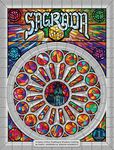
Oo, that looks tasty. Welcome folks. Jay the Hungry Gamer is back with another game review and today we're talking about Sigrada designed by Daryl Andrews and Adrien Adams Skuw with art byWani Maria and Bridget Enelicato. And I do apologize if I mispronounced those names. And additionally, Floodgate was kind enough to send me an advanced copy of the upcoming expansion, which is obviously the first expansion for the new edition of Sagrada, which is what we are looking at right now. And this new Panorama expansion has some things that have never before been seen in Sagrada. With that being said, I'm going to be talking about both of these together kind of as a single unit.
though I will do my best to point out things that come from the expansion versus the regular game. Now with that being said, this is a game of dice drafting and pattern making and the idea is you are making the stained glass windows at the Sigrada Familia which is still not done after 200 years or whatever. Supposedly going to be done like 2030 or something like that. But anyhow, so that is what this game is about and it'll take place over 10 rounds of as I said dice drafting. And obviously, thank you to Floodgate Games for sending me both of these copies so I can make this video. Now, with that being said, if you are not interested in how this game is played and want to jump into my final thoughts, then you want to go to the timestamp on the screen right now. For those of us still here, let's talk about how this game is played. And to start out, I will talk about the core basic game. And so, what's going to happen is when you're playing, you will have three different scoring objectives that you will have out, and these will change every game. and you'll have three different tools that are out. And I will point out that the three that I have here are actually tools that specifically come with the expansion.
So, I will just put these out for the moment so it does not become too confusing as I go through this game. And this little dice tray here also is with the expansion. So, I'll pull that away for just a moment. And so, what's going to happen is based on the number of players, you will draw two dice per player plus one out of the bag. So, we're just going to pretend we're playing with two players. So, I will draw four dice for the players plus one. And then these dice would get rolled. And then starting with the first player, you would do a snake draft. And what a snake draft means is the first player chooses, then the next player chooses. And in this case, our two-player game, the second player, which is the last player, chooses again, and then the first player gets to choose. Then you'll see we have one dye left here which would then get placed up here and would mark our rounds. After 10 rounds, the game will be over. Now, what do you do with these dice? Well, what you will have done at the beginning of the game is everybody will have gotten a window pattern. And there are two sides to it. And this one here, you can see this little die symbol down there that comes from the expansion. And so what you will have done is you will have selected one of the two sides. And depending on which side you pick, it'll have a number of pips in the bottom right corner. In this case, we have five or four. And that's going to tell you how many favor tokens that you get. So, in this case, I'll be getting four. And I'll slide this
pattern in. And now, this is the pattern that I'm creating. And as I said, I will have four favor tokens. And for now, I'm going to move everything off to the side while I explain how this works. We will say that I had drafted these two dice. After I've done my draft, there are three things that I will do. I will place both dice and I have the option to activate one of these tools. If at any time you choose not to place a die or you can't place a die, then it simply gets discarded. And to activate these tools, you put one of your favor tokens on them. If there's already a favor token on one of these tools because another player has placed it there, then you have to place two favor tokens. And the maximum you ever have to pay is two. So if another player wanted to use this again, they would only have to place two tokens. And you can see each of these does something different. For example, this one here allows you to move dice.
This allows you to move two different dice. And this one here allows you to roll one of the dice that you've taken. And these will all do different things. So, I'm not going to go into too much depth about that. The only thing I will point out though is that you'll see that there is a die color up here. And that means, let's just say I had drafted this die. I could instead of paying favor tokens, I could pay that die instead. Which means I won't get to place the die. But I could activate it without spending favor tokens. So when it comes to placement, there are a few rules you have to follow. The first rule is the first die you place must be around the edge. And after that, every die you place must be adjacent, either orthogonal or diagonal to a die that's already been placed. And then if we look at my particular board here, you will see that it has different colors you have to have and different shades you have to have or numbers. So in this case, I could put this green dye right here. No problem. I could put it here, here, here, here, here, anywhere around, but not here because I have a five or here, here, or here. But I can place it right there. And then in theory, I could place this next die, which is a five, right here, except the second rule is you can never place the same number orthogonally adjacent to the same number. And the same thing is true when it comes to color. So, for example, I could not place dice like this either. I would just change this around real quick and we'll assume that that was actually a six. And then I could place this five right here. Then we would move into the next round. The
first player would change and there and therefore the way the snake draft goes would change as well. And just very quickly, I'm going to fill in this board with a random smattering of dice. And so let's say the game ended like this. First thing that you would do is you would clear these off. And then you flip this over. And as you can see on the other side, that is where your score will be will be tracked. And it comes with these nice little tokens. So you can do that. Then what's going to happen is you're going to get points for any leftover favor tokens that you have. And you will also then evaluate all of these objectives. So for example, for each set of five colors, I would get four points. So in this case, you can see I only have two purple dice. So the most I could do is two. And in that case, I do have two full sets of all colors. That would give me eight points. Then for this one here, for each row that I have that has all different numbers, I get five points. So that would be five points, 10 points, and that's all. And that puts me up to 18. And then this one here, for each row that has no repeated colors, I get five points. So in that case, I will get five points for that one right there.
Then the last thing that you'll do is you'll gain points for your secret objective that you would have gotten at the beginning of the game. In this case, three points for every yellow die that I have. So 3 6 9 12 15 points, putting me up to 38. And we'll say I used all my favorite tokens. So that is my entire score. And that's the core game. However, when you add in the expansion, there is several things that you can do. First off, as I mentioned, there is a bunch of new tools that you can use. There's new objectives that you can use, and there are new windows that you can use. However, in addition to that, there is something called the lightboard that you're able to use. And so, the way that works is at the beginning of the game, you will take two of each color dye, roll them, and then you'll place them in your lightboard like so. And the change to the game is instead of drawing two dice per player plus one, you draw one dice per player plus one. So in our two-player game, that would be three dice that we would draw. And we would then roll. And you still do your draft.
It doesn't have to be a snake draft anymore. We'll just say that I chose this die right here. And then when it comes time to place, you will then place this die from here. And you also pick one of the dice from your lightboard. So you already know what the number and color is. So in this case, perhaps I would choose to do this one right here. And I'll take this one instead to make this work out. And then that one like so. And then now, as you can see over here, all of these different tools that are from the expansion have to do with the lightboard. So, for example, if we were in this situation right here, I could use this tool here, and I could swap a die from my lightboard with what is on the round tracker. So, maybe I said, you know what, I don't want this.
I really want that green one later. And so, I can swap it out like so. And that's how the lightboard works. The next thing is, if you recall, at the end of the game, you have your secret objective, which is based on dye color. Well, now there's an option to base it off the shades or the numbers. And so for this one here, you can see there's five different spaces in the window and I'll add up all the pips from those spaces and that's how many points I'll get at the end of the game. So now you're trying to push these numbers higher in order to get more points. But of course, that's going to interact possibly in a negative way with the objective cards that are out on the board. And the final thing are collective goals that you'll be working on. And so this is only usable in at least a three-player game, but in between each player, there will be cards like this. And so what this is saying is that one player is going to look at the farthest right column of their board and the player next to them will be looking at the farthest left on their board. In other words, you will at the end of the game, you will basically put your two boards next to each other and you will evaluate the columns that are next to each other on your windows. And then depending on how well you do, you'll get a different amount of points. And of course, depending on the relative challenge of the objectives, but that's it. That's how this game and the expansion work. So, with that said, what do I like about this expansion? End game both. What do I like about the new
Cigar? So, to start out with, it's the same really fun game and that has not changed. There's been a few scoring changes is my understanding. I hadn't played the regular Shagata in a while, but the scoring has changed a little bit if memory serves. Originally, you got points for the PIP values, and that's something that's been kind of taken out. Though, the one expansion does add it back in. That said, I really like how simple and clean the game is. I love the drafting. I think it's again just very clean, especially with the way the snake draft works if you're playing without the expansion, especially when you have a lot of players around the table. And so, I really like the way that all of that works. But what makes the game is one, when you're done, it's really pretty. It's just silly how pretty it looks at the end of the game. But that pattern making that you're doing and you can't put the colors next to each other but they can go diagonal and you're trying to work out the numbers and you're trying to figure out the draft to fill out this window because you know exactly what you need is really satisfying and it's really easy not to do well but it's very easy to do. It's easy to understand and so you can jump in and be playing almost right away. And I really do like that. It says it's a 30-minute game on the box. And I think and I think that's accurate. I think it's a 30-minute game for most people when they play this game. I'll talk a little more about that later on. In addition to that, I like that it has that mitigation there for you built into
the game with the different tools that are going to be out. And I like that they're always going to be different tools and different objectives every time that you play. But it is a dice game and it is a drafting game. So, at the core, you can get screwed, but then you have those tools. And if you don't need the tools, then you get a few extra points. And I like the amount of favor that you get is based pretty much on how hard is your window. And that's that's it. If there are more requirements, then you're going to get more tools because you have more chances to do things. And along with that, it makes for an interesting way to kind of balance the game a little bit as you're playing with people who are newer or more experienced. you can give someone who is more experienced with those harder windows because even with those tools, it's still more likely that you have spaces that don't get filled in. And I really, really like how that works. But then when we start to talk about the expansion, and I cannot believe I forgot to show this. I showed it very briefly at the beginning of the video, but then I totally forgot about it. With the expansion, you get a little dice tray to roll in. It looks like the base of the cathedral. It's got little holes where is where the windows would be and all that. And it's it's just a very cute little thing. And it's a way that you can if you're playing with a lot of people, you can just kind of pass this around the table and let people draft the dice out of it. It's totally unnecessary, but very cute. And I really like it. Now, moving into the expansion.
I like it. I think it's very, very good. And and there's a couple things I think that really make it work really well. First off, you can play up to six players now. And as I mentioned, it's a fast game, so that works just fine. The main two things for me are one, that lightboard. That is fantastic because that does to me two different things. One, it reduces the likelihood that you're going to get stuck because sometimes you do and that's not really satisfying. But the other thing is it actually speeds the game up because it reduces the amount of drafting you're doing and you already know what you have there. you're already planning, okay, I can use these dice in these spots. I just got to get there. And it actually speeds that up. It reduces some of the randomness and the chance, but in a way that I think is very, very satisfying.
And I think that works really, really well. And a lot of the new tools are super satisfying because it affects the lightboard. It's having you change numbers on the lightboard or it has you taking a die off your lightboard, throwing it in the bag, and getting a new one or taking it off of the round tracker or something. really really good new tools and the way they interact with the lightboard I think is just spectacular. And I also really like the new secret objectives and that's kind of a throwback to what I mentioned earlier, the idea of you're adding up all your pips. But I love that that is an option that you have. You can have that choice. Ah, do we just want to go straight for colors, which is a little bit simpler, or do we want to add this little bit of complexity with the numbers? And I say it adds a little complexity because what's happening here is it's now affecting the numbers you're placing in those spots. And if you're affecting the numbers you're placing in the spots, that's affecting what numbers can go around it. So it actually really adjusts what your planning is as you're going through. Or you can just say, you know what, colors. I'm just going to go with the colors. And that's a lot quicker, a lot simpler. And I like that that choice is there. And then the final thing in the expansion are the new shared objectives. I think they're very very interesting. And what I like that they do is it forces you to pay attention to the players at least on your right and your left. And you actually have to work together to do it because if one person does it, the other doesn't, you're not getting the points. So you have to actually communicate and work together
to make that happen. And I think that's a really really clever little way to increase table interaction. and also as I said increases the complexity just a little bit. So with that said, what are my quibbles with the game? The first thing is this is a game that you can be hit with some AP. Absolutely. Especially if you're playing a bigger game with a lot of dice out there trying to figure out where it is that you want to go, what you want to take. It absolutely is a slight danger in this game, which is why I said for most people it is a 30inut game. Next thing I'll say is to me the way that the tools work which allows you to always use them but if someone's already used one once they cost a little bit more to me I just don't know that that's necessary for most players and I understand why it's there to make you think about using the tools or use the tools early but to me that actually slows the game down a little bit when you are doing that because then you actually have to make sure you're kind of doing this in turn order as you're going and it just slows the game down a little more than I think it needs to be there. And so actually Mrs. Hungry Gamer and I we have just made a house rule. Whatever just just use it, put one on there, use it and be done and move on. And the only other quibble that I can think of is with the shared objectives. And with that, my only quibble with them are it's not something that you want to introduce early. Mrs. Hungry Gamer and I actually
introduced original Don and his wife to Sagrada. Neither of them had ever played before and we just threw in those shared objectives and it just totally slowed things down and added a level of confusion that just wasn't quite needed. So, I don't think there's anything bad about them at all, but it is something that because the game is so simple to understand and simple to play, you think you can throw it in. And that is the only place where we discovered any kind of confusion trying to parse what the cards meant, how they match up together. And because we were sitting around the table, trying to keep in our heads that no, no, no, you're sitting across from me, but really, even though on the table right now, our windows are sitting like this, we have to remember that no, no, no, no. They're going to come around and they're going to be like this. And it was just a little bit confusing. And it's the only thing in all of my plays of Sigrada that has been confusing at all. But there you have it, folks. That is Sagrada, the new edition and the Sigrada Panorama expansion which is coming very, very soon. Really a nice redo refresh of this game and a really good expansion. I really think it's a good expansion. I think if you like Sigrada, you should already order it.
Absolutely. you've already know you like Sigrada and even if you've never played Sigrada I think just having those things the little lightboard actually yes just the lightboard I think that is a must a must own for anyone getting Sigrada because just that one change drastically changes the experience of the game and it's a way that you're able to kind of adjust the game for different types of players and how much chance they want to deal with and how planning they want to do and how much they like the drafting versus not like the drafting. Excellent, excellent new version of a game that's obviously already a classic. So, there you have it, folks. As always, if I made any mistakes in the rules overview, please let me know in the comments with the time stamps. I'll get that in the cling on subtitles. If you found this video useful, please like, subscribe, share, maybe become a channel member. As always, thank you so much for watching.
Have a wonderful, wonderful day.