Shrinkopolis Essen Spiele Spotlight
Games in This Video
1 game is featured in this video — it unlocks as you watch.
Transcript
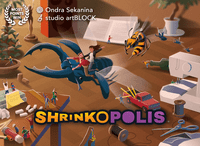
Hello my friends. It's the Game Boy Geek here and today we find ourselves in Shrinkopoulos because humanity had a rough time with climate change, overpopulation, and hunger. So the scientists got together to fix everything with a shrink ray. Well, one mysterious lab experiment later and boom, everyone on Earth woke up funsized. So you're trying to rebuild society, but everyone wants to be in charge. You'll be building your own district inside the great living room, winning the hearts of your fellow micro citizens trying to become the first crowned mayor of Shrinkopoulos. Now, Shrinkopoulos is a resource management tile placement game for one to four players. It takes 15 to 45 minutes to play, is for ages 10 and up, and published by Tama Games. Now, it's going to be at the Essence Spiel Convention, and they're going to be at booth 5B 625.
That's hall number five and booth B is in boy 625. Now I'm going to show you how the game works and I'll see you on the other side. Shrinkopolis has played over five rounds and each player is building their own district inside of the great living room with all sorts of different types of cards and you're trying to link things together to get you the most points in the end to become the mayor at the end of the game. Now, some of the cards you'll be playing in your district are city cards, and these are played immediately at no cost after selecting them from the offer. and they provide resources and also can provide victory points if you link them together, which I'll talk about a little bit. Now, there are animal cards and there's five different sets, one for each of the animal types like ants and rodents and wasps and fish and stag beetles. And these are a great source of victory points because you're trying to get them adjacent to each other. And depending on how you've oriented them, they might even give you some bonus points. Now, purple cards are culture cards, and these provide valuable victory point links scored at the end of the game if the connection links are connected and finished, but they also provide connection cubes, which help you connect and link other cards. And there are tool cards, and they provide you with a special once per turn ability when you get them. There's different tools you can get like the glue, the scissors, or the paintbrush, and they do all different things. Yellow objective cards give you extra scoring conditions for final scoring, like having three yellow
vertical cards next to each other, or for every two connections with two victory points next to each other. And you start with one of these cards in your reserve, which is going to give you some focus at the beginning of the game. Now, to give you an idea of what you're trying to do, here is my district at the end of the game. And I'll show you how different types of things score. For example, I have this objective card. This is going to give me a point for every linked empty connection. because as you put cards next to each other, you're going to be connecting and linking different things like this. So, everywhere you see these uh blank links like here and here and here, I'm going to get a point for that. In this case, I actually got seven of them. And this objective is going to get me two points for every linked to culture. So, we have one here, we have one here, so that's four points. Some tool cards like these three will just give you points like three, three, and four for 10 points.
Now, animals will score points, sometimes bonuses. If the same animal type is vertical and adjacent to another one, they'll get the bonus points, the better one. So, three plus four. Well, this one's alone, so it just gets the non- bonus standard points of five. And this one will just get four cuz it's sitting here all by itself. Sometimes you get points by just connecting victory points to something, even if it's empty, like a point here and two points there. Now, each game is going to have some design cards. These are public goals in the game, and they're split up into two types, A's and B's. And so these are the A's and here are some of the B objectives for these design cards. Now these are going to allow you to try to score more points at the end of the game. Now in this case, the A1 will give you four or two points if you have the most or second most of links between tool and animal cards. And this one will get you six points if you make a square or rectangle of at least four cards. And so we got those six points because we have a rectangle with at least four cards.
And we actually ended up scoring two points because we came in second place for the tool and animal links. I had only one of them right there. So now you know what you're trying to do. Build your district, link things together for different types of points. Let's show you how you go about building this and how the game plays. Generally speaking, you're going to gain some cards. You're going to play a city card and then you might play some reward cards and such. Every player gets a player board and some dice to track their resources of the different types. Now, when gaining cards, you're going to gain them from this central area that has the different types of cards out there. And when doing so, you'll take one city card, which are the gray ones, and one reward cards, which are the other ones that are next to each other. So, I might take these two, or these two, or things like that. Now, you must place a city card, and you can rotate it any way you want. Now, when placing a card like this, the city cards don't cost you anything, but the reward cards do. Like this one costs two of the the culture here. I only have one, so I can't actually play this yet.
But on a future turn, I might end up drawing this card that only costs one. And when I place the city card, I might line this up. And so this links this. So I am going to get a culture resource and one wild one. Now you can only hold up to three cards here reserved on your side. Otherwise it goes into a market where other people can get them. But in this case I got one more of that and I get a wild one that I could choose. So maybe I actually do this again. I put three like this. So now I could place this or this. However, whenever you spend a dice, it goes all it gets all used. So even though this one costs two or one, all three of those resources are used. So, for that reason, maybe I just left this at a two and I upped maybe the, you know, the the food for the animals here to two. So, when I get animal card, I'll be able to, you know, play it. So, maybe I played this here and look at this. I linked. Now, when you place subsequent cards, they just have to make at least one link like this. So, I linked this here. I get a tool and any one. So, let's say I go up two on that. So, after spending those purple, this comes off. And so, now I have this left. This we just gained two tools. And you'll notice the purple cards gain you a connection cube. And you place these on your board and you can use them to make a connection. We'll show you how that works in just a moment. Now, let's say on the next turn, I put this city card here, which is going to give me one food and one tool.
And I was able to now afford from having three tools to get this. Now, this is going to allow me to get a tool immediately like a paintbrush. However, it's also going to get me one food, but we have that connection cube. We could put it here, and this is going to essentially link these two points for the end of the game. So, you can create a link where there isn't one using those connection cubes. But, let's talk about the paintbrush. Now, that's one of the three special uh tiles you get to get. You can have at most one of each of these. Now, you can use these tokens once per turn. They'll end up flipping back over at the end of your turn so you can use it next turn, but they do different things. Like the paintbrush, you can buy a card with a dye of a different color. Or the scissors. When buying cards, you can subtract the cost from the resource die and keep the remaining where normally it's all used. or glue. You can buy a single card with a combination of two different dice. And the type of card has to match with the color of at least one of these dice. So, giving you all ways to break the resource rules to get the cards that you need into your district. Now, let's say you got uh an animal card. Now, likely you'd probably put it like this. So, you could link this essentially. Now, you'd get some culture points there. But notice that this is a fish. And if no one's placed a fish yet, it'll be on the board with all the other ones that no one has played yet this game. And so I'll put it on my board. And now nobody can take it directly from me. However, in the future, I can use it to sort of piggy back on other players turns. Now, let's say another player places this in their district, and they're going to get a tool and a wild resource. You can take your fish and place it on there and do the same thing. A yellow uh tool uh and resource and a wild one. And now this
player can now in the future use this and place it on someone else's. So, it's sort of a player interaction. It's all positive. the player who places it gets something extra and nothing negative for the player that gets it put on them. At a high level, those are the main concepts of the game and the game lasts five rounds and you'll score as I showed previously. In addition to the main way to play as I showed, there's also a solo game. There's a cooperative and team variant and there's a campaign module with multiple missions. Well, there's Shrinkopoulos. And as I showed in the overview, you're trying to become the mayor of Shrinkopoulos by building your city better than everyone by licking together food for animals and art for culture cards and utilizing tools at the right time. And you'll be earning points from reward cards and public and personal goals. Now, the game is going to be at the Essence Spiel convention in Germany at booth 5B 625.
That's hall number five and booth B as in boy 625. And I'm sure that Talama Games would love to see you there.