

Shrinkopolis Deep Dive
What the Community Thinks About Shrinkopolis
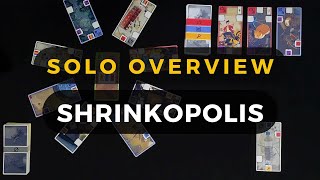
Reviewers describe Shrinkopolis as a quick, puzzle-driven resource management tile placement game set after a shrink ray has left humanity only an inch or two tall. Published by TLAMA Games in 2025, it supports one to four players, and reviewers place a session somewhere between roughly 15 and 45 minutes. Enthusiasm among people who have played it is strong. Watch Review ranks it among their favorite releases of 2025 and calls it an overlooked hidden gem, praising the drafting, the tile laying, and the positive interaction between players.
TheGameBoyGeek presents the game as a district-building contest in which each player tries to become the first crowned mayor of Shrinkopolis by linking cards together for the most points. Early impressions of the physical product come from Danielle, Watch Review, who examined prototype components ahead of the game's crowdfunding launch on GameFound. Danielle singled out the animal meeples as very cute and said the components look fantastic, while cautioning viewers that the pieces were prototypes that could change before release.
Core Mechanics That Define Shrinkopolis
Entwined Card Drafting
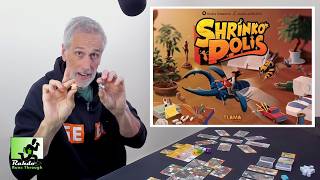
Each turn a player gains two cards from a central offer, one gray city card and one reward card. The offer is arranged in pairs, so a player is choosing a bundle rather than a single card. Rahdo describes this as Cascadia style entwined drafting, where you take bundles that contain some cards you want and some you do not, and the choice of which pair to take is often the most interesting decision of the turn. The city card must be placed immediately, while a reward card can be played only if the player can pay its resource cost. An unplayed reward card can be held in a reserve of up to three cards or released to the market. In solo play, the automated opponent simply takes the two cards opposite the player's choice, which Rahdo notes is a convenient shortcut that keeps the solo game moving.
Tile Laying and Connection Links
Every city card must make at least one connection with the existing layout, and its orientation determines which resources and points it produces. Watch Review compares the tile placement to a jigsaw puzzle and says the freedom to rotate cards, including placing them at angles that are not parallel, gives the layout a great deal of flexibility and fun. Objective cards reward careful arrangement. Some score a point for every linked empty connection, some reward a rectangle or square of at least four cards, and one of the public objectives rewards a layout with no perpendicular cards at all. Purple culture cards provide connection cubes, which TheGameBoyGeek describes as a way to create a link where the layout does not provide one, so that a player can connect two points for the end of the game.
The Shrinkopolis Experience
A Quick Five Round Build
Shrinkopolis lasts five rounds, and reviewers are consistently surprised by how much fits into that time. Each turn follows a clear sequence: gain cards, play the mandatory city card, optionally play reward cards, decide whether to reserve or release unused rewards, and then clean up. Danielle notes that setup is very quick because the game has relatively few components to lay out. Rahdo says that players will be amazed at how much they can accomplish in five turns as they rebuild humanity on a micro scale, and Rahdo describes the pace as one of the game's strongest qualities.
Combo Chains and Resource Puzzles
The feel of a turn comes from chaining effects together. Players pay for cards by spending resource dice, and a spent die is used up in full. TheGameBoyGeek points out that this happens even when a card costs less than the die shows, which pushes players to plan their layouts around exact costs. Tools are the main way around this constraint. A paintbrush recolors a die, a glue tool combines two dice to pay for a more expensive card, and a scissors tool lets a player keep the change from a payment. Each tool can be used once per turn, and only one tool can be used when playing a card. Rahdo's solo run shows how one well-placed city card can generate food that pays for a reward card, which then produces tools and culture that enable the next build, creating the kind of chain that makes each turn feel rewarding.
What Makes Shrinkopolis Stand Out
A Theme About Shrinking
For many reviewers the setting is the main hook. Rahdo says that half of that enthusiasm comes from the theme, and Rahdo compares its tone to the film Downsizing, which Rahdo describes as harrowing yet ultimately uplifting. Rahdo also links it to the animated series Solar Opposites, which contains a show within a show about a world where humanity has been shrunk. Rahdo acknowledges that the tile layout is largely abstract, yet the premise of building a city from plastic bottles and napkins is enough to pull them in. Danielle highlights the charming animal meeples as a standout part of the presentation.
Positive Interaction Through Animal Helpers
Animal helpers are the main channel for player interaction. The game includes five sets of animals, such as ants, rodents, wasps, fish, and stag beetles, and each animal scores points at the end of the game, with bonuses when animals of the same type sit next to each other. When an opponent makes a connection, a player with an animal on their board can send it to that opponent's board, and both players gain resources from the exchange. TheGameBoyGeek describes this as entirely positive, since the player who places the animal gains something extra and the receiving player is not penalized. Rahdo says this mechanism is a major reason for loving the game, because animals can pass back and forth across the table in a way that turns competition into shared progress. The box also includes solo, team, cooperative, and campaign modules, which Rahdo highlights as a source of replayability.
Potential Drawbacks
Strict Building Rules
The most frequently raised concern is the rule that building does not return change. Rahdo acknowledges that some players will find this harsh and restrictive, because a player who spends a tool or die on a card that costs less keeps nothing from the remainder unless they have the scissors tool. The result is that players must be very precise about what they harvest, and a single imprecise placement can waste resources or block alignment-based bonuses. Rahdo notes that the tools soften this considerably, but the rule remains a point of friction for players who prefer looser planning.
Scarce Resources and Contested Objectives
Reviewers also point out that resources are hard to come by. Rahdo says players must avoid wasting what they harvest, precisely because resources are so difficult to get. Danielle's solo overview adds that the animal meeples have no purpose in the solo game, which may disappoint anyone hoping for the same experience. In multiplayer, Rahdo warns that public objectives sit in the market, so an opponent can claim one that a player has been building toward. Rahdo compares this risk to the tension found in Key Flower, where investing in a goal does not guarantee that you will get to finish it.
If You Enjoy Shrinkopolis
Players who enjoy Shrinkopolis for its drafting and layout puzzles should look at Cascadia. Rahdo draws the comparison directly, praising the entwined drafting as the best kind of drafting, Cascadia style. Both games ask players to take bundles of tiles and then arrange them so the layout produces scoring combinations, which means the decision of which pair to take matters as much as where the chosen tile goes. Shrinkopolis adds resource dice and tools on top of that structure, so fans of Cascadia who enjoy managing a tight resource budget will find a familiar kind of planning in a faster package.
Key Flower is the other comparison reviewers make. The risk of building toward an objective that an opponent can claim first is what Rahdo links to Key Flower, so players who enjoy the planning and competition of Key Flower may appreciate the same tension in Shrinkopolis's public objectives.
What Reviewers Are Saying
"Whenever you spend a dice, it goes all it gets all used. So even though this one costs two or one, all three of those resources are used."
— TheGameBoyGeek
"It's just a blazingly fast game that is engaging from start to finish with tons of variability and replayability built in. I haven't even got a chance to play it cooperatively."
— Watch Review
"They're animal meeples and they're very cute so we have like a bumblebee um a crab or or a lobster actually we have like a whale an ant and also um I I'm not sure what this is let's see is it a a Geral maybe yeah a Geral maybe or a hamster um but yeah these look really neat so take a close look at the design of these."
— Danielle, Watch Review