Jungo Review - Why I'll Never Play Scout Again!
Games in This Video
1 game is featured in this video — it unlocks as you watch.
Transcript
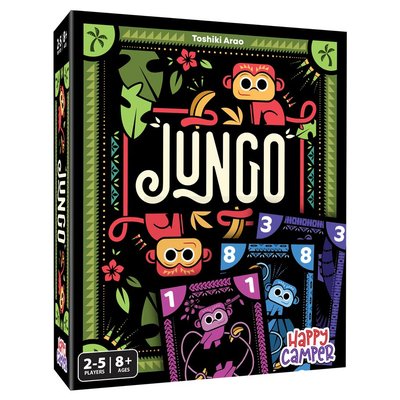
Miniature Market has thousands of board games at discounted prices. Click the direct link below to see all those discounted games. Hello my friends. Today we're going to be looking at a cute little card game called Jungo. Uh this is from Happy Camper Games and this they've done things like combo uh and they've done Trio and a lot of little small card games. Let me show you how this card shedding game works and I'll see you on the other side. Now, the deck of cards in Jungo looks nice and fresh. The artwork is nice. It's light just like the game is. And cards are going to range from one to eight with some of the cards having choices where you want that card to be. Now, the object of the game is to run out of cards. The first one that does that wins. And it's a card shedding game. Now, you are trying to get rid of the cards. But you can only play cards that are next to each other. These would be in my hand, secret from other players. And you cannot rearrange the cards once they're dealt to you. So this is the way they were dealt. Now when you play cards, you can play a single card like the two or the eight. You can play it from anywhere. But if you play multiple cards, they can be next to each other. So if I want to play these two ones, I could do that because they're next to each other. And I can do that.
Now, why would I want to play two ones? Well, playing two ones is good because, well, it's a set of two cards. But now look at this. Now I've got sixes set up for my next for a possible future play that are all next to each other. And then the more cards you play, the better. Now, the next player has a few choices. They can play cards, which if they play cards, they can play either more cards or the same amount of cards. That's more, for example, they could play two eights. That's a seven eight. They say, "Hey, this is two eights." And so, because they beat this the same amount of cards and the numbers are higher, they beat it. Now, the player that played this can either discard these cards or they can take them and put them in their hand. They might want two ones and they can put them anywhere in their hand because this might allow them to place it next to a card that they already have one. So maybe they take this. So now the next player, they need to beat two eights. So let's say the next player plays three fives. Well, it's more cards than two. So it automatically beats it. You can only play the same numbers. There's no there's no runs or straits in this game.
It's always the same rank. And so someone might play three fives and it beats us because it's more cards. Even though the number's lower, it's more cards. So it always beats less cards. And then that person would decide, do I want these or do I want to discard them? Maybe they discard them. Maybe like, you know what, I can't really do anything with those eights. Um or I don't want to. So, this would be there like that. Now, let's say it comes back to me. And technically, I could beat this with my three sixes, but it's gonna give me not a great hand. So, I'm not going to beat that uh for now. What I want to do is I want to pull a card. So, you can just draw a card instead of playing a card. Now, this card, I could discard it or I could put it anywhere in my hand. So, maybe I want to put it right here because now I've got the eight there. So, you can draw a card, put it in your hand. That's it. You can also when you draw that card, play it in front of you if you can beat what's there uh by adding cards to it. So for example, if I drew that eight and I could say, "Hey, I'm going to put an eight down. I have two other eights that are next to each other." You can do that, too. So you have a lot of flexibility in drawing a card. You can either put it in your hand, you can discard it, or you can play it along with other cards of the same rank that are next to each other in your hand to try to beat that. That's called a jungo. Now, if this ever gets back to the player, nobody beat it, it gets discarded and they start a new set.
So, let's say by the time it gets back to me, there's two fours and I'm like, "Okay, well, I could beat this with the three sixes and I'll take those two fours because I want to slot them in right here so that now I have three fours to to to push a little bit later. But again, you're trying to get rid of cards. So, you're trying to get yourself powerful sets in order to go out first. And whoever goes out first wins or you can play multiple rounds, and whoever wins two rounds first wins." All right, first thing I like about this game, adorable artwork on the cards, uh the little monkeys and such. It's just it's light looking. The game's light, so the the art sort of matches the the the the type of game it is. Good quality cards. I'm a stickler. So, if it's a card game, make the cards good, please. They did with this. They're nice. They're thick enough. They're linen quality. They have linen finish. They're quality. I like in this game that you're I mean, it's a it's a card shedding game, right? So, I like that you're crafting your hand all the time. You're you're you're you're you're taking cards, you're getting rid of cards, you're trying to run out of cards, but you're crafting a hand over the course of the round, and that hand is going to change. You're trying to sort of bridge things together, like in most card shedding games. But I like that it has sort of a fluid hand size where like you're dropping down as you're throwing cards, but then you maybe be adding it back up by taking other cards that you just beat. So, you're like, "Well, I'm not even getting closer to having no cards, and that's how you win." Yes, it is how you win, but sometimes you'll need or want to pick up the cards that you just beat and put them anywhere you want in your hands because, you know, that's it. So, that's the next thing is deciding what to do with the beaten cards. Do I want to take them or do I
want to just discard them? And that's a big choice. Earlier in the game, you might want to take them. Later in the game, if you don't have a big set that that's going to add to, you might want to leave them because someone else might be able to, you know, beat you out and that's going to add you another turn in order to go out and people are getting low on cards like, uh, this would make a really big set over here, but I have a small set for that. I'm almost out. So, deciding what to do and that decision will change based upon what state the game is and how close to end you think it is. I like that. The same exact state cards that that that I could take, I might take them, sometimes I might not, depending on what's going on in the game. I like that. Uh I like that you have uh multiple options when drawing a card. So, hey, I don't want to play a card. I can't play a card. I'm going to draw a card. Great. Am I going to discard that card? Am I just going to put it in my hand? Or am I going to jungle and place it down and then add cards that are next to each other in my hand to try to to beat what's there. I love that you you randomly get a card, but if you've set yourself up well, you might be able to do different things with it. I like that you have lots of choices even when you don't have a good set to play. And that feels good. Pick up a card. Oh, I can discard it. I can keep it, put it anywhere, have all this flexibility or play it possibly and still beat something. That's great. When you don't think you have a plan and something falls in, that's that's awesome. Uh, this game has like a feeling like deck building um or you know, building a hand at first. So, like in deck builders, you build this hand, you build the engine, you build the engine, you build the engine, you build this money engine, you get all these cards. At some point, you got to convert cards and money and engine to points, right? And this is sort of a similar feel to that where you're like, I'm
building this this hand. I'm building these cards. I'm grabbing these cards. I'm beating these cards. I'm adding these cards. I'm making these things. But at some point, you're going to have to be like boom, boom, boom. And like three turns in a row try to like drop your whole hand down. And you got to try to convert from what you had to some to, you know, big points. It kind of feels a little bit like a deck builder there. Now, I I read somebody had u mentioned like this is as if Riner Kenichi designed Scout. And I gotta say, I kind of I kind of agree with that. Um, there's a couple games that this is very similar to. Well, there's a lot of games this is similar to, but there's a couple that stand out my mind. U, one of them is Linko, which was a Keyling and Kramer Keysling uh, card shedding game where you're playing sets just like this, and you're taking cards that you beat and things like that. This one, Jungo, and I played Linko and Scout back toback with Jungo. Uh, and this is so much more streamlined and clean than than Linko was. Like I really remembered enjoying Linko, but after playing Jungo, this is replacing Linko for me, period. Also, Scout, I never was a huge fan of Scout.
I didn't like it as much as many people did. Um, but you know, I didn't like how the trick taking just kept going around and around and around. It kind of felt like one big hand. I in in Scout, you know, you're scouting, you removed a card, making it easier to beat. Uh, so that just made it go over around and around. there was not enough like sort of fresh resets in a within a single round. You know, with jungo like like with scout, you're playing a card or if you don't, you can scout and then take a card. In jungo, you're playing a set of cards and you're taking cards. You're either putting them in your hand anywhere, flexibility, or you're discarding them. So, it's like it's like double the fun of scout because it's like, I'm not doing this or this. I'm doing this and this. Playing cards, taking those. Huh, I did something good and I'm getting something good. It's just positive reinforcement and it feels good and it's super streamlined. It's a lot less fiddly than scout. It's a lot easier to teach than scout. Sure, you might say, "Well, there's not the double-sided cards in Jungo. You can't even play runs in Jungo." True, but the game, I think, is a better game. It's more streamlined. It's easier to teach, but yet there's still great decision space. And the positive reinforcement of playing cards and taking cards and not have to be like I'm doing one or the other. I think makes this game better than scout for me. I I didn't love scout before. I know a lot of people do. I like this better. In fact, everyone that I played this with likes it better than scout except one person who loves scout and even they said, "You know what? I would sometimes scout is really hard to teach to people that don't play a lot of games. Jungo, if I play taught them
Jungo and then taught them scout, that'd be even better." So, one person that like will defend scout to their deathbed still would say I would play jungle with new people first and then teach them scout. Use this as a stepping stone, but almost everybody that I've talked to and played this with uh will likes this more than scout. So, I think this is a scout a scout replacement personally for me and for most of the people I've played this with. Uh so, I I think this is a fantastic thing. Anything I don't like about it? Couple things. Well, it's a card game. Luck of the draw can really make a difference. Uh, which is why they say you should kind of play multiple rounds so you can have, you know, whoever wins two rounds first. The game is better than with more than two people. It's not great with two. It's better with more. The other thing is the longer variant is like play till everyone has two two things. The problem is that kind of it doesn't scale that well because with three players versus five, the amount of rounds you play are going to be more. Now granted, the rounds are quick, so it's not a long game. It's not a big deal, but I would have rather have said, you know, three hands feels about right for this game.
And there should have been some type of scoring like, hey, if you went out first, you know, let's say you're playing a four-player game. You go out first, you get four points. You go out second, you get three points. You go out third, you get two points. You go out last, you get nothing, right? Uh, play three hands. Whoever's the most points in the end wins. I like that better than just saying, "Well, play till someone wins two because a three-player game is going to be usually shorter and a handful of rounds less than or a few rounds less than a five player game possibly." Uh, and I think I think that's a better way to do it, but it is what it is. It's a minor quibble. I really enjoyed this game. I think a lot of people are going if you like carding games, if you like Scout, this is definitely one to check out. And this is Jungo. And for all those reasons, it's staying in my gaming library. and it is getting a saxophone serenade which is my biggest award. So, here we go.
Game Toppers upgrades every game you play, being the one table to rule them all with game toppers, leg kits, dining covers, premium game mats, and more in their 5.0 Kickstarter, they found a way to deflate prices to prepandemic levels without sacrificing their quality brand and in some cases by $200, plus dropping the shipping price as much as 50%, saving another $100. Go to gametoppers llc.com to late pledge now.