Grand Central Skyport Review
Games in This Video
1 game is featured in this video — it unlocks as you watch.
Transcript
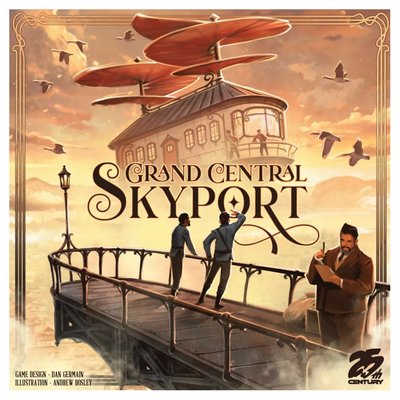
Miniature Market has thousands of board games at discounted prices. Click the direct link below to see all those discounted games. Hello my friends. Today we're going to be up in the sky going from station to station. Uh we're going to be enacting tycoons. Today we're taking a look at Grand Central Skyport. This is from 21st Century Games. Let me show you how it works. I'll see you on the other side. At the middle of the game, you're going to select a city that gives you a player token, nice acrylic one from New York, to Tokyo, London, or Paris. And like if you select New York, you'll also get a starting skyport, which has two different stations and two different airship. What you're trying to do is build up the skyport that scores the most points. On your turn, you're going to play a card from your hand to either the most right or left side of your skyport, like this. Then, it's going to have an ability that you must do, like move left or right two to three spaces.
So, I go one, two. So, it's going to go in between these ones just like this. Now, why' I do that? Because this one is yellow. This station is yellow. So, this is good because this now links with this, which gets me a star. This little icon here, which is a point. At the end of the game, I'm going to get a point one times every yellow card I have uh in this one big column here because you're trying to sort of set collect colors and link them to the right colored station. But the cards you play also tell you how far you'll move on the Rondell. Now, you can move up to that number. I can move up to three. So I could go one, two, or three spaces clockwise. And let's say I go two. Some spaces you can choose between the card that's there or an action like taking this station and adding that station to try to score with red and orange uh colors a little bit later. But in this case, I'm going to take this card and then this will get refilled and then it will be the next player's turn. Now, you always have two cards in your hand, at least two.
There's some abilities that let you have more. Uh but you'll pick one of those two to play. In this case, I'm going to play the one I just played. This says move left, right by three spaces. So great. 1 2 3. So it's going to place it in between this like this. But anytime after the movement, if you have same colors together, well, they combine. And this is great, too, because now here I'm going to have this point linked to this. It's going to be one times the amount of cards, two. So at this point, I have two points. But there's ways to get more points, and we'll show you that in a moment. because some of the spots allow you to take different types of tycoons. And there's five different types of tycoons, all with different types of abilities and scoring objectives. Some of them depend on the color of card that you play. Some of them have different icons that allow you to do different things like move further on the rondelle. Some of them allow you to break the rules of placement like placing it right next to it. But again, scoring for certain types of icons and things on the cards at the end of the game, like crates and clocks and tickets. For example, this one allows me to insert airships to the left or right of this station because they attach to a bottom of the station. But look at this.
Now I have two icons here. So now at the end of the game, I'm going to get two times these two cards of the same color that's linked here. So that's going to be four points. And later on during the game, if I get this one, that's one, two. So it's 1 2 3* three. Now you're up to nine points there. So you can see you can get the multipliers up pretty quickly. and that's what you're trying to do. Now, you notice there's different icons like clocks and uh tickets and sometimes there'll be uh you know crates and such. And that's great cuz there's a spot on the board that when you go there and you take this card, if you have a complete set, you get this, which is the most points, seven, and then it goes down as people get there slower than you. And if you end up going to this spot and only get the card, but if you have a complete set of one of all the colors, you get this, which starts at nine points and goes down. Sometimes you can immediately move that a lane that matches the color of this card, like orange, uh one to two spaces. Sometimes depending on which cards on the board, different things will happen. And sometimes you'll be getting stations instead of cards, adding those to your skyport. And for example, adding this on your next turn and on a future turn, maybe adding this allows us to move one or two spaces to the left or right. And so now I'm going to be trying to score purple there. Some contra swap with any lane. And that's great cuz now I can swap with this blue one. Putting this here. And now that those are together, they'll merge, making this one two cards, where I have one, two, three, four. Wow. So, you've got four icons and two cards. That's already eight points because I got purple being scored on both sides. That's pretty much what you're doing at the end of the game.
You're trying to have the most points as I showed. And that's pretty much Grand Central Skyport. All right, there's a very highle look at Grand Central Skyport. Definitely did not show you all the rules or all the cards there. Uh, first of all, gorgeous art to look at. Andrew Bosley art. He does amazing work. Uh, and it looks great here. Uh, I like the randell with multiple levels of depth. So, there's a lot to think about here with how simple the game is. You're, you know, you're going to take a card or you're going to use an action. So, sometimes you're doing one or both. Sometimes you're actually able to do both of those on the rondelle. Uh, sometimes you're going to be moving a color lane of this card one or two spaces because I went to that spot at the right time. I was able to manipulate my tableau and my my skyport specific ways. There's a lot of the things here where there's a lot of sort of strategies in the game that aren't obvious the first couple times you play them, but as you play the game, you'll find the right times to do the right things, like getting the right station at the right time or enacting those specific spots on the board that allow you to manipulate your sky port and things like that. There's a lot of opportunities for strategies here that are very nuanced in playing that you don't see sort of right away in this game. It has a lot of depth. I like that you're playing a card for its color, ability, and or movement. So, there's multi-use cards there. You're playing the card, you're looking at it, and you're going, "Okay, I'm going to move this three time, you know, up to two or three to the right or left, and then I, you know, I'm going to now be able to move that much." it it's interesting that it's the ability which changes your
tableau hopefully changes your scoring but then that also allows you to then move a certain amount up to a certain amount of spots on that board and so you you're thinking about a lot on the turn a little bit more on that on later I like that you're trying to line up colors adjacent to each other that are the same so you can sort of merge them together that's like the name of the game is trying to get large columns of the same color uh and then get a a tycoon to those stations and try to get as many points as you can on Uh the tycoons add a lot of crunchiness and flexibility to the game. So a lot of things of like hey you know if you have these icons you'll get extra points or if you have these ticket icons you can move further on the rondelle. Those types of things are cool. They let you break the rules of the game but it also gives you some flexibility. Like there's one of them that allows you to say hey place your card next to the station this tycoon's in and then enact its ability.
Gives you more flexibility on placement. So, they really allow you to change a lot about the game, but also gives you some endgame focus. I like that they sort of like put both of those two types of things together with those. Uh, so overall, the game is, you know, it's a it's seems like a basic Rondell game, and it is. I'm not saying this is some heavy game, but there's a lot to think about there. Um, now the next thing I'm going to talk about is could be a negative for some, but part of the reason, so normally in Rondell games, you usually you move around a rondelle, you get something like some sort of resource or take an action and then you do something with that and then it's like the next turn. This, it's almost backwards. It put that on its head where you're playing a card, you're doing an ability that's completely changing your skyport, which is going to change what you want to do next. Then you're going to move on the rondelle up to based upon what you played. Then gain an action and or a card and then that card is something that you're hoping to plan for for the next turn or the turn after that. And it might seem like not that big a difference, but it really is because you know in Rondell games normally when you do the other thing you're still thinking like two or three turns ahead. Okay, I'm going to go here.
I'll get this. I'll do this. Next turn I'll be able to go to this spot. And it's pretty straightforward. this I don't want to say it's unintuitive uh but it's it's makes it a lot more crunchy where it's backwards than than than most games play because again you're playing that card you're manipulating something you're then moving and then taking a card. It's almost like you're you're thinking two turns ahead every turn no matter what but you're thinking three to four turns ahead because you're doing basically two things with each with each turn. You're playing a card, manipulating your your your all you're scoring is skyport, then you're moving, then you're doing something else, and then you're also doing that something else based upon what you want to do next turn. So, it can feel unintuitive to a player that that uh that doesn't play a lot of games, but it's also what makes this game different. It's also what makes this game incredibly crunchy uh even with how light the mechanisms are because it's almost like you're like, whoa. It's it's it's I think it's a good thing, but some people might feel like it's a little because it's hard to, hey, I'm going to play this card, then my tableau's going to look like this, and then I might be able to move up to this, and then I might be able to get this. You know, there's a lot of things you have to sort of like think picture in your head before it happens for the planning in this game. And some people are going to love that, and some people it it might not rub them the right way.
The brain might just not work that way. U the one other weird thing, it's a it's a minor thing, is the the scoring tokens for the set collection. and of the token of the of the uh icons and the the airship colors. They didn't scale uh per per player count, which I thought was interesting. They the same ones there. So, like if you're playing a two-player game, you're just getting two more points to the next person. Feels like they should have like taken out that second token uh and maybe put like the top one and one two down from that and then that's it cuz there's two players. You can only take one of those each anyways. Kind of surprised it didn't have some some type of specific setup for the different player counts. Feels like that was made for the four-player game and they didn't scale that in the setup for the three three of two-player game. Minor minor nitpick there. Um sometimes, hey, it's luck of the draw.
The specific station you need might not come up and if it does come up, it might come up when it's kind of too late in the game. That's just going to happen. You're going to have to work your way around that. But that randomness might be negative for some people. Now, one of the things in this game is you have to you it in the rules it says you're required to do the thing that's on there like moving or swapping. And sometimes you have a card, you have you have two cards in your hand, and maybe neither of them allows you to do something great at the time. Maybe you should have planned better on the rondelle, but maybe there was just the luck of the draw. It didn't matter what you took either turn. You have things that aren't going to let you do things that you want. Sometimes you're forced to sort of misalign a color by moving things around to a spot where you didn't want to have it. So now the thing that was scoring is no longer hooked up to that station, and you're going to need to figure out a way to get that back. And that might frustrate some people. Uh, but that's part of the game.
So, that's pretty much it. I think if you like Rondell games, if you like sort of that abstract moving things around type of thing, you like special abilities, I think you'll like this. But there are some things that might trip some people up in this game, but that's also what makes this game different, which is good. And that is Grand Central Skyport. It's the game by geek breaking down barriers, growing relationship with board games by helping you find one you love. Game Toppers upgrades every game you play, being the one table to rule them all with game toppers, leg kits, dining covers, premium game mats, and more. In their 5.0 Kickstarter, they found a way to deflate prices to prepandemic levels without sacrificing their quality brand and in some cases by $200, plus dropping the shipping price as much as 50%, saving another $100. Go to gametopperslc.com to late pledge now.