Tintas - First Play Review
Games in This Video
1 game is featured in this video — it unlocks as you watch.
Transcript
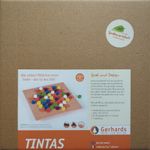
Hey there, I'm Jonathan with Getting Games and this is my first play review for Tikal. In this video, I'll be giving you an overview of how the game plays and I'll talk about what I was thinking about while I was playing the game and my thoughts on it at the end. Now, what you're going to see here is a segment that was recorded for the Patreon supporters of the channel and you can learn more about how you can join in on that by going to gettinggames.com/support. Now, if you have thoughts about this game while you're watching this video, I'd love to see those as a comment down below. Also, if you enjoyed the video, then please click the like and subscribe buttons down there. Okay, let's talk about the game. This is a wonderful two-player only abstract game that came out in 2016 designed by Dieter Stein and published by Gerhards Spiel who makes really great looking wooden games, just really good component quality. As you can see, the board is wood with grooves in it and these discs and this pawn right here. And the game is very straightforward to play and I'm actually just kind of kind of teach you the rules to it because it's quick before I talk about how it went. And I think I'm actually going to be doing it using the online interface. So, I played this one online on a website called abstractplay.com and this is a screenshot from like halfway through the game or so. So, the way this game works is there is a neutral pawn and on your turn, you must move that pawn in any one of six directions until it reaches a token and then you take the token that went there. So, in this case, you can see the pawn was here and it moved on to that spot and it then took the token and you put the token in front of you. There are seven different color tokens and there are seven of each color token and the goal of the game is to either get all seven of one color or once the game
is over when all the tokens are taken, you have four or more in four or more of the colors, essentially a majority of the majorities. Now, as I said, you move in one direction until you reach a token and then you take that token, you can't skip over things. And the last real wrinkle to this game that really makes it pop is if you land on a token and you can move from that token onto another one of the same color, you can do so. So, for example, in this moment, I think it's my turn, the pawn is right here. If I move it here onto a purple, well, I can move from there onto another purple without having to skip anything else. So, I can go there and also take that purple. From here, doesn't look like I can do that anymore, so I'd stop. Or I can go onto this orange and then take this orange. But if I do that, then I have these two orange which is good, but that means on my opponent's turn, they could go here and then here and then there because of course this orange is gone and then there. So, if I do this orange play, I'm setting my opponent up to get four purples on their turn. I'm obviously not going to be doing that.
And this is the where the game is. That's essentially all the rules to the game like there's a couple little nitty-gritty things, but the decision space in this game for its rules complexity fascinated me. I actually played this one online a couple of years ago and I thought it was really not very good and then I realized subsequently that I was taught the game wrong. Now that I played the game correctly, I'm like, "Wow, I get it. I can see why people talk about this game." Honestly, at some point, I'm not rushing out for it, but at some point, I think I want to own this game. I'm not actually an abstract games person, but I think it's beautiful on the table and the box I think has a has a nice aesthetic to it on the the shelf. And even though I don't play abstracts that much, this feels like the kind of game that I would probably just keep forever because you can teach it to pretty much anybody. And let's talk a little bit more about the decision space and the head space that I was in. I've only played this game once, but I would certainly like to play this one more.
So, obviously, you have all of these tokens in front of you and you're aiming for these majority majorities while also keeping your eye out for that elusive get all of one color. And of course, at the top end of decisions, there are six different directions that you could potentially go, but usually that's not actually the case. For example, with the pawn right here, you could go in two directions. You go here, here, here or here or up there, but you can't go up there because there is no token to go to. If I send it over here, then that means on my opponent's turn from here, they have to go there or there. They only have the two spots. So, that's a big thing that you're thinking about as the board is starting to clear out. Like, can I put my opponent into a position where no matter what they do, they do something that helps me or both of the options that they have are not good or maybe there's only one option and I'm forcing them into a play that kind of keeps me in control because that means they have to go over to this spot and I really want them in that spot because then I could grab those two and then take that majority.
So, obviously, part of this game is trying to get one of each color, especially if you think your opponent might be gunning for the seven. If you get one of each color, then it's not going to be an instant win, you're going to keep playing until one person has a majority of majorities, which again is four or more in four or more of these colors. And you're also thinking about the jumping. I remember this part of the game being really fascinating to think through. As you can see, I actually have three purples already. There are four purples on this board. So, my opponent could see that there was the potential for these four purples to be taken in one move if he didn't, you know, if he wasn't careful essentially. So, he was very careful to make sure that that did not happen, but you know, with the pawn in this area, it's entirely possible I was trying to get the pawn into this area because I wanted these.
But also at the same time, I could make a simple mistake and then suddenly my opponent takes four of these and four is bigger than my three. So, I go from like vying to end the game by grabbing all four of these to just losing an entire majority like that because of the randomness of how these tokens were placed out. Like, this is a game where every single time you play, you set it up and it's just a new puzzle to try and think through. At the very beginning of the game, the first player can put their token down anywhere. So, that's also just a decent amount to think about. Like, what color do I want essentially to start things off, but also you're setting the tone for the entire early game by being the first player to decide where this pawn actually goes down. I don't know if I actually have that much more to say beyond what should now just be obvious that this is it feels like a classic game. It feels like a game that, well, I guess 2016 is 10 years ago, but it feels like a game that could have come out a long time before that. It feels like almost an emergent design like, "Oh wow, yeah, of course this game should should exist." Like, "Why didn't I think of that?" sort of a thing. Not because it was easy, but because it just feels so elegant. I think it's fascinating. It's one I'd love to introduce to more people when I have the opportunity. Again, I don't play abstract games that often, but also from like a, you know, kind of collector's perspective, I think it just looks great. I think it has that classic vibe also on the table. And it's not very cheap, so I'm not going to be rushing out to grab this one right away, but at some point, I do want to own a copy of Tikal.