Cthulhu: Dark Providence Review: Cult of Personalities
Games in This Video
1 game is featured in this video — it unlocks as you watch.
Transcript
Hey everybody, I'm Tom Vassel.
I'm Joey Evans.
And I'm Mike Delisio.
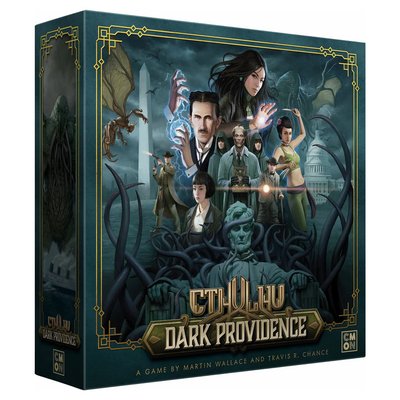
And today we're taking a look at a game called Cthulhu: Dark Providence. Now, this is a sequel of a sequel. Um, this is based on well an older game from Martin Wallace
Study Emerald.
Study in Emerald. There were two Study in Emeralds. There was Study in Emerald and then Studying Emerald 2. And the games were considerably different. They they had some of the same basic attributes to them. This is a remake of those games. Uh, the those games alluded to Elder Gods and things like that. This is like uh yo, Cthulhu's here. Um, it also because the game is made from Sean has a lot of crossover at least in universe/artwork with their Cthulhu Death May Die universe.
And then this has another designer, Travis Chance, uh, worked with Martin Walls to make this game. Mike, you have played one of the original games.
I played both of the original games. Yeah.
So, which one is this closer to?
It's much closer to first edition. Yeah. So,
first edition is the game I played back in the day. I never did play the second.
Yeah. Second game. The second edition kind of streamlined things, but we'll get to it because I'll talk a little bit about it.
All right. Well, let's take a look at a little bit about how this game plays and we'll be back. We're not going to go over every rule, but I'm going to explain some of the basic concepts of the game. Players are scoring points in this game, and there's many different ways that the game end can be triggered. But at the beginning of the game, depending on the number of players, you're going to get randomly dealt an allegiance. You're either on the one of the investigators, one of the cultist, or like a side party, a dissident cultist or dissident investigator. These are kept secret. There might be a reason that you can and should reveal it over the course of the game, but you'll get extra points at any game if you don't. The thing is, the two investigators are on a team and the two cultists are on a team and the dissidents are kind of on their own team. And at the end of the game, let's say I'm a purple player and I find out that the blue player is on my team.
Well, whoever has the lowest score is eliminated along with the same person who's on their team. And then whoever has the highest score wins. This is not mean you're kind of on a team, but only one person is going to win. These people are sort of scoring points the same way one of the the either the cultist or the investigators are, but they're by themselves a little bit differently than that. So, that is the endgame. How do you get to this point? Well, each person is going to have a starting agent. So, here, for example, is agent Monday. You'll put it on this little platform here to show that it's yours. You'll be starting in one of the locations on the board. And you also have a starting deck of cards. These are all the cards for agent Monday. You're going to keep these on your board. And this is what we call a deck building game where you're going to shuffle this deck. And you're going to have five of these cards to spend.
And you'll have a chance to get more cards into your deck. On a player's turn, they have two actions. And there is quite a few actions that you can do over the course of the game, but the majority of what you're doing with many of your actions are you're playing cards to do things. Cards will give you cubes. When you have cubes, you can put these cubes on any of these asset cards that are out in play. You can put them on a city that's out there, or up here next to the board are giant mythos cards, and you can put them on there. At the beginning of your turn, if you have the most control on a card, and control counts your cubes and agents that you have at a spot, if you have the most control on that, you will take all the cubes that are on it. Those cubes go to limbo. And as you get more and more cubes in limbo, they're kind of stuck there. So, you can also play cards with cubes on to pull them out of limbo. You can even take cubes off any card and play. And then this card will go into your deck. some of the cards when you take them. So, let's say I take agent Moses Fleet here, I get another agent that I will again put on one of mine and I have an agent that can move around.
So, controlling cards, when you control a city, you'll put your marker in that city to show and immediately get victory points for it. This is one of the only ways to get points during the game. You will find that city card and add that to your deck. City cards have a lot of icons in the corners of them. And if you take a city that someone else has, they're going to have to give you that city. They'll lose points and you will gain points. So area control of these cards is going to go on. These cards when they're gone, new cards will come out. There's also cards are going to be moving up the two different tracks here. One for the cultist and one for the investigators. There's a slightly more complicated action that you can do with your agents where you will shut gates down or open a gate up which is going to give your team more points at the end of the game. Many of the actions that you do will cause you to draw from this bag here, insanity bag, or sometimes you'll buy a card. Let's say you you win the Shogunth card here. You'll draw from the bag. So, if you draw an insanity token, you're going to place on your board. And if you have three sanity, you've gone insane. and choose one of the endgame triggers. So, that is kind of the extent of the game. You're going to be playing two actions. And again, like I said, there's lots of actions. You can one of your agents can try to assassinate another agent. You can try to close gates down. You can move on the board.
There's little gold bars and you will spend gold bars on your cards to move. You also can spend gold bars to buy more cubes so that your pool is bigger. You can put lock tokens on cards so that they can and cannot be bought. And there's also other kind of things that can happen. There can be deep one figures that get placed on the board. You're moving up these tracks. If one of these tracks gets to the top, it ends the game. But also, how high your track is is how many victory points your side gets plus gates. Some cards will do all kinds of crazy things like this Dean card here. When you claim it, you'll instantly get the cube that you would move the limbo. Go somewhere else instead. And for the rest of the game, you can claim cards where you're tied for the the cubes. And at the end of the game, you win all ties during scoring.
So that card there, but you also might get this wormfilled book where you can obliterate this to claim a mythos or a primary asset. Those in the board that has two or more of your cubes on. You can do that immediately as a free action. And there's all sorts of cards in here, including the dreaded. There's a black goat, but also Cthulhu, which is a figure that comes out and does all sorts of nastiness, blows up a city, basically. And so, you're just going to keep doing this. You'll take your two actions. You'll draw up the five cards. Then, the next person goes and you go around the table until one of the endgame conditions is triggered. Then, we score like I mentioned at the beginning.
So, first before we jump into the gameplay itself, I want to talk about the the components. The rule book is fine. The not not great. And I like the art. I like the cards. Um, it all kinds of comes together. The symbols are pretty easy. I have one major issue, which is those little holders for the the agents. I am currently as his review is being spoken um someone is gluing ours together. Yes. So that they never come apart again because even glued together they're not going to be good. I don't know why they didn't put sides on them.
I agree. The the slant like you have to be facing it to re Yeah, I understand that. But you do.
Yeah, it is a fiddly component. There have been multiple people online complaining about it. The only thing I will say is that I do agree that that component specifically probably did not work out the way that they had hoped it would. There's also even a a situation where it could be blocking some cubes because it's on an angle. I don't worry about that as much. It's just the falling apart. There have already been a lot of 3D print um you know things out there. But I will say on the other end of things that I don't know that I would have sacrificed a higher price and a larger box to really significantly change that because one of the things I appreciate about this production is that they kept this in a very reasonable size box and a very reasonable price point.
I agree. But I think you could have just had little colored bases for each player and put the figure in it and move them around.
Sure. That's but like Mike said, this is for Sean not a particularly gigantic production. Um especially if you're just getting it right off the shelf uh in the store. Now I will tell you this also though, the game looks like a big game. This is definitely a game that I think almost lies to you when you look at it and you're just like, "What am I looking at? there's, you know, 12 different cards out there and three mythos cards and different areas and my cards and a there's so much going on
until you start playing and you're like, "Oh, I'm doing basically the same three actions over and over again with the occasional delving into a few other actions."
That's the one big thing when you look at the rule book, you're like, "This going to be overwhelming." And then you start playing, you're like, "Okay, I think I got it." I mean, they're little small things you have to look up, but
yeah, it's it's a and here's where I'll talk just briefly about the differences. You know, the first edition game, the one you played, Tom, um was very kind of ambitious in scope and in scale. Um had some very weird things that could happen, some kind of rough edges, but that was a lot of the charm of the original, too, is that it did take big swings. The second one streamlined it down to a point where I felt it took a lot of the soul out of the game. And I feel like this one uh is kind of the best of both worlds. It is more streamlined than the first edition. Um they made some very specific choices uh that made it a little bit less likely to have the crazy edge cases because as you said, it's a relatively simple action uh that you've got going on there. you're you're usually going to be placing out influence cubes or retrieving cards uh to in a kind of a deck buildingesque thing happening. Um but it does still have some kind of weird edge cases you have to worry about, just not as bad as it used to be. Um the the thing that I like the best, like my favorite mechanical part of this game is the way that you uh basically auction for the cards that you're going to be putting in your deck. And you know, in a lot of games that you utilize deck building, the cards, most games that utilize deck building, the cards have a fixed cost.
And it's like, okay, this costs me six coins. I have six coins. I'm getting this card. This card doesn't do that, or this game doesn't do that at all. All the cards are determined, the costs are determined by the players around the table. And I think that's brilliant because it kind of you don't have to worry about balance issues because the players are balancing it as they play. I just think it's such a clever design decision. Uh you can never say, "Well, this card is too powerful. It's too cheap." Well, it's going to cost whatever people are willing to pay for it. That is one of the things I think this makes this game very unique.
And then when you win, your cubes are pulled out of the game for a while while everyone else gets their cubes back. So that kind of balances things out a little
because there's so much going on. There are many people who I would not want to play this with because they're going to look at all these different options that you have. You have all these cities, like 12 cities, 12 cards, you 24 things that you can bid on at any given point, plus the different things in your hand. Um, so there's a lot of that going on, but I think the game shines best when you just play it almost from the hip.
That card looks cool.
Yeah,
I want that card. And in fact, I think, and you guys correct me if we're wrong, that this there's almost a direct analogy between this and Cthulhu, Death May Die,
which is Simon's other big game, where they're just kind of like, "Hey man, it's Cthulhu. Woo, now go have fun." And in this one, you're like, "Oh, it's Cthulhu. Ooh, I want that card. Oo, I want that card. Oo, I'll do this. I'll fight you. Oh, you assassinated me. Oh, bummer. I'm going to go close this gate." And it's kind of like this action and reaction. And while I don't want to I don't want to belittle the game by saying there's no strategy here, but I think to me the theme is so strong in all these cards and things that the entertaining value of just all the stuff you're doing is what makes it fun.
That's a huge thing too. This there's so much theme. I mean there's there's mechanics I love in it. I mean I love like Mike Mike said there's deck building with an auction mechanic type of thing where you drop the cubes. There's also like area control which is goes into the auction thing which I love. But the theme, you've got people that are just bidding and bidding for some maggot book over there that they don't know what it does. They're like, I need that in my life, you know, and it's just, it makes the game so fun. Then then of course you forget that you have to seal the gates, which is really critical, you know, because there's so much else fun stuff happening.
Well, say who you are.
Yeah, I was gonna say maybe you don't want to seal the gates, maybe you want them wide open. Um, and that's kind of one of the things also that is unique about this game that that that kind of carries through. Although they did make a pretty major change in this one is that at the beginning of the game, you're going to be dealt a particular faction. Um, and your win conditions will be different depending upon which faction you're in. You know, just on a high level thing, if you're an investigator, you want to close these gates. You want to kind of keep the influence of the great old ones out. And if you're a cultist, obviously you want the opposite. And then you've got dissident. Now, that is new. Uh, this idea of a dissident cultist or a dissident investigator was not in either of the previous two versions of the game. I think it's a positive change and it makes it more viable at lower player counts. Um, Study and Emerald was never a game that I would want to play at the lower player counts before, whereas here, I feel like you could. I probably still wouldn't want to play it at two, me personally. Uh but at three you still kind of have that intrigue of not knowing exactly what people are doing.
You're trying to read into what the you know people are doing and sometimes you can throw red herrings out there and those dissident agents allow you to do that more.
Yeah. The the game the game itself there's all this stuff going on. But I think while I said earlier, you know, once you start playing it's so easy. Get cards, do this. One thing that you're gonna kind of need to explain multiple times to people who've never played the other games, and this is the first one, is the scoring because it's a bit wonky. Even in the overview, I used the word teams, but I kind of hate saying that because we're we're no team, man.
We may both want to see Cthulhu come out the gate, but I want him to then hug me and crush you. So, it's the only reason if Joy's on the same team as me is I don't want him to be in last place.
That's Yeah, that's interesting. I would like him to be second last because I want to win.
So that's that's kind of wonky. And I think the dissident help a lot because it essentially adds a third team into the mix.
And it kind of balances well. The only part where that falters for me a bit is that a about halfway through the game, ain't no secret who's who. I mean, maybe there's a little bit, but it's usually pretty obvious. Um, and there's not a lot you can really do unless like if I'm like I think Joey's on my team, there's not a lot I can do to help him. There might be a few things. There's a few cards and stuff, but that that kind of brings the game together in that strong thing. I think this game's fun. I think it's rollicking, entertaining. I'm giving it an eight out of 10. You get to move around. you get to do lots of things, move up the tracks once you know how things work and in particularly how assassinations and taking um opening a gate. Those are kind of the two trickiest things and they're not even that tricky. Um especially again if you can teach everything in thematic. It's harder for me to assassinate you in this city because the police presence is so strong. Oh, okay. That makes more sense.
You know, there's things like that. And then all the different cards, it will be different every game. The the two teams play very differently. It's easier to close gates than it is to open them, but at the same time, it's easier for the cultist to shoot up their track than it is for the good guys. Um, and I yeah, I do mean good guys. So, uh, yeah. So, very fun game. All right, I'm going to go next. I'm coming in higher at a nine. And I'll tell you why. I love this game because I love the theme so much. I love the characters. When you play through and you see the characters throughout history or whatever. I And I also I love grabbing those city cards, throw them in your deck, you get control. You can lose that. that adds has a deck building thing that really everything flows well. My one hesitation before I played it was the hidden roll thing. I I'm not crazy about how that's implemented. I think here it fits in pretty seamlessly. I don't think it becomes a focus as much unless you're towards the end of the game and you've got that scoring thing, that first and last. But I really think this game flows really well. So, I'm coming in a nine on it.
Yeah, I'm right with you there, Joey. I'm a nine. I mean, uh, anybody who saw the top 100, uh, would probably have a hint of of how much I like the game. It was in my top 100, and I felt comfortable doing that because really this is an iteration off of a game that's been out for many, many years. And I think this is closer, as I said, to the first edition. Um, while making some changes that does make it easier to teach, the whole way that, you know, opening and closing gates, the strength of the city thing has been much simplified, which makes it easier to teach and play. So, all the changes that they've made, I think, are for the better. Maybe not production-wise, but game, you know, gameplaywise. And, um, it still keeps that kind of charm, weirdness, uh, uniqueness of the design while making it more approachable. I really had a hard time teaching the first edition of the game to people.
This one has not been as hard of a of a teach. So, uh, a nine for me as well. Just a fantastic game.
Well, there you go, folks. That is Cthulhu Dark Providence. I'm Tom. I'm Joey. And I can't do that.
Um, I'm Mike and I don't know what my last name is.
Hey everybody, thanks for watching this video. If you like this review or whatever you just watched, wasn't it amazing? Uh, check out our channel, Dice Tower. Uh, we have all kinds of things. We review games, we do top 10s, we play games live. It's all about board games, but especially the people who play them. Check out Dice Tower YouTube channel.