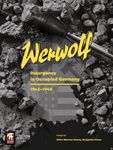
TDG: Werwolf: Insurgency in Occupied Germany, 1945-1948
Games in This Video
1 game is featured in this video — it unlocks as you watch.
Transcript
Hello ladies and gentlemen and welcome to the discriminating gamer. You know, I saw a werewolf behind the bus stop last night or he was just a really hairy homeless guy. Either way, the silver bullet worked. Ladies and gentlemen, today we're going to go ahead and take a look at Werewolf: Insurgency in Occupy Germany 1945 to 1948 from Legion War Games.
would uses flories flor
[singing]
fall asleep. is craw [singing] is cruel [singing]
[singing and music] in dest. Her is not thus fightwolf
insurgency in occupied Germany 1945 and 1948 is an alternate history coin like war game that takes place of course in Germany following World War II. Now, as I say, it's alternate history. So, the theme here is the werewolf movement takes hold and you have this insurgency that is going on in Germany that is fighting the allies and complicating their lives at the dawn of the cold war. Now, you have four factions here. You have the allies. This is the western allies, the British, the Americans, their friends. You have the Soviets, then you have the Adalvvice movement. And Adalvvice is a uh militant movement that wants to get rid of the occupiers. Uh they're committed to German nationalism, but they are not kind of hardcore unrepentant Nazis. The werewolves are these unreonstructed Nazis that want to bring back Nazism to Germany. Now, the map depicts occupied Germany at this time. You have various kind of rural spaces, provinces and then you have the city spaces as well. Uh Berlin is actually two city spaces, east and west Berlin as it is occupied by both the Americans uh the British on one hand and the Soviets on the other. Now each side has bases. These of course are the little discs uh in their color and then the Soviets have kind of their troops and their policemen. I think they're orange and red. The Western Allies have their troops and policemen.
They are blue and green. Adal vice has yellow uh discs for their bases. They also have kind of the yellow uh I don't know what they're called, the little kind of the hexagonal shapes. And then the werewolf has those in the black. Now for the Adal vice and the varolf, if they're units are they're gorilla units is what they are. If they are underground, they are just laid down flat. And then if they're active, they pop up. And of course, when you take certain actions, you're just going to force you to activate them. So essentially, you're revealing yourself. You're exposing yourself in order to carry out your objectives. Now, this game is coin inspired. So essentially, you have um decks of cards, and depending on how long a game you want to play, you're going to kind of modify the deck um with that in mind. But you're going to mix into these decks crisis cards. And that's of course kind of going to be where a lot of the victory checks happen, scoring happens, those sorts of things. So you're going to create your deck. You draw the first card that becomes the current card and then you also reveal the next card so people can see what's coming up. Each card has the flags along the top of it. So you can see uh the turn order. Now you've got of course eligibility. The first player whose flag is there, they can decide, do they want to play the event and they can choose either the top or the bottom part of the event card. Do they want to do that or uh do they want to go ahead and do their faction ability and a special action? They can also choose to do espionage which kind of just screws up the person coming after them but then it
allows them to remain eligible. So that's a choice they can make. The various players can make these decisions of what they want to play and of course after they do their action they become ineligible for the next next turn round. So basically each round only two of the four players are going to be able to actually do something. Now as I say each faction has different actions that they can do. I'm not going to get into all of the different actions, but of course they're attacking their enemies. They are recruiting more units. Like I say, some of these things, the the resistance units, the Adal dice and the variable are going to have to expose their gorillas in order to carry out some of these things. But, you know, you can also move them. You can put up blockades. You can commit terrorist attacks. You put out terror markers. And of course, the different spaces on the board represent population. You're trying to get them under your control.
And then critically, you have markers out there that are either they they are passive resistance, active resistance, they're neutral, or they are loyal, that is to say, loyal to the allies, or they are passive loyal or active loyal to the allies. It behooves the resistance fighters to do whatever they can to try to move that support closer to active resistance, and it behooves the allies to try to get it closer to active loyalty. Now, something else that's going on through the throughout the game is there are cold war tensions. Essentially, you have the Soviets and the Americans don't trust each other that much and the resistance movements can kind of play on that and they can kind of do things to try to get that track up. And as they get the track up, things become harder for them. When they get to I think about the fourth or fifth level, then suddenly all of their actions cost them double. And that's critical because the allies have some pretty massive amounts of resources compared with the resistance. As I say, when the when the crisis cards come up, the first thing you're going to do is check for victory. Has anybody achieved their victory yet? Now, what really that means is victory is different for every one of the players. You're going to be looking at different factors to determine victory for each of the factions. Now, on the board, you also have heavy equipment. These are markers you can place under the cubes of the gorillas. This represents um tanks or artillery, things that you can actually use. um they can be targeted by their opponents and they can give advantages in military uh conflicts. You also have
research tokens. Now this represents the science that the Nazis were working on that the allies and the Soviets both want, but that also the insurgents can also use in their terrorist attacks. Now over the course of the game, the Allies and the Soviets can attempt to actually take those research markers off the board and put them in front of them. And that can give them depending on who has more than get a research advantage and that can be an important number when it comes to final scoring. Now the allies also have a morale track and the morale track is very important. It's going to play into scoring and it's going to also affect some of the other conditions on the board as well. Now the various locations on the board are controlled by a faction when they have the most military units in that location. So the victory conditions for the allies are total allied loyalty plus morale plus the research advantage that they have.
So essentially you're looking at the population of every place on the board and you are trying to determine uh based on your the loyalty level if they are loyal to you. If you've got active loyalty then the population number doubles. If it's just passive then it's just worth one. Neutral nothing. And if it's in the resistance, it doesn't count for anything for the allies. If all of those numbers for the allies reach 50 and you get to the victory check, then the allies win. Now the Soviets win the game. If their total loyalty and the total population under their control and their research advantage all adds up to at least 40. Now for Adal Visivin, the total population under their control plus their bases must be 25. Now, for the Vervolt to win, their total resistance number and the number of bases they have must reach 35. Whoever reaches their victory condition at the appropriate time wins.
Vervul insurgents in occupied Germany 1945 1948. We'll get back to the review in just a moment. I want to take a minute to ask you to check out my other channel that is Cody Carlson PhD where we talk about history, books on history, military history. I even post some of my uh lectures for my classes on there. Please check that out. Please subscribe to that channel. And now back to the review. Okay, there is a ton more going on in this game. Um like any coin game I review, I feel like I'm just scratching the surface. This game is of course not technically a coin game because it's not a GMT game. It's a coin inspired game and it it very much feels like you're playing a GMT coin game. It's it's you know I think honestly the biggest conceptual difference is in GMT coin games you've got your units that you turn upside down. They got a star on them when they're activated. Here you just lie them down when they're underground and you flip them stand them up to show they're activated. But other than that it just feels it kind of ticks all the coin boxes. One of the things I really, really, really like about this game is the theme. The theme of insurgency in Germany, you know, Nazis and and other German nationalists trying to reclaim their country from the Allied occupiers and Soviet occupiers. It's it's just a fascinating alternate history concept. Now, I have to tell you, I am a big fan of the genre of alternate history. I don't read as much
as I used to, but I used to read alternate history left and right. Um, I I read a ton of alternate history books. I just it was such a fun and interesting genre for me. It's a way to take history and turn it on its head. And years ago, I read uh one one of the authors that I read a lot of was Harry Turtle. And he wrote a book called The Man with the Iron Heart uh which uh is is about this very thing. It's about the an insurgency in Germany. Essentially, his point of divergence is Reinhardt Hydrickch was not assassinated in 1942 and he was still alive at the end of the war. And so Reinhardt Hydrickch essentially leads this guerilla operation against the Allies. And so it's a very interesting concept of what could have been. And indeed, you know, if if you've read Max Boot's small wars of peace or savage wars of peace, you know, he discusses that that wars of insurgency and small wars like this are far more common than wars about lines on a map like World War II or the US Civil War or the Korean War, right? These these kind of wars of insurgency are far far more common. So, I I like that that idea. I think it's a fun and chilling concept of what could have been there. Certainly, Eisenhower was worried about the Alpine readout.
The Germans were going to set up, you know, resistance, continued resistance from the Alpines. Um, thank thank goodness it didn't work out that way. So, the game itself has got a great theme. I love the theme here. I love the alternate history and play. It's awesome. Now, the game play mechanics, like I say, it's very much a coin game. And it's very interesting as each faction is chasing their unique goals, and they're trying to do these and kind of the as each faction is chasing their own goals, they're kind of indirectly and sometimes directly stomping on what other people are trying to accomplish, right? So, that's I I like that interplay and I like that that idea there. And then two, like like pretty much most good coin games, I like the fact that you've got these kind of de facto allies.
You you you you can't work with them and you you but you you have got to work against them. And so I like that. I like how the Adel Vice and the Verwolf um they're on the same page, but they're working for their own ends. And so I like that. And then occasionally they might have to to butttheads, but but generally they like each other. And the same thing with the Soviets and the Americans, right? Generally, they're working together, but they can't completely work together because they've got their own agendas. And I really like that aspect of this game, and that's a fun thing in a lot of coin games. I think, you know, some of the actions you can take here are fun and interesting and devastating. I know, um, like whenever I would activate one of my werewolves, uh, gorillas, uh, Chris, he could do an air strike as the allies. He could launch these air strikes and take them out. And it was also fun, too. If if if the werewolves got a hold of research, they could do these like like dirty bomb attacks, you know, where they can roll a dice and see how many of the Allied units they can take out.
[clears throat] Just the terrorist aspect of it here is is very interesting and what that amounts to. Uh you can blockade roads. The allies have to move through the roads so you can blockade them and stuff. That was very fun. Overall, it was really good. Now, I know [clears throat] you've got the the Cold War, the tension track between the two allies. And this is something where over the course of the game, this this this tension track rises, and I say things become more expensive for for the Allies and the Soviets. And if ever that gets to the end um during a victory check, they they can't win. That has to be lowered. And one of the one of the ways they can lower it is it kind of by burning a turn, they can negotiate. If one of them chooses to negotiate, it lowers it down one turn. Now, as we were playing this game, I know Ry, who was playing the Soviets, he was kind of upset because he felt like that was OP.
It made it so he he wasn't going to be able to to to really win the game. [snorts] And, you know, from my perspective, the Allies and the Soviets are so resourceheavy that occasionally [clears throat] they're going to have to burn turns as kind of a an equalizing thing. It's kind of a leveler there. So, I thought that worked out really well. I thought that was a pretty cool mechanic, actually. After really thinking about it and listening to what Ray had to say, I thought it was just a lot of fun. So, there is there's just a lot going on here. You've got a great theme. You've got these great mechanisms. You've got some some really fun and interesting cards and and the way that we play with history is is a lot of fun. The component wise, I think it's great. I I'll be blunt. I had a ball with this game. I loved Werewolf.
I think this is um frankly one of the best coin games I played. And I and I have, you know, I played by this point, I think I maybe played half a dozen or so. So, I haven't played nearly all of them, but this one was just amazing. It was really good. And like all coin games, there is a learning curve. You know, it's a process. Every time you play it, you you know, you're going to learn more and more about it. Um, but I really gosh, I just really had fun with this one. And, uh, I'm going to go ahead right now on the Cody scale. I'm going to give it an eight, maybe an 8.5. I really think with more play, this will be a nine. I really had fun with it. Uh, so I I I recommend this game if you like coin and you like this this kind of ahistorical alternate history theme. Gosh, you're going to have a field day with this one.
Thank you once again for joining us today on the discriminating gamer. As always, we'd ask you to please leave a comment for us here on YouTube, on Board Game, on our Facebook page. Uh we'd really love to hear back from you and please subscribe to this channel. Please uh like us on social media. If you really like what you see here, I would humbly ask you to click on my other channel that is Cody Carlson PhD where we talk about history, military history, books on history, fun things like that. It would mean the world to me if you would subscribe to that channel as well. And of course, if you do really like what we do here on the Discriminating Gamer, I would humbly ask you to click on the super thanks button and leave a tip. What do you call a werewolf who doesn't know he's a werewolf? An unaware werewolf. on my feet again. And I DON'T KNOW WHERE I'M GOING. AND I DON'T KNOW where I've been. Please somebody
Oh, hello. I didn't see you there. Just kidding. I did. I'm filming myself so I know what that I can see you do that. You know what I'm talking about. Oh boy.