Flip 7 Review | Push Your Luck to get the Perfect Hand!
Games in This Video
1 game is featured in this video — it unlocks as you watch.
Transcript
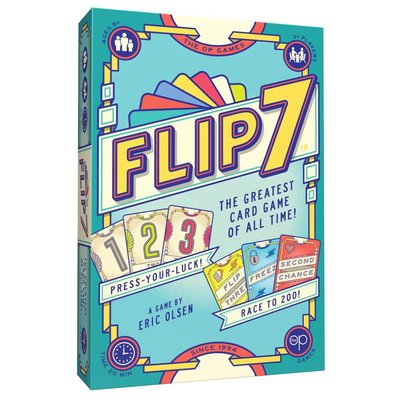
Let's talk about a press your luck party game that might get non-gamers involved in your game nights. Welcome to Brains on Games. I'm Dr. Brian McDonald. In this episode, we're going to talk about a party game, a press your luck game that's we got a super simple set of rules that, you know, folks who are playing games like Skipo or Uno are going to get involved in this one, but it's also fun for folks who like heavier games. This is a game called Flip Seven that comes from the OP. Now, Flip Seven is a party game. It's a game that you can play with three or more players. They say if you've got more than eight players, it's best to have two decks. But you can play with a big gang of people and the game still goes quickly. Kids aged eight and up can figure out this game and games only take about 20 minutes to play. Let's take a deeper look at Flip Seven from the OP. Flip 7 is a super light game. It's got a great big deck of cards. I want to say there's maybe 94 cards in this deck.
I'm not I haven't done all the math or counted out all the cards here. Uh, but you've got number cards like this and there are a few score modifier cards. What you're trying to do in this light push your luck game is to earn 200 points. The first player who gets to 200 points is going to be the winner. But it is super flexible. I've played games of this where, you know, if you want to make it shorter, oh, everybody gets to be the dealer once or twice or maybe we're going to play a longer game up to 300 points. So, it's very flexible in terms of how you play this game. Uh, and as I said, the rules are very simple. How are you going to earn those points? Well, the points are based on the values here of the cards that are going to get dealt out. What do you do in this game?
Well, you're going to start by shuffling things up and choosing a dealer. I've pulled out all the cards here. This is not what the table's going to look like. You're just going to have this big this big deck, and each player is going to have a card that gets dealt in front of them. Once all the players have a card, then they get to choose one at a time. Do you want to hit and take another card or do you want to stay? The dealer's involved in this process, too. And then you're just continuing until the round ends. The round's going to end if a player manages to flip seven cards. That stops everything. The player who flipped seven cards is going to get an extra 15 points for that round. So either you're going to flip seven or everyone has decided to stay or everyone's busted. So once nobody else can play any cards because they stay or bust, then that's the end of the round. The next player gets to be the dealer and you start the process all over again. Now, how do you bust in this game? Well, the key here is that you're going to be out of the round if you draw two identical number cards.
Now, there are some other cards in the deck that modify your score. It's not the modifier cards. It's these cards that have a number and the number spelled out here underneath. If you get doubles, then you're out of the round and you get zero points for that round. Now, this is where the game gets interesting. This is where you're pressing your luck. So, you're going to earn points based on the numbers on the card. So, at the end of the round, if you haven't busted, uh, if this is the only card and I decided to stand on a five, I'm going to get five points. What makes this game clever, I think, is that the number of cards in the deck uh, of each of these number cards is the number on the face of the card. So, there are 12elves, 11s, 10, etc., etc. The only one that breaks that rule is the zero.
There's one zero in this entire deck. So, you're trying to make sure that you get as many points as possible, but the higher numbers, there's more of those in in the deck, you're more likely to get a double card, and then you're going to bust. Special modifiers are great because you're you're not going you don't those don't count. Those aren't going to cause you to bust if you manage to get one of these modifier cards. This one's going to double your score at the end of the round unless you bust again. Uh, so you don't get any bonuses if you draw a double card. You might want to stand once you get one of these times two, especially if you have an 11 or a 12 that's uh face up in front of you. There are some other cards that do um add to the drama here of this game. Uh, so you're kind of almost playing a blackjack style game with the different numbers of cards that are in the deck plus the score modifiers. But there are some take that kinds of cards, some action cards in this deck as well. So, it's not just numbers and modifiers.
You've also got one of the best cards that you can possibly get in this game is the second chance card. You hang on to this and if you bust, you get to continue your turn. You don't get knocked out of the game because you get a second chance to draw a different card. The freeze card is one where you can force another active player to stop that round. So, if you've got somebody who's getting close to those seven cards, you might want to stop them from getting those points. Um, and then there's a flip three card that forces a player, whoever you play it on, that player is going to be forced to draw three cards and they can't stop and say, "I want to stand." So, you might want to give this to somebody who has large numbers so that they're likely to bust on that flip three. Play continues until you hit a set number of points. The rule book of course says that set number is 200. And then I mean we almost always played another game after we finished up one of one of these games of flip seven because it does go so very quickly. One other thing I should mention, once the round is over, all of the cards that have been played go face down. They don't get shuffled back into the deck.
You don't reshuffle those cards in until this deck is depleted. That makes things interesting, too, because you're you're going to kind of want to keep track of how many 11s have you seen go through. Maybe there's not that many 11s left in the deck. And so, it's safe to hit on an 11, even though in total there are a lot of 11s in this stack of cards, maybe many of them have been played and you're less likely to get one of those cards. What skills though are people practicing when they play a game of flip seven? Uh well, I mean this is not a high skill game. This is very much based on luck. It's a push your luck game. Uh but there there are some skills being exercised here and maybe especially for the younger kids. Um it's a game that does require some quantitative reasoning. Reasoning about quantities.
You're reasoning about how many of each card is in that deck. And then you're thinking about probability. Am I likely to draw another one of those cards? I mean, it is purely luck based. You could get a four. And it's happened. I mean, I've played this game enough times that, you know, I draw a four as my first card and my second card I get is a four when I hit. That's not really ideal. You don't want to bust out too early because then you're waiting for everybody else to play through. The rounds do go quickly enough. But, um, so, so it is luck based, but you are basing your decision to hit or stay on uh the number of each of these cards that's in the deck. the likelihood that you're going to hit a d a duplicate. And then because those cards that have been played do not get shuffled back into the deck at the end of each round, there's a memory component here as well, a visual memory component. What you're trying to do is keep track of to the extent that you can, you're trying to keep track of the number of those cards that have been played because that's going to feed into your estimate of the probability that you're going to get a duplicate and bust out early. Final thoughts though about Flip 7. Uh, this is a game that I mean, it's super simple and quick. It's the It's very rules light. It's probably the most rules light game I've talked about in a while. This is a very very light game uh that I think you know people who like games like Uno or Skip Bow like I said at the beginning um are going to potentially get sucked into um Flip 7.
It it's a game that's interesting because you know I've played this game with multiple groups. I've played it with folks who like lighter games. I've played it with non-gamers. I've played it with, in fact, it was introduced to me by a friend of mine uh at an invitational game day that we had. He's a heavy gamer. He likes the really heavy ones and he's like, "Oh, you guys are going to really like this." And he dealt out this flip seven and what a great time we have. I've never seen, even if I'm not the one who's playing, I've never seen a game of flip seven go by where you're not hearing cries from the table of oh or yay. you know, people are applauding and cheering and yelling and shouting at each other and there's trash talk. Um, this is honestly it's a game that that's more fun than it has any right to be just because it's so simple. But that idea of the probability of highlevel cards, you're likely you're more likely to bust out when you get those high point cards and less likely to do so if you've got low points, but then you get a bonus if you get seven of those cards and you're going to be tempted to hit when you've got six cards. Um that that is a fun decision. So it can be tense. You don't get I mean even people who tend to think about their turns for a long time.
You're not thinking for a long time when you're playing a game of flip seven. It goes quickly. Rounds go quickly. There's player elimination. But those eliminations don't keep you out of the game for very long because the next round is going to start very, you know, even with a large number of players, the next round is going to be coming up very soon. Um, so this is a familyfriendly light game that seems to appeal to just a broad range of game players, whether they prefer heavier games or lighter ones. What a great filler on a game night. Oh, or if you're if you're waiting to start the next game because one of your friends is missing, you can get a game in, a flip seven without too much trouble. I'm going to I'm I'm heading out to visit my my parents uh this week and I'm going to bring this game with me in the suitcase because it's small, it's easy to transport, and everybody can get into it. Are there downsides though with Flip 7? Um well, yeah. I mean, it it's purely luck based. So, if you really are looking for a strategy game, of course, you know, you're not going to be playing a party game if you if you're looking for strategy. Um this is not a strategy based game. It's swingy. It goes back and forth. You know, you could be in last place one round and and be in contention for the lead in the next. Um, it's a a game where you do benefit from having more players. So, if you've only got three players, it's less fun with only three. It's much more fun when you get, you know, four or more, five or six players is quite ideal for this one
because then you're going around, you're cycling through those cards quite quickly. Uh, and you've got lots of options when it comes to freezing a player or forcing them to draw those extra cards. So, uh, I do think higher play counts are better. It was a party game. Of course, higher play counts are are going to be better. Um, and you know, you you might if you play this game five times in a row, you might get t it's a repetitive kind of hit or stand sort of a game. Uh, so there's some player interaction with the take that cards. Uh but it it's a game where you you know you you might get tired of it after you're not going to play this game five times in a night probably. We have played it multiple times on a game night. I won't lie to you about that. Um and it's always been fun, but you know, you're doing really one thing. You're making one choice each turn. Uh and either taking a card or not. So um your mileage may vary on that one, but we had a great time with flip seven. Uh, and that in a nutshell is the game. If you have any comments or questions about flip7 or anything to do with brains ongames, you can of course leave them in the comments section below the video or you can email me at brianbrainsgames.ca. Brainssonames.ca is the website. That's where future episodes will go. The previous ones are already up there. Brains on games is the x handle in the Facebook page in the Instagram feed. So, we're all over the place. And if you enjoyed this video, you want to be notified of future ones, you can head on over to YouTube and click that subscribe button.
Thanks for joining me and hopefully I'll see you next time.