Rumble Nation Review: Rumble in the Box
Games in This Video
1 game is featured in this video — it unlocks as you watch.
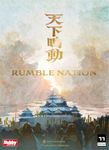
Transcript
Hello everyone. Welcome back to the Dice Tower. My name is Chris Yi.
I'm Mike Delisio.
Today we're taking a look at this game here, Rumble Nation, which always has the sound of like a WWE you know, WCW wrestling thon kind of a game.
Let's get ready to nation.
So this is a very quick, very small I suppose you could call it an area control game.
That's where my head goes, yeah.
Yeah. A little dice chucking action here. So let me show you how this game plays and then we'll give our thoughts. So let's go down to the table. Here's Rumble Nation set up on the table. Now this is simulating far into a game. This is an area control game where players are vying for control of the different islands of Japan. All of these number tokens are randomized out here. The yellow tokens are placed out and then the silver tokens for second place control of each area equal to half the value rounded down are placed below them. And the island areas are going to resolve in this order during the last phase of the game, the the war phase. However, during the deployment phase, players are going to in turn order be rolling their three dice and they're going to group up two of them together to form the numbered space where they'll be deploying soldiers and then based on the one leftover die according to this chart, they will deploy one, two, or three units based on whether the die result was a one or two or a three or four or a five or a six. So blue could choose at this point to deploy one soldier into the number 11 area or they could deploy three soldiers into the number seven area or any combination thereof, three soldiers into number six maybe. So let's say that they deploy three soldiers into seven. That's their turn and they are done. Then red would go. Every turn you have a choice of either rolling your dice to deploy soldiers or you can use one of these tactics cards. If you choose to do one of these cards, you spend your entire
turn, you do it and you can only do this action uh in the So if red chooses to use this exile power, for example, says that they can move a soldier meeple of an opponent into an adjacent space. So they say uh well uh yellow, you can move this fellow right over here since you already are going to gain that control of that anyway and now you're out of this region. Players will take that card to show that they have used a power card once and you are only allowed to do it once. Then it goes to yellow's turn and they can use a power card or they can roll the dice, so on and so forth. So play like this is going to continue until uh all of the troops have been deployed for all players. Once a player on their turn deploys their final troop out into different areas, they are then out of turns and will therefore take the topmost tiebreaker token. You'll see there are different number of swords up to four of them for a four-player game.
So since blue ran out of soldiers first, they'll take the strongest tiebreaker. Once a single player has run out of troops, no player can anymore use these tactics cards. They are simply removed from the game. So you have to use them early enough. You can't just wait until other people are out of turns. Then in turn order, red and yellow will continue taking turns skipping blue. Now the other little module in the game is uh well point out these daimyo here. Each player is going to have a daimyo that counts as two strength for control of a region. All the normal soldiers simply count as one. Uh these can be deployed just like any other normal troop. However, they have a special power associated with them that is going to be drafted at the start of the game. This is an advanced rule. You don't have to play with these. So for example, the blue player on their next turn can either use a tactics card or roll the dice or they can activate their daimyo. This one here, for example, reads place a soldier from your stock into each area into areas adjacent to where your daimyo is located up to three times. So they could actually go out by using the daimyo effect by placing one fellow here And then, yeah, we'll they'll just do that again.
So, play will then continue until red is deployed all the troops and yellow has deployed all their troops. So, that will mark the end of the uh the deployment phase. Let's just go ahead and drop some of these onto here. As I mentioned, Rumble Nation takes place across two phases. So, you saw the deployment phase. You're now going to see the war phase where each of these areas is going to resolve in numerical order. And that is where these reinforcement troops come in. No player controls the white soldiers. They will instead reinforce adjacent areas for the winner. And since you resolve them in number order, even though right now, for example, yellow is has more control in the number 12 region, which is 12 points and then six points to second place, this can change. Starting with region number two, the lowest number region, blue is going to take control of it, so they will get the two points and then no one would get the second place benefit. More importantly, blue gets to reinforce with soldiers into every adjacent region through sea lanes and through land passage uh through uh every region where they have presence on the map. You'll notice that blue does not have any presence in the number nine region and therefore they don't get to reinforce because there's nothing to reinforce. They can't send troops over there, but they can bolster up in six and in 12.
Now coming across to the number three region, yellow wins the three region uncontested, so they'll score the points. And then they'll also get to reinforce down here into the number 10 region, so they are currently winning there, but that might not be the case as we continue to go through. In the number four region, uh this the red is going to win because the daimyo counts for two strength. So, red will get the four points. Blue will get the two points. And then red is going to reinforce every region adjacent where they have presence. So, those soldiers go there, they go here. So now, red is currently in the lead of the number 11 region, and they also reinforce here into five. And now that we're done resolving four, we're going to resolve five. So red takes this, yellow takes the second place, and red gets to reinforce every adjacent region uh where they have troops that hasn't already fired off and scored. So now red is going to go up here to the 10 region as well as to the 11 region, pretty well securing their lead there it looks like.
Going from this to number six, blue is in the lead, and so blue will take first place. And now we see the tie breaker. Also blue reinforces up here into the 12. Now since there is a tie for second place here for the three points, you're going to compare the number of swords that red and yellow took. Since yellow deployed their troops quicker, they took the higher tie breakers uh sword token here. So they will get the second place points and red will walk away with nothing. So now we go over to number seven, which blue wins, and then yellow gets second place. Blue gets to reinforce into the number 11 region. And we go over to nine. Red wins here, uh gets first place, yellow gets second.
However, there's nothing left to reinforce cuz all the other battles directly adjacent have gone off. Number eight, red is going to win first place here, no one wins second, but there's nothing left to reinforce. Red has no presence in 12, so nothing happens there. Going over to number 10, we see that there is once again a tie, and once again yellow is going to break that tie because they have more swords on their token than red. So yellow gets the 10 points and red gets the five. Coming to the number 11 region, red wins here. Oh and because red won, they would also reinforce again. Or sorry, yellow wins actually, so they reinforce. But red wins here, so red takes the number uh 11 points and yellow is uh no, blue is going to take the five points. And I'm going through all of just to demonstrate exactly how all of this would work here.
Now that all the wars are done, you're going to add up all the points that you have acquired here. So Red is going to win with 42 points, though 34 and 31 is not much of a slouch behind them. And so that's the idea of the game. There are six total daimyos that come in the box and then there are several of these uh tactics cards that you only use a handful of them each game, so a good amount of variety. Plus you set out the tokens in different orientations onto the map. So that changes up each game. That is Rumble Nation.
So originally this was brought out from Hobby Japan.
Mhm.
Uh they did a deluxe edition of it a little bit later and then it was recently brought to a wider distribution market through Asmodee.
Yes.
Uh but it's funny cuz when I look on Amazon now, I think you buy the Hobby Japan edition in the US. I'm very confused about its publication and distribution availability, but I know that it's available currently as we do this review.
And yeah, no, I've I've I've been playing this game for years. It's been on my top 100 for for uh well gives a little bit away, I suppose. Um but yeah, I've been playing this this game. This this new nice version is certainly an upgrade component-wise, but um yeah, I don't know that it it's I don't even remember which edition I played first. I know it was a Hobby Japan one, but I don't know if it was the first edition or the second edition. It's been around for a while, but it has not been easy to get in a lot of parts of the world. Now that seems to be changing.
Yeah, exactly. And I'm very happy about that because uh I've talked about this game on many top 10 lists. So obviously from the get-go, you're hearing we like this game, right? This is simple. It's incredibly simple. This box almost belies just how uh cuz this is like that bigger edition of it. More more meeples, more custom shapes, sets of dice for every player, fun little quality of life upgrades and everything uh compared to the first printing that was much harder to find. But at its core is a very simple little dice chucking system that almost reminiscent of Can't Stop or maybe even Mountain Goats, like one of those types of games. Roll some dice and then split them into two pieces of information.
Yeah, it's remarkably simple. So much so that people are often taken aback when they're taught it. You get the you you get a lot of that's it. And then it's a game that has two distinct kind of phases. And the first phase is so straightforward. If you if you're teaching it, you do your best to try to explain and sometimes of give examples such as what you showed in the overview of kind of how that second phase work. But I don't care how many times you are shown it, the first time you get to that second phase and you see it actually in action, that's when the game just expands. At least it did for me.
Right. Yeah, it is the first phase is fun because it is that, you know, roll dice, put out soldiers and stuff. Yeah, yeah, oh, I've got the majorities here. But it's tough to understand visually the how the cascading effects will will take place in that second phase. And the second phase is completely passive. You're no longer hands-on. And I have I have had some people say they don't really like that because it is truly deterministic at that point. There's no decisions to make. You're just watching the game happen.
Yeah.
I happen to think that because of all of the first half of the game setup, and we say second half, it's shorter.
It's shorter, yeah.
Yeah, it's
You're just resolving essentially.
Yeah, resolving and scoring. But it's so like for me, it feels dynamic. It feels interesting to watch. Like oh, because someone controlled this area in two, they spread out into the adjacent regions and so regions four, five, and seven, he's going to have that advantage. Oh, but then region three scores and then the advantage swings back in favor of this way, that way. It's very fun and it it it kind of lives up to that name like Rumble Nation in a way.
And it's funny. I I should probably uh acknowledge within myself that it's always this kind of big, you know, dynamic, exciting thing because I don't and I'm not saying this just to to be, you know, self-deprecating. I don't have the mental capacity to completely understand. You know what I mean? It You know, some people I think have the type of brain that the second half is just purely like, I know what's going to happen. Now I'm just seeing it happen.
Right.
That's not me. I have a general idea, of course. You know, I've made moves that I think are going to work out in a way, but I don't have that the flowchart ability to to to get all the way through there where some people might. So it's always a surprise to me.
It is.
At least a little bit.
This is not a trick-taking game, but I'm going to make a trick-taking comparison. It is like the people who can count cards so well in a in a card game like that that with five cards left in hand, someone just throws down their hand and goes, well, I'm going to win these last five anyway.
Right.
What? Oh, I guess you're right.
Yeah.
Yeah, if you have that computer-like brain where you're just perfectly able to calculate everything, the game is going to lose a little bit of its charm. But you still have You're still at the mercy of those dice rolls.
You have the dice rolls, you have the power cards, things along those lines.
Exactly. When someone takes a power card for their turn that you weren't expecting them to do, one, it removes it from play. Two, you're like, I I could not have predicted that you were going to do that. So it still creates that human element in there, which is going to break your perfect calculation.
is true.
So I I I love this. And it's all of this
Mhm.
in a game that takes 20 minutes to play and resolve
Yeah.
uh with very simple rules explanation and just such fun moments where you chuck those dice and you go, ha I can work with this or I can roll one Like you have one reroll each turn. And that is sometimes more stressful, the thought of like, this isn't a great die roll, but I can do something with it.
Yeah.
I could reroll and I could get something great or way worse.
Yeah. It's For a as tight of a rule set it is, there are very compelling decisions to be made. There's, you know, a little bit of push your luck if you want to look at it that way and like yeah, how am I going to handle these dice? Am I going to try to mitigate them? Or I'm going to try to make the best I can of what I have in, you know, trying not to get something worse. Um the powers, adding a a bit of spice to it. Um it there's a lot of area control, area majority games that are small in scope like this, but none that I feel has quite the drama that this one does in the length of time that it does. Um this one to me is far as short area majority games kind of stands towards the top of the heap.
It really does for me as well. There's so many small design decisions that are great. Obviously in a game like this if you slow roll it, then you have more reaction, like you know, more ability to see what people have invested in and say, well, is it worth fighting them or or not? Uh so the game rewards you. If you are the first person to run out of soldiers, you grab the first tie breaker token.
Right.
And tie breakers in this game
Huge.
huge deal.
Yes.
So you will consider, you know, how how much do you want to slow roll it or put things out fast? But if you do a bunch of quick like fast poor placements, that tie breaker will not save you. So it creates the right dynamic balance where you're always thinking, should I put out those three troops in this region right now? That would be great, but I know I'm depleting my supplies so much. Oh, just so many great choices in such a short time frame and everything.
Agreed.
Where did you come down final thoughts on this one?
Well, final thoughts are, you know, kind of kind of already been established. Uh this is a game I've liked for years. Now it's in a a nicer production, uh but still a reasonable, you know, this isn't like going to take up a whole Kallax shelf by any means. It's it's thin, uh but very nice upgrades to the usability and and the components. Uh a system that I think is is really really a solid system and kind of stands, you know, apart in the short area majority. It's an 8.5 for me. I do think this game is outstanding. Would it be higher uh if area majority more? Probably. I just don't area and this is pure area majority. As close as you can get. And so for it to be an 8.5 means it's one of the best in my opinion pure area majority games out there. So 8.5 for me.
And I'm giving this one a nine. I think it's fantastic. I'm so picky when it comes to area control area majority games and this just hits all those sweet spots for me. It does not outlast its welcome. It has dynamic moments that are little surprises, but no one's going to do something that is so underhanded like oh there's no way I could have predicted you would kill all my troops in a whole region. There's none of that stuff that I just that brings down that experience for me. But when someone does a thing and they take that 12 point spot majority from you, you sit there and you say you earned that. Everything is
to you. Yeah.
Exactly. Exactly. Everything in this game feels earned even though it comes down to dice rolls because you're setting up the the possibilities of these cascading chains and everything. I think it's phenomenal. I think it's a great production and such a like you said a small box that is easy to pull out and teach to people and then once they play it once and they see it all happen a lot of tables say hey can we run that again? And I love that experience in games. That why I'm giving Rumble Nation a nine. So yeah, nine and a 8.5 meaning that Rumble Nation gets a seal of excellence from us here at the Dice Tower. So if you've not given this one a try, we're recommending. If you have given it a try, let us know what you think of it below. Thanks for coming out to this review. I'm Chris Yi.
I'm Mike Delisio.
And yeah, let's get ready to get Rumble Nation.
Hey everybody, thanks for watching another video from the Dice Tower. Hey, you want to learn more about us, communicate with us. We have a Facebook group, we have a Discord channel, lots of different ways to get involved with the Dice Tower. You can find that in our link tree link below. So just click that and it will take you and you can communicate with us on Facebook, Join our Facebook groups. There's lots of cool things that you can find and become part of the Dice Tower. Thanks so much for watching. I'm Tom Vasel.