Lightning Train - This Will Go Fast at Gen Con!
Games in This Video
1 game is featured in this video — it unlocks as you watch.
Transcript
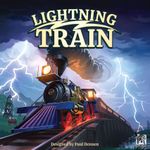
We are on the road to Gen Con 2025 and this is maybe not our first, but it's one of our first game previews for the convention. This is Lightning Train from Direwolf. Uh and designer Paul Denon.
Yeah. Favorite designer.
Yeah. Dude Imperium, all Clank, all sorts of things. And
Wild West.
Wise West. Uh yeah. Well, this one is a deck builder of sorts, but it's a baguer instead. Uh, but it's probably of all the baguilders we've played, the one that feels most like a traditional deck builder.
Yeah.
Um,
yeah. It's a we it's a weird way that they built this game cuz we've played bag builders before. Yeah. And we've said that bag builders and deck builders have a lot in common. You're adding chips to the bag like you're adding cards to your deck. When your bag's empty, just like when your deck's empty, you shuffle everything together, draw them out, calling. Yeah. You all of that. But the way that they did this where your chips, there's no like money. You're not you're not getting money. It's like when you play Clank and you play the cards and they have the buy power on them. A lot of your chips are going to have money and you're using that money to buy new chips like you'd buy new cards where I think in other big bag builders we've seen you get your chips in other ways by doing other things not necessarily by like buying them with the value of the chips which does feel like a deck builder.
Yeah, this one has a market of new chips that you will be able to purchase from. Uh, and another interesting thing is it's not broken out into phases where like you do all your things and then buy, right? You can buy, you can do in any order you want as you're taking your turn. And there's some things you can only do one of. And of course, it's all built around the concept of a train game. And we were talking about this before we started recording and we thought, and Ryan's way more into train games than I am. Um, but whereas I am down here on the ticket to ride side of the spectrum, Ryan is maybe way over here on the 18xx part of the spectrum, we feel that this game in terms of what you're doing and the weight of it is probably pretty squarely in the center of that spectrum between it. So, you wouldn't go up to someone and say, "Oh, do you like Ticket to Ride? You'd like this." But you might. And the same thing with 18X. Although I think if you prefer a really heavy heavy experience like that, this one doesn't have this one doesn't have like the stock part of it.
Sure, it doesn't have doesn't have income. It doesn't have uh like you're not paying shares and percentages out like none of that stuff.
And but it does have the idea of building stations, laying track, making deliveries, which are kind of the three tenants of any train game.
Yeah. And you can tell that Paul's a big fan of those games. Whereas maybe this doesn't have as much common with uh like the 18 exile, it does have more in common like with Age of Steam, which is you're going to definitely see some like Age of Steam DNA in this game because the game is about building routes and making deliveries, but a lot of like I'm going to use some Age of Steam terms here because I think this game is kind of generated in that same way. Class, you're trying to make deliveries and your goal is to make the biggest delivery possible using anybody's trains. So there's a whole concept here of it doesn't like to ride. You need to build your routes and that's how you score points.
You can win this game without building routes. Theoretically, if you just build a few select key ones where people that are making deliveries are using your routes over and over again, they're giving you more and more points. So that's I think where it maybe is a step higher of strategy wise than ticket to ride because there's a whole level of like looking at the board. You're putting out these stations. Stations want goods. You can look at the board and you can see where those goods will be produced and there's a whole deck of cards. Again, kind of like Age of Steam where you might get more cubes added to some of the cities throughout the game. You're going to flip over a card every round that tells you which areas of the board produce goods and then those goods are right for deliveries for anybody that's in a good position to make that delivery.
Yeah. And at the beginning of the game, there are some neutral stations out there so that it gives you some places that you want to deliver to. It also puts out some goods on the board so you can see where you can deliver from. But it is up to you to lay some track between these things like Ryan said to score some of those points because when a delivery is made, each segment of track, not each train, but each segment is going to score a point. And then if the uh station where it's receiving the goods, you own that station. For instance, some of these have some different colored cubes on them that represent Ryan, me, and the neutral player in this case. you're going to score a point as well. But the meat of what's driving all of this, building the stations, everything you do in the game is the bag building. And you have a player board here that has a lot of spaces with a lot of actions you can take, but it has this boarding area on the left hand side. And at the beginning of your turn, or really after your turn is done, you're going to be taking tokens out and filling this boarding area. Now, the interesting thing here is as you fill, there's five general spaces and then there's two spaces that have plus symbols on them. You're going to fill this area until you filled the five general areas. If you draw a token out of your bag that has a little plus in the corner, and spoiler alert, you don't start with any of those. But as you buy tokens, you might get some. Those can go in the plus area, allowing you to basically have more tokens. So, future turns, you could have five, maybe seven.
And then there's even an area that you can open up for two more of those. So you can have some really big turns, but at the beginning of the game, things start out a little more slowly, like a train almost. Uh because at the beginning of the game, you're just going to be using those five tokens to do all the various things. Some of those tokens literally just look like pieces of train, right? You're going to use these not only to lay out on the board to lay the rails, but you're going to assign them to the spaces on the rest of your board to do all these different things like building a station.
Yeah. And let's talk about why this bag building matters because it matters in a way that is a unique twist for this game that I've not seen in any other train game that I think is is something that you're going to have to pay very close attention to. At the start of the game, mixed into your bag, everybody starts with the same setup. You're going to start with what are called contract chips, and these are one-time contract chips. The board is divided into all of these different colors, like the Northeast, the Midwest, the the Southwest, whatever. If you want to build in an area, if you want to build a station or build a track in an area, you're going to have to have a contract for that area that you've pulled. You could be in a tough spot where you don't pull any contracts. The ones that you start with are one-time use. So, if you go very heavy on building at the very beginning, you build, build, build build, and you don't buy more chips that have more contracts, you can find yourself in a tough position where you literally cannot build. Now, the game does give you a little bit of a workaround. One of those actions you can take by putting trains on your playerboard is to gain a wild contract essentially, but you're spending those trains now to secure the contract, which means maybe you don't have the trains necessary to then build in that contract area. This whole idea of needing a contract to build, I've not seen that in another game.
No. And it is really interesting. And I'll tell you this, it's easy to miss because when you're taking your turn, you just want to do all the things, right? You're like, "Oh, I'm going to put all these trains out here. I'm going to build a station. I'm going to do this." When you lay tracks or when you build a station, you need one of those contracts. So, the first thing I would recommend when you're playing this game on your turn, just look what contracts you have.
Yeah. If you don't have any, your turn is going to be pretty straightforward. But if you have some, you can go, okay, I can do something. Build a track or station in the Northwest or the Atlantic area. I don't know if that's Atlantic or Appalachians,
probably Appalachia,
but those areas. Otherwise, you can't do anything in any of the other areas. again, unless you have trains to get the wild contract. But you need to check your contracts first because if you don't have any contracts, you're effectively just going to be setting up maybe your next turn by assigning some of your trains to some of the spaces or potentially just looking to see how much money you have and buying a new chip. Because in my first turn when we played in the very first round, all three of my base contracts came out and I did use one to do a thing and then at the end of that turn that particular contract gets sort of discarded out of the game. But then my second turn specifically had no contracts. So it was literally just a well I guess I'm going to just put trains over here and buy a new tile.
Right. Well, the fact that you can put some of your trains on your playerboard, there's one spot that just stores it for next round. You can save it to build a station. Even that secure contract spot takes two trains, but you can leave them there until you need them. Yes. So, you can always like if you have a turn where you can't do a lot, you can even just put one over there and then later add the second one. So, it does give you some ways to mitigate that. But when you're looking out here and you're buying these chips, you got a lot to think about because first, the game does run on an economy. Your chips also give you your money. And you start with these basic chips that are just a buck, but you can get better chips that give you more money throughout the game. And just like in a deck builder, you might find yourself wanting to call out the single dollars so that you could draw some of maybe the $2 chips or whatever that you get later on. Or some of these chips have a plus symbol extra money that can go in the plus spaces. So you have to decide, do I want to do the economy? Do I want to get chips that give me more trains? Because late in the game, you're going to want to do some of these routes that require like four trains, so you're going to need a lot of trains. Or do I want to do some that are going to give me the special abilities like some that let you build through these mines? or you need chips that let you do deliveries. Like you can't just do a delivery. You have to have an action chip that does a delivery. So there is a lot that you have to think about and balance when you're building out your bag, which again I think that does add contribute to what makes it feel more like a deck builder, right? Like all of those different things are balancing.
Well, you are considering a lot of things like Ryan said when you look at these chips. And one thing that we kind of glossed over until now is the name of the game. It's called lightning train. And Ryan mentioned you have there's chips that give you more trains. Those are the lightning trains. There's a little icon that has like a train car with a lightning bolt on it. When you are pulling tiles from your bag and placing them in your boarding area. Whenever you see a lightning train, you can immediately take a train from a giant pile of your own trains and add them to this lightning space of your board. Not taking up one of your slots, but giving you a lot of lightning trains. There were turns where I had drawn two tiles, one that gave me two lightning trains, one that gave me another. So those three extra trains plus whatever trains I pull out of my bag, you're able to look at some of these longer segments if you have the contract
and get some of those longer segments built, which in and of themselves can score you some points as well.
Yeah. And there are a few different ways to score points in the game, but the primary way that you're scoring points is by making those deliveries. You're going to have some cards that will give you some points at the end of the game if you've completed some specific things. And there are a few actions you can do in the game that are going to draw you action cards. Some of those action cards might give you points. Uh, but primarily you're going to get points from the deliveries or by going public. You can, one of the actions you can take is to flip over different parts of your board. One of the parts of your board just gives you more spaces to s store tokens, which is good. But the other one is going public, which gets you two victory points every time you make $7, which kind of snowballs because if you have $7, then you can buy maybe some of these better uh options. And some of them that are like seven or eight bucks on this actually do give you points, but really, especially towards the end of the game, one or two points is nothing compared to like a nine-point delivery that you might be able to make if you planned your route correctly and can deliver like from one side of the US to the other.
And this is where I want to bring in a big point to make about this. If you're a familiar with the way train games work, you'll know this. If you're like me, less experienced, you won't know this as much. But this is these games and this one in particular, there's going to be times where someone's making tons of points. So, you really have to be competitive and and think approach this game with competitive spirit because Ryan was delivering something from really far away scoring seven points along the way. Now, in that case, I had a couple segments there, too. So, I scored like two points. But if I kept allowing him to do that, and more on that in a second, cuz there is a limit, you can build another station that wants that same good much closer or in another space to take that good away. Or you could build, you know, take advantage of where goods may have popped to deliver to that space that he was going to deliver to. So there's all sorts of kind of claim jumping, if you will, in a game like this where, oh, someone's built a very big sort of abusive line that they can score a lot of points with. It's probably more important that you stop them from doing that than building a little tiny segment where I can score two points.
Well, yeah, because this is game's a little different when it comes to deliveries than like an 18x or Age of Steam style. You're not necessarily delivering the goods. uh specifically you're looking at a station and you're looking at what that station needs and then you're pulling it from somewhere so they can actually pass through other stations that need that good on their way to where you want it to go. But another player sees that they but they're like I'm just going to deliver it. You were going to make a seven delivery. I'm going to deliver to one space away. I might only get one point, but I robbed you of seven. And in a two-player game, robbing somebody of seven points is effectively like scoring seven points. It becomes a little more complicated when you're playing in a four-player game though because this board is going to get filled with rabbits.
Yeah. More people more people will have more points when you do something like that. It should be noted in a two-player game there is sort of a dummy player. They don't score points in a two-player game. So, you could utilize their rails,
which yeah, Ryan was significantly. And it kind of makes it interesting because that's a very different two-player experience because you can like look at that third player as basically helpful for both of us in a way as much as helpful as much as they are hurtful.
So I'm going to talk about just for a second. I'm going to talk about my experience with this game a little bit as a train gamer who loves those games. I love Aegis theme. I enjoy 18x Railways of the World. All those this scratches a very different itch. I do think I'm better at this game because I've played those probably because it does have that element of the the board starts with very little goods. And I think if you're a new player, you're like, "Okay, well, I see there's cows here and I cow station right there. I'm going to deliver for one point."
That's what I did.
But I'm looking and seeing like, "Okay, this spot's empty. There are no goods there, but at some point in this deck, that's going to fill up with goods and the second it does, I want to be ready to do a giant like eight delivery." But while this game feels like those games in that essence, what you're doing to prepare for those, the bag building aspect, getting rid of the stocks, getting rid of the income phase, getting rid of like having to pay for your trains or getting rid of the fact that like in Age of Steam you you have to increase your engine and you can only deliver four space. Like none of that's in here. They've taken out a lot of those rules where you have to like double think. Now, they did replace it with the contracts, which maybe gives you a different thing you have to wrap your head around, but you you can just kind of make these deliveries as long as you have a delivery chip.
I like it. I like the bag building. I like deck builders. I like bag builders. I like Paul's Games. For me, this is another one that I think if you like any of those elements, it's going to expose you to a different one, right? Like if you love bag builders or deck builders, you might play this and go, "Well, maybe I want to give Age of Steam a try now."
That's possible. or vice versa.
I would say, and I hopefully no one jumps on me in the comments for this, I think this takes the concept of some of the things you would might do in a train game and makes it more fun with the mechanics that are driving it, which is what Ryan was experiencing. What you're doing, deck building, that mechanic is very fun. It just is. There's a lot of accessible games that use it, and it's why a lot of people enjoy games like Clank and Dune and all the deck builders before it. this. It's a fun process to go through that drives something that you would be doing in one of those other train games that are driven by mechanics that are a little heavier and a little less satisfying. Well, to some players, I know there are players who love that stuff, but to the masses and to mass audiences, I think this is a more satisfying and fun experience.
Yeah. And I know that you said we we talked about this a little bit. This is not necessarily the next level from Ticket to Ride. It might be a few levels up. Yeah,
but if you've got people like I know people that love train games that still enjoy Ticket to Ride for what it does, this might replace Ticket to Ride for that group of people. If you really enjoy it, but maybe you're looking for a little bit heavier of an experience.
You mean the next step from like if you want if you enjoy rideing a little bit more, maybe
you want something a little heavier, this might be worth a try, too.
Yeah. But with that said, like Ryan said, it is not I would say it's just as close to the heavier stuff than it is to ticket to ride. right there in the middle. I would think what you say Age of Steam is probably
three way of the way to the 18X. So, if you're familiar with the spectrum of train games, we've just defined it for you. Uh, but if you have any questions about this at all, please make them in the comments below. They're going to have limited quantities of this at Gen Con.
I expect just like Direwolf, every Gen Con has something in limited quantities. It's going to go quickly. Uh, so be sure to check out uh stop by their booth and check it out. But like I said, get down in the comments. Let us know what you think of the game. Until next time though, make sure everyone has fun at the table and we'll see you then.