Railroad Tiles Review - Chairman of the Board
Games in This Video
1 game is featured in this video — it unlocks as you watch.
Transcript
Hey everybody. Today I'm going to be sharing my thoughts about Railroad Tiles. Now, this is a board game that is based on quite a famous roll and write dice game uh called Railroad Inc. and the Railroad Inc. series has had tons of spin-offs. I happen to have the yellow version in my own collection, and I actually only recently acquired that one. So, I'm kind of new to the game series. But when I heard that there was a tile version of the game coming out, I wanted to play it and I had an opportunity to do so. So, uh, here are my thoughts. And I suppose in this review, I'll be answering kind of two two key questions. Number one, is it good? And number two, more importantly, is it better than the original? Now, before I share my thoughts on the game, I want to give a shout out to the show sponsor kienda.co.uk, who are my go-to online retailer. And if you use the link in the show notes or the QR code, then you can get 5% off your first order. So, Railroad Tiles um has the same premise of the original. In this one, the scoring is slightly uh different. So, unlike the original, you're not trying to kind of connect all the parameters of the board together. In this one, you are trying to build your biggest kind of rectangle or, you know, or or square of tiles because you're going to get a point for each of those.
You're trying to get the city tiles into blocks of three if you can or three or more, but keep them separated for some bonus points. Um, and you are also trying to score points based on actually populating the board uh with these trains, I think, like buses and also pedestrians. So, that's one of the key differences um between the two. Now, of course, this one is not a dice game, so you won't be rolling dice and drafting what you want in this one. It will be based on a tile draft, but you're not drafting tiles by themsel. You are drafting them in clusters. Uh, which is actually a spin on the drafting mechanism that I usually like because I like the fact that you might think, well, I like this tile and this one, but I'm not quite sure what to do with this one, but I'm willing to take the one I don't want to take the ones that I do want. I really like that. And also there's this kind of king domino kind of floriferous mechanism going on where the stronger groups of tiles, you know, clearly broken down into quantity and will move you further along the initiative track, meaning that you'll be last to go next turn. So sometimes if you're not too bothered about which tiles you get, sometimes you can go a bit earlier to make sure that you get first choice next time. a mechanism that is kind of timeless, always works, and it's used to a good degree here. So, as I said, you're just trying to pick up the tiles, place them on your own personal map. Um, they connect much like the original where, you know, you do roads to roads, uh, you know, train track to train track, or you do have these stations which will convert one,
uh, into the other, and again, you're trying to map out and so on. Now the difference is as I mentioned is that you are placing things onto your board and that is done on this kind of strategic mechanism where you can see what scoring opportunities opportunities are coming up. Um so basically it will say things like well at the end of this round you can place a person on your board um or or your people will score and basically you're trying to um populate roads or you know um train tracks with the relevant uh pieces um and kind of compound your scoring um as you do so. So so you are encouraged to build longer roads um which of course restricts you because you of course want to abide by that square rule as well. So, you're trying to minmax everything you do uh in this game. Um, so it's not the most complex of games in terms of rules overhead. There are a few additional modules you can add in if you want to um through these kind of unique buildings that will score in unique ways. Um, but the premise of the game is very simple, straightforward tile placement games.
Again, build that square, get the town separate, build your roads, um, and get the relevant pieces in the relevant spaces. That's pretty much what the game entails. It's not much more uh than that. Um that being said, it's very fast. I think it's only like eight rounds or so. So, you can play this in around 20 or 30 minutes, which I think is a really good kind of bang for your buck time investment. Um and but let's start with mainly talking about the differences between the two. So, one thing that I definitely think that Railroad Tiles does better than the Railroad Inc. games uh is that uh I think the game takes on a lot more of the kind of onus of the housekeeping um and kind of processing power that it puts onto the players. Uh because in this one of course you just have sets of tiles, you place them and you're done.
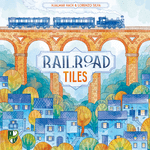
In the original it can be a bit of an information dump at times because you you know you're rolling like five dice or something and you have to choose the ones you want. Sometimes you can double them. Sometimes you can accidentally, you know, forget which ones you've used, which ones you haven't used, how many left have you got, uh, and so on. And sometimes those little fiddly things can get in the way. Um, also, this game is, of course, they're they're nice, well illustrated tiles. It's a bit cleaner in terms of its visual appeal as well. So, it's quite nice. You can look down at your own little um, you know, little town you're building with your tiles. Very clear where all the roads are, very clear where all the train tracks are. in the original, you know, maybe if you're not the best artist or you're not exactly a neat um, you know, not got neat penmanship, it can become a bit messy as there's lines going everywhere and so on. But that being said, I do kind of enjoy that controlled chaos of the original where, you know, you do not know what you've got coming up because you're just rolling randomly. You got train tracks galore, you've got U-turns, you've got road into rails and so on.
Um, but I think all those kind of additional um, maybe labor you have to put into play the original, I think it's worth it. Um, I do prefer the scoring system in the original simply by trying to connect the edges to the edges. I think that's such a clean rule system and it gives you a nice clean objective to work towards. Um, so all in all, the games are very similar and if you like one, you're probably going to like the other. Um, if I had to choose between the two, which I obviously have choose chosen between the two, I would definitely stick with the original, I think it's much more um, kind of chaotic in a good way. I think the the dopamine is a bit higher when it comes to rolling those dice and populating your sheet. It kind of makes it feel a little bit more variable because you're not quite sure what you're going to get. Um, albeit it is nice to have that extra luxury of having these nice illustrated tiles. Uh, I'm not quite sure what populating your board with these different pedestrians and things adds to the game. Now, I understand it does kind of put a strategic thread through the game because you do um you can look, you know, two turns ahead or something, which is a nice touch. Um, but again, I could do without it really. And I think without that part, it's not really different enough from the original.
Therefore, I'll just stick with the original. You know, it's a third of the box size. It's just as fast. And again, I just like that. Um, I like that chaotic touch that a little bit more. Now, maybe I'm slightly biased because I had played, of course, the original first. Maybe if it was the other way round, I would have leaned towards the tile version. Um, but right for right now, I'm more than content with the original version. Now, that being said, I I don't put any negative um review on the railroad tiles version. I think if you definitely lean towards tile placement games, uh you're going to like it. And if you prefer that rather than rolling rights, then go for this one, of course. But if you don't mind rolling rights and you do have the original, I don't think the new one is enough to or different enough to warrant owning both. Now, that's just my opinion. I try to keep a streamlined collection and I don't think I'm well, I've got no interest in buying the the new one because the original one does everything I want it to do. Um, and that's everything that's in the new one, too.
So, it doesn't really offer anything new and there's no reason for me to get it. So hopefully that's um you given a bit of clarity on the differences between the two. You know, there's not that many, but I do slightly prefer the original. So I will be keeping my original uh shining yellow version. Now, hopefully you've enjoyed the review. If you have, please be sure to hit like and subscribe to the channel and check out my other content, too. But for everybody else, I'll see you next time on Chairman of the Board. Bye-bye.