Fountains - How To Play
Games in This Video
1 game is featured in this video — it unlocks as you watch.
Transcript
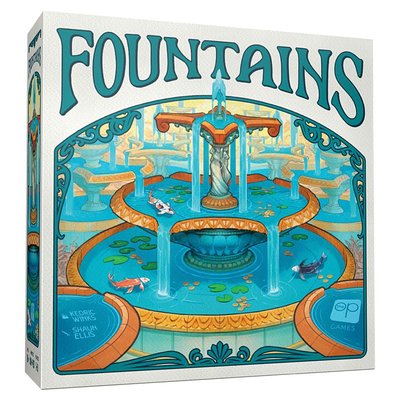
Hi and welcome to Watch It Played. My name is Rodney Smith and in this video we're going to learn the one to five player game Fountains designed by Kedrick Winks and published by VOP who helped sponsor this video. The mayor is on a quest to bring beauty back to your city and she wants your help. As a skilled fountainer, you're to build a magnificent fountain filled with fish and flowing waters as a symbol of beauty and renewal for everyone to enjoy. But other fountainers are also working to achieve this goal. And only one of your fountains will be declared the mayor's favorite. So join me at the table and let's learn how to play. To set up, use these two pieces to make a stand in the center of the play area and then put this basin board on top of it. In its center, you'll find a blue, white, and green space. And on each of these spaces, you'll place a matching colored pawn. Next, find all of the fountain tiles, which have this back, and separate them by shape. Now, as you can see, they're already stored in the box, separated by shape, making this step very easy. Just be aware, there are five double-sided round tiles that you leave in the box for now. All the rest you shuffle and stack face down separately by shape and then using this chart found in the rule book. You'll keep a certain number of tiles from each stack based on your number of players returning the rest unseen back to the box. We'll assume we have three players, so we keep
10 tiles from each stack. We then put these piles by the area of the basin board showing their related shapes on its border. So these go here and this pile would go here and so on. In the end, it will look something like this. And then you flip the top tile of each stack face up. Next, find the bonus tokens which have this back and mix them face down. Then draw five of them randomly to put face up into this area of the basin board. So it looks something like this when you're done. nearby. Also, create a supply of these double-sided pondweed tokens. Now, have each person take a player reference and one wooden scoring piece and three point tokens in their chosen color, returning any unused pieces back to the box. Each person also collects one of these double-sided starting fountain tiles we had left in the box previously. Then, set out this score track and have each person add their scoring piece to this starting space. The cards with this back are the fountain design cards. Now, these are for the optional variant, which you can choose to leave out of your first game, but we'll use them in this setup so I can show you how they work. Simply shuffle and deal three of them face up into the play area, returning the leftovers to the box.
Then, pick someone randomly to be the first player and give them this first player token. And that's the setup. In fountains, you and the other players will be taking and placing tiles to expand and elevate the fountain you're constructing. Filling it with fish and lily pads, which will score you points. The height and layout of your fountain and any coins thrown into it will also earn you points. But just make sure water is flowing to all of its various pools, or you'll get ugly pondweed. Earn the most points by the end of the game, and you win. The game is played over a series of turns, starting with the first player and going clockwise around and around the table. And on your turn, you'll perform three steps. Starting with drafting. Here, you pick any one of the pawns on the basin and move it clockwise one, two, or three spaces, skipping over and not counting any that have a pawn. So, if I choose to move this green pawn two spaces, I'd count it as one, two, and land here. If I instead chose to move the white pawn three spaces, I'd go 1 2 3. Either way, after advancing one, two, or three spaces, if you land next to one of the spots with a tile stack, collect the top tile from that stack and flip the next one face up. Then it's time for the place tile step of your turn. Here you add the tile you collected to the fountain you have in front of yourself, which at the beginning of the game is just this one piece. The new tile can be put beside
any other tile you already have as long as at least two of its dark bricks, which are the parts that look like this, are touching any two dark bricks of your current fountain. So, I might put this here where these bricks are touching, or maybe here, but I couldn't put it like this. We'll see why you might want to place tiles in certain ways as we learn more of the rules, but you'll notice that the tiles have areas where the water is flowing off of their edges. These are known as open channels. And you'll usually want to place tiles so they have connecting open channels like this. However, they do not have to connect this way. It's all right if you have an open channel going into a closed wall like this. But for now, we'll assume I connected these two tiles this way. When placing a new piece, you can also put it on top of any number of other tiles in your fountain. If we assume it's a future turn and I had this tile, I could add it on top of this part of my fountain. Again, at least two of its dark bricks must touch two other dark bricks, which can include bricks under it like these. That means I couldn't put it like this because none of its dark bricks are touching any others. But again, rotated like this would work. Also, any new piece you put on top of others must be fully supported by the tiles underneath it. You can't have any part of it overhanging. So,
this is not a valid placement. But, if I rotated it around this way, we would now satisfy all of the rules. I could even put a tile directly on top of another tile with the same shape if I wanted. And notice I'm ensuring that two of its bricks are directly over at least two other bricks on the tile underneath to ensure I satisfy that requirement. Here I've created an example fountain that's several tiles high to show you that we could add this tile here even though we can't see dark bricks that this is connecting to. Because if we lift up these tiles, we can see that there are dark bricks here. Also, because the placement of dark bricks is consistent across all the tiles, we can look from the top down and see that dark bricks would be in these two areas. I'll also mention that these two open channels are considered connected even though they're at different levels. Another concept we need to understand is the idea of pools.
Each fountain tile shows a single pool surrounded by a border. So we start with one pool and adding this tile here would give us two pools. And now we have three. This is all one fountain but three separate pools. When adding tiles on top of others, we may create several new pools at once. Here we have one pool, but adding this tile turns it into 1 2 3 4 five pools. While adding this tile here would turn it into one, two, three pools. Placed tiles must respect what we might call the circular grid of these shapes. This is a valid placement, but this wouldn't be. The smaller pools can't be cut down smaller than this size. And with that understood, we can now talk about these icons you'll find on various tiles known as jets. These represent the areas where water is being pumped into your fountain, causing water to flow into its various pools. Water will flow freely from a jet to every tile connected to its pool through open channels at the same level or lower. And there's no limit to how far the water will flow from a jet. So with a fountain like this, the water in this jet is flowing from here into this pool, then into here, and into here. And it also flows from here into this pool. It does not go into this pool because there are no open connections on any of its sides
that leads to a jet. The water from this jet is also not flowing into this pool because although they are connected, this one is at a higher level. That means this small pool here also isn't receiving flowing water since the only pool it's connected to doesn't have flowing water either. Any pool in your fountain that is not receiving water from a jet immediately gains a pondweed token that you take from the supply. So we would put one in each of these pools. If we later added this tile here, it doesn't have any connections to water flowing from a jet. So it immediately gains a pondweed. Now keep in mind water can flow from a higher jet to lower levels. So for example, we could have this piece here and this jet on a higher level would still be flowing into all of the locations lower than it as it had been before. At the same time, these pools are still not receiving flowing water because even though this jet is now at the same level as this pool, the water from it is first flowing down into this lower level which can't then flow upwards into this area. That said, you can have more than one jet in your fountain. And if one you add sends water flowing to pools with pond weeds, you immediately return those tokens back to the supply. So adding this here, we now have a jet that has flowing water going into this pool and into this pool here
and into this one as well. So that means we can now remove each one of these tokens. We'll see the effect of pond weeds later, but for now, it's enough to know they're not good. So, on your turn, you'll move a pawn on the basin board in order to draft a tile, which you then put into your fountain. But there's actually another type of piece you can instead gain on your turn. During the drafting step, you may move a pawn onto this space, which is by this display of bonus tokens. And if so, you pick any one of these to collect and then replace it with a random one from the supply. The token you collected must immediately be put on top of any of the existing icons in your fountain or in one of these shadowed spaces. So, as an example, I might put this token here or maybe I would put it here. You can also later put a token on top of a previously placed one. just discard the one you're covering up and return it to the box.
We'll see the benefits of these symbols later, but just be aware if you ever add a fountain tile, so it would cover a bonus token, remove that token, and return it to the box. You can also put a bonus token on top of a jet, but after check to see if that stops water flowing to any of your pools. We have a jet here, but it's at a lower level. So now there's no water flowing into this pool. And that means we now have to add pond weed to it. But remember, if water flows to pools with weeds later, here we've added a jet symbol. You then immediately remove those weed tokens. All right, with that, we've covered the first two steps of a turn, which you'll also find on your player aid. First, you move a pawn one, two, or three spaces and collect the tile or token next to that pawn. Then, you add it to your fountain.
Finally, as it says here, you check for reward triggers. If the tile or token you just placed includes this coin icon, as long as its pool is along a path of pools that connects to a jet, you immediately gain five points. Anytime you gain points during the game, move your token along this track, the related number of spaces. Now, if you would ever earn more than 50 points, bank the points you've earned so far by adding the 50 point marker to your matching colored space here and then continue around the score track again. If you would earn another 50 points, then you would add your 100 point score token here to bank the next 50 points you've earned. And you also have a 150 point token to use as well if you loop the track again. Just be aware, you only earn points from coin icons at the moment. You add them to your fountain and only if water is flowing to them. If I had added this pool flipped around so that there's not an open connection, there's no longer water flowing into this pool. So, I wouldn't earn any points for this icon, even if I add a jet connected to it later. The other way to earn rewards during the game is by moving a pawn to its matching colored space on this track when you are drafting. If this happens, first collect and place your tile as normal and then resolve that space's reward. In this case, the pool reward. You'll find each
reward explained on the back of your player aid. But let's go through these together. When scoring the blue pool's reward, each person counts how many pools are in their fountain with water flowing to them, so ignore any with pond weeds. This fountain has 1 2 3 4 5 six pools. Now, using this chart, the player with the most pools earns 10 points. The person with the second most earns six, and so on. And as it says here, in a two-player game, the person with the most pools earns seven points, and the other player earns none. In the case of a tie, all tied players earn the full amount of the rank they tied for with others earning the points for their related rank. So in a three-player game, if two players were tied for the most pools, they would each earn 10 points.
The player with the next highest pool count would be the third player. So they're considered to be in third place and earn three points. If you had four players and three tied for first, they'd each earn 10 points and the fourth player would be in fourth place and they'd earn one point. So, as you can see, when triggering a reward, all players at the table can earn points. And this is true for each reward on the basin. If you land the white pawn on the white bordered space while drafting, you score the fish reward. You'll find three colors of fish in the game, black, white, and red. And the player triggering this reward picks one of those fish colors to score. Then every player at the table earns points for each of those fish in their fountain.
There are also wild fish, which count as every color. So you score these no matter which color is picked. And each fish in the chosen color that has water flowing from a jet into its pool is worth a number of points equal to its height in your fountain. So fish on the first level are worth one point. Fish at the second level are worth two and so on. In this example, let's assume we were scoring the white fish. This would be worth one point. This is on the second level, so it' be worth two points. And the one on this token is at the third level, so it's worth three points. We also score wild fish. So this is worth one more point and this is worth two more points here. We do not include this fish because there is pondweed in its pool. All right. Lastly, if you land the green pawn on the green bordered space while drafting, every player scores their lily pads. These are the icons that look like this. And each clump is a separate lily pad. So these are one, two, three different lily pads.
Like fish, lily pads are scored based on their height in your fountain, and you ignore any in pools with pond weeds. However, you only consider your single highest scoring group of adjacent pools as viewed from above, where each pool connects to another by flowing water and contains at least one lily pad. So, in this example, we have one group of connected lily pads here made up of these 1 2 3 4 5 six pools. They're connected because each one is adjacent to at least one other pool in that group. They all have flowing water and they all have at least one lily pad. We do not include this pool because it doesn't contain any liies. And as usual, we don't include pools with pond weeds. We do have a separate group of 1 2 3 four connected lily pad pools here, but you only score the single group that is worth the most points. And each lily pad is worth points based on its height, just like fish. So even though this group has fewer pools compared to this group, it's worth more points. So this is the one we score. The lily pad here is at level three, so that's worth three points. This one's at a level two height, so that's worth two points. Each of these are worth one. So that's a total of seven points, where this group is worth 1 2 3 4 5 six points. And if you had a tie, you would just pick one of the groups to score. And those are all the rewards, which again you'll find listed on your player aid. I should also mention during the game, once you place a tile or bonus token, you must leave it
where it is. You can't move it to a different area of your fountain later. That said, when you're considering which stack you might like to collect a tile from on your turn, feel free to first test the tile that's on the top of a stack before moving your pawn and making a final decision. Either way, after drawing and placing a tile or token and resolving any reward trigger, the next person in clockwise order takes their turn. And turns will continue like this around and around the table until the end of the game is triggered. This happens if either the last faceown bonus token is moved to the basin board or any one stack of fountain tiles runs out. You then continue playing so that everyone has had an even number of turns. This means the game will end with the player seated to the right of the one holding the first player token.
During these last turns, it is possible a player might move a pawn to a space with no tiles. And if so, they don't collect one, but they can still resolve any reward that might have been triggered. That said, when the final player's turn is complete, it's time for final scoring. Here you resolve the pool, fish, and lily pad rewards one final time. And when scoring for fish, each person makes their own decision about which fish color they'd like to earn points for. After, if you're playing with the advanced variant, you'll have three of these fountain design cards face up on the table, and you now score each of them one after the other. For example, here each person earns two points for every visible jet in their fountain. While here, they'd earn four points for every complete set of red, black, and white fish in their fountain, not including wild fish. We won't go through all the fountain design cards in this video, but you'll find them explained on this page of the rule book if you have questions while playing. Either way, after the fountain designs are scored, if you happen to be using them, the player with the most points wins. In the case of a tie, the tied player with the fewest pond weeds remaining in their fountain wins. And if there's still a tie, the tied player with the most bonus tokens in their fountain wins. And if there's still a tie, the tied players share the victory.
The game also comes with a component and rules for solo play, but those I'll leave for you to discover on your own. Otherwise, that's everything you need to know to play Fountains. If you have any questions about anything you saw here, feel free to put them in the comments below and I'll gladly answer them as soon as I get a chance. You'll also find forums for discussion, pictures, other videos, and lots more over on the games page at Boardamege Geek. and I'll put a link to that in the description below. And if you found this video helpful, please consider giving it a like, subscribing, and clicking that little bell icon so you get notification anytime we post a new video. And if you'd like to support us directly, you can join our Patreon team, which I'll have linked below. But until next time, thanks for watching.