Luthier | A Thematic Masterpiece | Hidden Bidding Worker Placement | Kickstarter Preview
Games in This Video
1 game is featured in this video — it unlocks as you watch.
Transcript
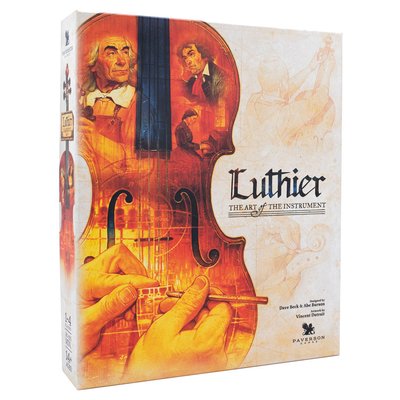
one and two and three and four one and two and three and four one and two and three four that's a cute that's your cute that's your cute oh now you're just making use hello my name is Ilia and my name is Tyler together we make up c a couple that loves to play board games and music we do love music and today we'll be doing a preview of The One and the only luier the art of the instrument big game yeah this is a huge box anyways luia is designed by Dave Beck and ab buron the art is done by Vincent D trit and it's published by pavon games who help sponsor this video now in this game you'll be working as a luier which repairs and fine tun instruments now you'll do this so that musicians can perform and become first chairs and you can get that reput ation as the best luier of the Modern Age of the classical age yeah yeah of the age that this game's theme is in exactly with that said let's give you a quick overview of how to play please note that this is a prototype and everything you see may be subject to change in luier you'll aim to be the most prestigious luier family you'll earn Prestige by making new instruments on your workbench performing music repairing instruments working to achieve personal goals
claiming public rewards and competing for those first chair positions this game takes place over six rounds and is played in two separate phases now at the start of each round the patron patience cubes are Advanced and you'll receive gifts from your patrons you'll also prepare any instruments you wish to work on for the round now the first phase in each round is the planning phase here in turns you'll choose which location to send your workers to you'll send your workers face down so others will not have knowledge of the values here you can also boost your values by placing apprentices on top now later in the game you'll acquire more workers you can use or even specialty workers for advancing on the performance reputation and craft skill tracks which you can use instead of your number value workers now the purpose for all of this is to hope to take the various actions on the board to gain yourself the most prestige now this includes going to the guild to obtain new plans to craft instruments the repair section to fix refin or repair instruments to Showcase your skills the perform section to demonstrate the skill in your instruments or the salon to attract new patrons which will essentially provide you goals to achieve so they can give you ongoing bonuses in the game and support you now other actions include the balcony which gives you an opportunity to score public Awards once you fulfilled them and the space Also contributes to the turn order in this game lastly on your own workbench you'll be able to place your workers to either take the roughing or finishing actions which is how you'll craft instruments
fulfill the Patron's requirements and take control of the coveted first chair role in the orchestra now of course each location has secondary actions you can take if you cannot take the action in the space as priority and Order may change your plans this will include gaining resources inspiration or apprentices and there'll be a skill bonus in these sections as well if you place a worker of the required value this is where apprentices are particularly helpful now once everyone has placed all of their workers on the board which is the planning phase the resolution phase begins here starting with a first player you'll take turns choosing a location to resolve now you don't need to be in the location to resolve it all locations we've just discussed are eligible for your choice along with a market location where you'll be able to buy or trade resources once around now these values change so the market does look different round to Round And once you've taken the market location action you move your marker to the right as you'll not be able to do it again this round now how does resolution work let's take a look at an example say I chose to resolve the repair section I'll take all the chips drop them into the resolution board placing the first place on the very left and moving towards the right sorting by player color once placed I'll evaluate the values higher values will be adjusted to the left and we'll have priority any ties are broken by who are placed in the section first now once priority is set you'll resolve the action having each player take the main or alternate action in the priority
order you'll also obtain the skill bonus if you're eligible here now with cards you'll notice the first couple of spaces are free however cards taken from these spaces cost additional coins and or inspiration as you can see priority has quite a significant influence in the game and Order activation matters even more you'll take turns activating various locations for everybody until all locations have been resolved now important thing to note here is that cards are not replaced until the start of the next round and each location may only be activated once your general goal is to gain Prestige and the best way to do this is to support your patrons which means crafting and repairing instruments or performing specific styles of music you need to do all of this before your patrons loses patience and in turn they'll give you a lifetime ability throughout all of this as well you'll be competing for first chair you'll place your first chair tokens when completing instruments or you'll battle for influence as you repair and perform now you'll keep playing until the sixth round comes to an end here you'll score additional Prestige based on your first chair positions end game Patron bonuses instruments on your finishing bench which are worth half the points personal goals specialty workers and finally a few Prestige for leftover inspiration money materials and apprentices One prestige for every 10 you'll add up the prestige and the player with the most wins now that we've got an overview of how Luther works Works let's dive into some of the highlights that we wanted to feature to help make your decision on
whether or not you wanted to check this game out now the obvious the theme and the art oh my goodness Vincent Detroit has spoiled us immensely yes as he as he typically does as he typically does but I think just seeing like every single little detail in this game is just polished and where there is space to really embellish something it is done uh I particularly really love the little player Sor board oh yeah like the action Sequence board yeah I I just I don't know why but like the fact that it kind it looks like it's 3D but it's not 3D and it just it does stand out yeah there are certain things especially about this game that like go really well together there's something about music games that always like the art typically just like bounces um and yeah that's really it I think has a big thing to do with it as well mhm well of course the table presentence like this game takes a big amount of table space but every is just gorgeous like the different instrument cards the cards really making the board Shine Your Own player boards the patrons that come and visit you there's so many different elements that really invite you into the game um and it is pretty wild on the kickstarter page they have a monstrous playmat oh I'm pretty sure if I remember correctly I may be wrong this you'll have to double check what I'm saying but I think when I was reading the height of the board is actually as tall as I am no way of the playmat no
way it may be we'll put in AA if I'm incorrect but I think it's pretty close no way that's how big it is wow no way but that's a lot of art that is a lot of art oh my goodness anyways if we're if we're if we're going to talk about this a little bit more the theme really does bounce out not many games are you playing a luier so like I had no idea what that was to begin with learning more about like how a luier does their work and is involved in like that entire process they're very important for like the whole um like performance to continue going and it's important to like have all of those aspects going on so it's neat to see that you're taking the role as a family um that runs a business that does this and then jumping into like how everything connects into the game is really interesting like Ilia said you work with patrons you're going to be repairing specific uh instruments and then you're going to be making sure that certain musicians get their spots in like their like their first chair in different areas so it's cool to see it all come together it's really fun to compete for first chair for any of those band nerds or orchestra nerds out there first chair is where it's at I had first chair for for quite a bit but then it got St subtle brag it got stolen a couple of times so it was a fierce competition now that flows quite
smoothly into our second point which is the complexity of this game now this is a complex game there's a lot going on it takes a while to play uh but there's a lot of elements that really make it friendly to walk into first of all there is a rehearsal there is which is basically it guides everyone through their actions for the first few turn or I think for the first round first round at least and it's showcases all the the various elements of the game so you see how those actions if you're familiar with the wingspan uh quick start guide yeah uh it's similar to that and it's really friendly because you do get to see how the game works now the other element and I think this is a must for complex games in my opinion is the complex games that I enjoy and I think that really shine are games where the theme really integrates with what you're doing yes and this game is certainly that everything you're doing it makes sense to what towards what your goal is so it decreases a complexity in your mind a little bit because of that yeah 100% I think when games do exactly that the theme integration with the uh complexity of the game it makes it easier to play and then you get through this like 2 three hour game where it doesn't feel as long or you feel like you did a good job even like the first playthrough just because like you were able to decide what action you needed to do just because like oh I I I need another instrument instead of oh I need to go here so I can get this to do that you can just kind of latch it onto the
theme well especially as you get more bonuses too and your patrons give you bonuses too there's more it's also one of those games that even if you mess up you still get stuff and it feels good too like it's not as punishing where but where the punishing aspect really comes in is the decisions space in this game that is super true it's really interesting in this game to be able to number one on your turn just decide where you're going to go and decide like how powerful that action for you will be uh because you have different like varying numbers like I mean the first you start out with like 1 three and five I believe it is um and deciding where you place those including your assistance in that is really really interesting because you have to ask yourself like if I go here who else might go there and will I be able to be the first person to go because nothing on the board refills until the end of the round and that's really key because you might lose out on something that would help you like optimally push your strategy forward then the other thing of course is the way that you activate actions is really interesting I on my turn can choose to activate whatever is still available I don't even have to be there so you can kind of like Tinker with what's going on in your game and it might negatively impact the other players so you kind of have to like decide if it's worth like activating something that you believe you'll definitely win or if you'll activate
something that is not necessarily going to impact you because of what's going on in the game yeah I feel like this is a really Innovative aspect of the game a lot of the games you typically follow a sequence of all the different areas what you're going to do within each of the areas but here you have that control so there is a time where I can see that Tyler is planning to go to the market to get something so he can get a resource here but I might be shady and activate the space where he's getting the resource yeah or with a space where he's getting that card but because he doesn't have the resources cuz he didn't get to activate that action first he can't really get a card yes which benefits me because Tyler is a little bit further behind so it's a little bit of that like take that but it's also really mindful because while I'm doing that somebody could trigger something that could negatively impact me so you're weighing that balance of which area will benefit me most but be the most detrimental to everybody else because it is a competitive game and we're trying to be the best luers in town yeah I will say that I that during our playthroughs I didn't find it I didn't find that I was selecting spaces that I wasn't in I I I was more interested in activating spaces that I was involved in but the timing of that like the first action in the round for me might be easier for me to do exactly what I want uh if I'm I don't know um accepting or taking a new Patron into my shop that might be the first thing I want to do but it might be Ila's third thing he was hoping to do uh so by throwing that off Ilia might not have
the resources to get the patron that he was hoping to get and now he has to decide to get like one of the the the cheaper uh patrons it's also a mechanic that keeps everyone at the edge of their seats it's not one of those games where you're going to wait be like okay I'll get to my turn I'll do this every single action matters and it impacts everybody so it's really interesting to see how the game progresses and because you really drive that progression yes yep now onto our next point is some of the different mechanics in this game what can you expect to see mechanically yeah so because this game is quite complex you can expect to see a number of different mechanics we've kind've already hinted at some of them but one of the biggest ones that you'll notice is this worker placement uh aspect or bidding almost too it's almost bidding yeah um you're bidding for priority of the action uh so it's like bidding priority and worker placements combined together already that's something that is a little bit more complex and then the other thing that you can expect to uh look at is like an economy Resource Management thing going to the market at the right time willing to sell off like resources that cost a lot this round so that you can afford to get things next round or even like that round too is very important and that's on the cheap resources to hopefully see the price go up I think there's other elements too of different contract fulfillment with how you're going to navigate throughout the
game there's the patron Powers too as you complete the patrons they'll give you an ongoing ability and they have those which turns out to be like an engine buildy type feel yep is really and they also have start of round abilities too where you move that Cube and you can reset that but I think a lot of it is at this decision space too because what you can do can benefit your future game and not there's that weighing of like immediate benefit versus long-term benefit and I feel like that decision space between those two is constantly present like I could go here and actually do something for myself that will help me in the long run or I can get a couple points and do this easy thing so it's kind of weighing what is the best thing for me to do and a lot of it is impacted by the action resolution which we talked about earlier yes yeah yeah and then that being said like the theme really helps this push this along too because you understand what you're kind of trying to accomplish as a luier family uh it just it just clicks I guess you could say it is funny to see the different instruments everyone's working on I remember being like hm Tyler is working on the violin so I probably shouldn't cuz he's going to get first chair in that first chair so I want to get first chair too so maybe I'll work on like the timy or something else or maybe there's another violin out there and I actually have the resources to do it so I'm going to race for who is the best violin luier we'll find out that actually does remind me to mention that like even when the timing doesn't go in your favor there's still stuff that you can do and it's a really interesting space like we said is a very
interesting decision space of like how do you utilize your action the best uh to your ability with what you have right now and the best part about that is that once you start playing through it and learning a bit more about the game game you understand that you can still keep up with the game that's in front of you and you're not going to be put so far behind that you feel like you're never going to be able to win true so thankfully that's something like I I don't particularly enjoy in games that didn't H happen in this I felt and that's a highlight that I just wanted to point out because I know there are some people that are on the same page as me when it comes to that stuff mhm and I think last but not least is the general replayability and the whole package of this game oh yeah uh there is so much in this game and because of how the cards come out how the patrons come out and even starting patrons too and abilities like there is so much variance that you never really know what to expect in Game of Lu here yeah and the simple addition of like player asymmet asymmetry it's I if I'm remembering correctly it's just basically the family you choose has a certain ability rate off the bat and they start with different resources but that alone can really guide your strategy so being able to replay the game as a different family can actually like really change how you um are playing the game that being said like
you don't always have to lean into what you're given right away you can manage that and that's part of the fun you get to discover that and then the last thing I'll say about this is you get better and better as you play the game I think that could be said about any other game but in particular with a complex game like this it does feel really good when you can go into a new game and start to see like your progression your scores increase you start to understand it more and it just adds to the replayability value exactly now in summary luier is that heavy complex game with a gorgeous theme and artwork that really draws you in that gives that immense table presence but thoughtful and carefully crafted for you to enjoy Luther also has a variety of different mechanics but I think the key mechanic is this action activation where you're picking which one needs to activate when and I think that creates a very interesting decision space because the timing of how your actions are taking becomes very very key it sure does key now don't take her word for it look at all the page for yourself there is so many resources and information available to this game I even believe there's a demo available too that you can play and check out too so take a look see all the goodies that Kickstarter has to offer and come back to us and talk to us about it because we have had a splendid experience with this game and we would love to continue to share it with you
and like we said this is a preview video so if this helped you in your decision on whether or not you wanted to look into this game further give us that Thumbs Up Hit That subscribe button if you're new here cuz we make weekly board game content like this and we love talking about them now for our question of the day what instrument would you like to learn how to play or what instruments do you play trumpet saxophone I know how to play Amazing Grace on back pipes all it's been a while I don't know if I can do it anymore yeah I'd be interested to see I haven't seen you play the trumpet or the saxophone it's cuz I don't have one anymore it's so sad you should get one for me I also was a luier I used to when my younger days I used to buy broken ules and fix them up and sell them I do think I remember you telling me about that so yeah I was technically a luthia fun fact about me I did my grade nine um Conservatory in piano uh I cannot play as well as I used to before but I used to delve in the like high classical stuff which was a lot of uh lot of work honestly I can see it we'll get you back into it with that said thank you so much for watching and keep the music music playing bye