
/pic8145392.png)









Luthier: The Art of the Instrument Deep Dive
What the Community Thinks About Luthier: The Art of the Instrument
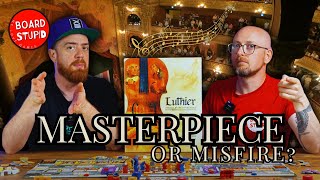
Luthier: The Art of the Instrument arrives as the follow-up from Paverson Games, the team behind Distilled, and reviewers see it as a big, crunchy euro with a theme that genuinely shapes play. Several of the early videos were previews of a crowdfunding prototype: The Board Game Garden and Ilia and Tyler were sponsored by the publisher, Rahdo Runs Through describes its video as a sponsored preview, and Board Gaming Ramblings played a prototype the publisher sent them. The later retail reviews are more mixed. Board Stupid gives it a strong recommendation and, on the day, ranks it above SETI and Galactic Cruise. The Broken Meeple, which bought the deluxe edition at retail rather than receiving a review copy, lands on a high six out of ten: a good game held back by length, punishing swings and a string of small blemishes. The Board Gaming Doctor finds it smooth and smart but not a game that stays on the mind for days afterwards.
Core Mechanics That Define Luthier: The Art of the Instrument
Hidden Bidding Worker Placement
The mechanism every reviewer leads with is what designer Dave Beck, in a UK Games Expo interview with Board Stupid, calls worker placement with a twist. Each family member is a numbered disc, starting with a one, a three and a five, and players send them to action spaces face down. When a space resolves, the discs are flipped and the highest value acts first, so a stronger worker gets first pick of the cards and, with a four or higher, a skill bonus. Apprentices can be stacked on top to push a value up, and more workers join the family as the rounds go on. Board Stupid contrasts this with open bidding worker placement where players bump each other, and says hiding the values creates a really interesting interaction. The Board Gaming Doctor compares the bidding-plus-placement blend to Ruck: Dawn of Keev.
Patrons and Their Patience
Patrons, drawn from real composers, nobles and performers, supply the game's goals. Each wants some mix of new instruments, repairs and performances, and a patience cube moves along their card every round, handing over a gift each step. Beck describes the catch: the cube also represents time, and if it reaches the end the patron leaves and takes points with them. Fulfil everything and the card flips to become a lasting bonus that builds your engine. Board Stupid names this one of their favorite parts, describing how a demanding patron can be kept waiting for rounds while the gifts keep coming. The Board Gaming Doctor likens the timer to the customers in Uwe Rosenberg's At the Gates of Loyang.
The Luthier: The Art of the Instrument Experience
Two Rounds of Tension
Rahdo describes two tense moments in every round. The first comes when workers go out in secret and each player guesses how much a rival has invested at a shared space. The second is the resolution phase, where players take turns choosing which location to trigger, and anyone may trigger a space they have no worker in. If a rival triggers the repair space before you have bought materials at the market, your plan collapses and you fall back on the secondary action. Rahdo stresses that this is not mean: plans change because of timing, not malice. Ilia and Tyler call the activation choice a really innovative aspect of the game, and note that you can deliberately trigger a space to disrupt a rival, though it can also backfire on you.
A Theme That Guides Decisions
Reviewers repeatedly say the theme makes a heavy game easier to navigate. Ilia and Tyler argue that because every action makes sense as instrument making, you reach for another instrument rather than for an abstract resource chain, which makes a two to three hour game feel shorter. Beck says a musicologist was hired to write biographies for more than 40 historical figures, and Board Stupid, whose hosts both have musical backgrounds, point to Mozart, Beethoven and Handel among the patrons. Board Gaming Ramblings add that everything is named in keeping with the theme, and a cousin who knows more about music said it matched how things work in real life.
What Makes Luthier: The Art of the Instrument Stand Out
Vincent Dutrait's Art and a Big Production
Vincent Dutrait's artwork draws praise in almost every video. Ilia and Tyler say every detail is polished, and Board Stupid calls the art warm and evocative, adding that a busy-looking board turns out to be clear once play begins. Board Gaming Ramblings single out the double-sided player aids and a rehearsal book, which The Broken Meeple also praises as a guided first round that is a great way to learn or teach. The Broken Meeple is less happy with the edition split: the deluxe version has dual layer boards, an insert and metal coins, while the standard edition drops the insert and the dual layer boards, which the channel calls a bit cheap for a game at that price.
Many Paths and a Standout Solo Opponent
Board Stupid says there is no single path to victory: one of them won by building instruments for the right patrons, just ahead of a partner who focused on performances. Ilia and Tyler highlight the family abilities and starting resources as a source of replay value, and The Broken Meeple adds that the special workers vary each game. The solo opponent divides opinion. Rahdo calls it one of the best automated opponents the channel has seen and credits Dave Digby and Richard Wood for it; The Board Gaming Doctor found it straightforward and challenging. The Broken Meeple respects its design but found it slow to run and prone to wild score swings, since it completes a whole instrument in one action.
Potential Drawbacks
Long, and Longer Than the Box Says
The box claims 90 to 150 minutes, and no reviewer believes it. Board Gaming Ramblings took two to two and a half hours at two and three players. The Broken Meeple expects first games to run 30 to 45 minutes over the box time and four-player games to pass three hours, and feels the game is one round too long. Rahdo loves the game but finds it a little too long for the channel's own table, noting that rounds grow as workers are added, so the final rounds are the slowest just when fatigue sets in. The Board Gaming Doctor's comparison to Everdell makes the same point from the other side: gaining workers means the game really picks up near the end.
Card Luck and Hard-to-Recover Swings
With four separate card decks, the instrument or performance you need may simply not appear. Board Gaming Ramblings were not bothered, since there are only three instrument types and three musical eras. The Broken Meeple was frustrated, because searching the deck costs so much money, inspiration or even an apprentice that most players never do it, and sometimes the search still misses. The channel also finds the game punishing: when rivals trigger spaces at the wrong moment, a round can fall apart, and a bad start in rounds one or two is very hard to recover from. It adds that the promised bluffing rarely happens in practice and that the performance dice feel like an odd splash of luck.
If You Enjoy Luthier: The Art of the Instrument
The obvious next step is Distilled, the earlier Paverson Games design that almost every reviewer references. The Board Gaming Doctor still prefers Luthier for its extra interaction, and Rahdo describes Distilled as a nice midweight built on card drafting. Board Stupid say fans of SETI and Galactic Cruise should find Luthier very much up their street. Rahdo recalls the old classic Caylus, where workers are placed first and activated later, and says the game could have been designed by Vital Lacerda, which is meant as high praise. The Board Gaming Doctor also points to Glass Road, where rivals can force your actions out of order, and to Viticulture for workers with special abilities.
What Reviewers Are Saying
"So this game pivots on these two really tension filled and incredibly interactive moments when you're deploying your workers and then when you're activating your workers"
— Rahdo Runs Through
"I feel like this is a really Innovative aspect of the game a lot of the games you typically follow a sequence of all the different areas what you're going to do within each of the areas but here you have that control"
— Ilia and Tyler
"There's a good amount of thinkiness in this game. The planning aspect is, you know, definitely going to test your brain cells. It's going to feel rewarding when your plans come to fruition, but it's also going to feel very deflating when they don't come to fruition."
— The Broken Meeple