Ezra & Nehemiah Board Game Review
Games in This Video
1 game is featured in this video — it unlocks as you watch.
Transcript
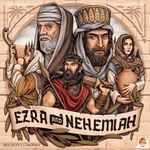
Miniature Market has thousands of board games at discounted prices. Click the direct link below to see all those discounted games. You know that feeling when you've just put the final touches on your majestic sand castle, turrets, moat, the works, and you just lean back to admire your masterpiece, only for a bully to stomp right through it. Or maybe it's a wildly adorable toddler who suddenly doesn't seem so adorable. Or maybe your sibling deleted your entire Minecraft world. One of your kids obliterated the Lego Death Star you spent weeks building. Or autosave failed you on that heartfelt project. Yeah, that feeling. Now imagine that, but it's your entire city. In the year 587 B.CE, the tyrant king of Babylon, Nebuchadnezzar II, laid siege to Jerusalem for over a year. The result, the city was raised, its temple destroyed, its walls torn down, and the people, they were brutally exiled. But probably exactly the same as your Minecraft world getting wiped. Am I right? Today, we're talking about Ezra and Nehemiah, a strategic card management, worker placement, and engine building game by Shem Phillips and SJ Macdonald. You didn't know rebuilding Solomon's temple in ancient Jerusalem was something you'd be into. And honestly, I get it. Brick Lane, scribing laws, wrangling priests. It's not exactly beach vacation material, at least not for normal people. But once you sit down with Ezra and Nehemiah, restoring a city, crafting scrolls, and managing sacred cows might convert you
faster than Ezra himself. Ezra and Nehemiah is a game for one to four players and will likely run you around 2 hours or so. Let's hop over to the table where I'll give you a general overview of how the game works, and I'll see you at the end for some final thoughts. In Ezra and Nehemiah, you're helping rebuild Jerusalem after the Babylonian exile, restoring the temple, rebuilding the wall, and bringing the community back to life, one holy task and dusty scroll at a time. Although the ancient story of Ezra and Nehemiah and Zerubbabel spanned nearly a century, the game takes place over three rounds, each of which represents a week. Each week consists of six player turns, or days of work, and concludes with a day of Sabbath rest. It's not often that a game instructs you to take a nap, but I'll take it. Thank God for that. Literally.
On your turn, you will play one of the character cards in your hand to your playerboard on either an empty space or a slot with only one card. No double piggybacks allowed. There's no way 7th century BCE Israeli labor laws would allow for that. Safety first. After playing a card, you will take a main action and may optionally take a number of free actions at any point. The three main actions are represented by the different colors of banners, red, gray, and blue. And the strength at which you will take this action is calculated by adding up all the banners of that color on your visible character cards, tucked cards, traders, and elders, and scroll tiles. After all of this, your turn concludes by drawing a card to refresh your hand. Let's take a quick look at the banner actions. First off, the red banners are all about embracing the historic journey of Zerubbabel by working on the reconstruction of the dilapitated temple and stoking the fires of the altar. When taking a red banner action, you may assign exactly one of your workers to serve as a Levite. And no, this doesn't mean they get to work in the factory of the millennial mom's go-to jeans brand. To do so, pay the bread cost on the left and gain the reward on the right. For each Levite you own, you may take a temple or an altar action. At the temple, place a resource on the leftmost open space of a row, spending the required red banners and immediately gain the bonus shown on the right and gain victory points relative to the resource you have placed. Each time one of these temple sectors is completed, players will gain rewards or penalties based on the number of Levites they have in play. I don't have time to explain all of these steps, but in short, loads of Levites good, lack of Levites bad. If instead of being
constructive and building the temple, you'd like to burn away your hard-earned resources, then you can spend your red banners at the altar. Here, you sacrifice wood or cinders in the flames of the altar to advance on the alter track and gain any immediate benefits along the way. Seems wasteful, right? Well, MLK Jr. did say nothing worthwhile is gained without sacrifice. I I guess he must have been homies with Zerubbabel and also maybe Shem Phillips and SJ Macdonald as well. Secondly, the gray banner actions allow you to follow the footsteps of Nehemiah, who rebuilt the annihilated walls of Jerusalem. I always imagine he did this while listening to We Built the City by Starship on repeat. And I do request that you at minimum hum this tune inside your head while taking this action. This action gives you three options: clearing rubble, rebuilding walls, and building gates. Whichever one you choose, you must select a single space around the main board. To clear rubble, first utter the incantation rubble on the double and then spend gray banners at this rate and take the cubes and add them to your personal supply, gaining these as resources. You can also build a wall. Just a note that this is an a-olitical video that takes no stances on wall building as it relates to 21st century politics. To do so, spend the displayed banners and resources. Then draw three wall cards, place one on the space, and receive the immediate rewards. Building gates works the same way as walls, except that you take the matching gate card from beside the board, gaining any silver that has accumulated on it and place it in the space. You must now assign a worker to serve as a gatekeeper and gain any
immediate benefit. Finally, the blue action where you get to aspire to the priestly path of Ezra. These actions are all about teaching the ancient scriptures and visiting people around the city. To teach the Torah, place one of your workers who now serves as a scribe on an available scroll tile that is connected to the bottom through previously placed scribes. Pay the blue banner and coin or resource cost pictured on the left. Each of these scroll tiles grants in-game benefits or endgame victory points. You can explore the myriad icons in the appendex of the rule book. And if you feel like being a happy camper, your blue banners can also be spent to move your tent around. I guess Ezra was always in search of that perfect campsite. Pay the required banner and resource costs and move your tent clockwise around the map, gaining every benefit you pass along the way. I know this isn't even a full how to play video, just an overview. And it's already been quite a bit. Let me quickly explain the free actions, Sabbath, and endame scoring, and then we'll be on to final thoughts. You can also take one auxiliary action per turn. These include trading, which lets you trigger the trade ability on your active character card, gaining resources, coins, or food, and possibly helping others if their gate is involved, or turning over a development tile, which means flipping over and upgrading one of your playerboard tiles by paying its cost.
This gives you a permanent boost. You may also choose to place a trader during your turn. Simply place an available worker on an open trader space and gain the rewards displayed there. In the same way, you can also opt to place an elder in one of these four spaces to receive the displayed benefits. Any banners gained here are only available during your current turn. After all players have taken six turns, it's time to rest up from all that hard work by taking a Sabbath. During the Sabbath, first trigger any Sabbath effects indicated by this symbol. Then, you place any unused workers on farmer and laborer spaces to gain resources, money, and food. Then move on to the prophet's judgment, which sounds scary, and truthfully, it kind of is in this game. Look at your spot on the alter track and also the row on this card based on the current round. If you're behind Zechariah, the black ghost looking dude, suffer the penalty on the left side of the card. If you are between him and the prophet Hegy, the white ghost looking dude, receive the reward or punishment in the middle of the card. And if you are ahead of Haggi, gain the prize on the right side of the card and breathe a sigh of relief for escaping the wrath of the prophets. To conclude a Sabbath, you must feed your workers or lose points if you can and tuck one or two cards depending on the round of the six played in that round under your player aid. You immediately score all of your tuck cards based on the conditions displayed at the top.
Also, the banners displayed by these cards now serve as permanent banners on future turns. If this is the end of the first or second round, you will reset for a new round to begin as explained on your player aid. If it is the end of the third and final round, you immediately move into endgame scoring to find out who is truly the greatest scholar of Old Testament Jewish law, or at least as good at math hero games. Here's how you tally scores at the end. First, convert your resources to silver at the rate shown here. Then, gain the following victory points. One point per five silver you have. Two points per development tile. Three points if you are the alter leader. The total number of points printed on all your walls and gates. Points based on the row that each of your scribes is in. And finally, points rewarded from your scroll tiles in the top row. Whoever has the most points wins. And not only that, they are clearly the holiest of the people currently sitting at the table and should probably spend the next 6 days shaming the unrighteous losers. but then after 6 days probably give it a rest. So, is Ezra and Nehemiah a godle game or is it about as thrilling as reading the genealogies in the Old Testament? Here are some pros and cons.
Pros. First, the mechanics in this game are both intricate but also seamless and tight. I don't know how Garfield/SHM/SJ/ whoever is making it happen over there comes up with all this magic, but the cardplay mechanics with the various features on each card is so immersive and exciting. The passive banners, the sacrificing of cards for their scoring benefits and the various trade options, it's so good. Secondly, while this is a thinky, fairly heavy euro, it's not as soul crushing and punishing as some. We've all felt the misery of not being able to feed our workers in a rough round of agricula. In this game, through trading and other options, you're usually able to have something positive to do and feel like you're always moving forward. Third, the theme. I realize that this might be a con for some. However, whether you're into biblical history or not, this theme is brilliantly pulled off and integrated, probably better than most games in the last few years in my opinion. and the actions actually support the theme in an amazing fashion.
Cons. This is tough because honestly this game's incredible, but here's where it potentially might go ary for you. The rule book is long. If you've played Paladins of the West Kingdom, which is the heaviest game from the West Kingdom series, the rules for this game are four pages longer than that. There are a lot of nuances and I guarantee for at least the first game, if not the first few, you'll be needing to reference the rule book quite a few times. And there's a decent chance you might get a minor rule or two wrong as well. And while the iconography is decent, it's not as quick to pick up as some games, so you'll probably have to hit up the appendix a fair amount. That being said, it's a very well-ritten rule book. Secondly, again, this is quite subjective. This is a Euro game where you're not targeting or attacking other players. That being said, especially at higher player counts, it is kind of hard to plan your actions between turns because there's a decent chance other players might get in your way. You might not mind this, but if you're the type of Eurogamer that doesn't want their toes stepped on, this might be a minor wrinkle for you. Those are such nitpicky potential cons because I always want to offer a balanced review. However, as you've already picked up on, I'm a massive fan of this game. Basically, everything Garfield does is gold. I have a lot of designers I love and all of them inevitably make games that I'm pretty meh on, but I got to say that Shem, SJ, and Team are pretty dang consistent. This game seriously rules on so many levels. I would recommend this game to anyone who is into games like Teayottowin, Great
Western Trail, Lisboa, The Taverns of Tentall, or pretty much any of the games put out by Garfield Games, maybe particularly Paladins of the West Kingdom. That being said, if you don't like the color beige or you're a passionate atheist, I'd probably skip this game. Thanks for joining me again for another board game review. It means the world to me that you would take the time. Now, after such a long review, I'm ahead for some Sabbath rest myself.