TDG: Legendary: Game of Thrones Deck Building Game
Games in This Video
1 game is featured in this video — it unlocks as you watch.
Transcript
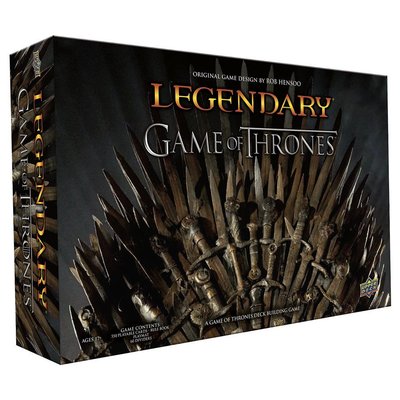
Hello ladies and gentlemen and welcome to the discriminating gamer. My wife said she's mad at me because I'm lazy, but I didn't even do anything. Ladies and gentlemen, today we're going to go ahead and take a look at legendary Game of Thrones from Upper Deck.
Heat. Heat.
Well, Upper Deck has finally decided to take legendary to that crazy world of Westeros as it dives right into Game of Thrones in this competitive deck building game. Now, if you know the channel, you know I love legendary. I started with Marvel Legendary. I think I've played every Legendary game since. Uh some are better than others, but they are all enjoyable. I always have fun with a legendary game. And while some game modes and stuff have allowed for competition, generally speaking, these are cooperative games. You play them together. And so, it's interesting to kind of see now a dedicated competitive game uh for Legendary. Let's take a look. Now, in this game, you will take on the role of one of the four great houses of Westeros or Essos. You will be either the Starks, the Lannisters, King's Landing, which is the Baratheons, or the Dothraki, who are coming uh from Essos. Now, what you're going to do here is you each have your own kind of player board, and it's got a spot for your own unique deck of masterminds. uh they will have uh defenders that will protect them and you will also have kind of your own dedicated hero deck. And then below that you will have five spaces for your own heroes to come out because each of the factions have their own unique heroes.
They have their own decks of cards for heroes, the 14 deck cards of heroes that you mix together, you shuffle together. Now the game board itself then is going to have uh instead of a villain deck, you're going to have the ally deck. Now, in the ally deck, you're going to be able to um each faction that's playing will mix in their allies. Uh they'll choose an ally. They I think they have two allies. You'll each mix in one depending on player count. Uh you'll also have an allied henchman group. You'll mix that in. You'll mix in master strikes. You'll mix in event cards and events kind of take the place of schemes. You'll put in some bystanders in there as well. You'll shuffle it together and that will be kind of what drives the game. Now, additionally, you'll also have a place for bystanders. More on that. You have a place for uh wounds. You'll have the maesters, which are essentially the cards you can buy that just give you extra recruit, but they can also help you get rid of wounds. And then you have kind of an a dedicated event deck on the board. Now, at the beginning of the game, you're going to each start out with a deck of uh your starting deck, which is going to have merchants, uh six merchants and four warriors. and they've of course got the uh recruit and attack attributes on them. Now, you're also going to get what is called the minor hero deck, and you're going to deal out two cards from the minor hero deck to each player.
They're going to go ahead and put those in their own deck. Now, the minor heroes then are shuffled in with the bystanders, and these become cards that can be rescued and added to your own play deck. Now, at the beginning of your turn, you actually reveal an ally from the ally deck. Now, if this is an enemy, you can attack it like normal. If it is one of your allies, if it has, you know, if it's a Lannister card and you're playing the Lannisters, you can actually pay its attack value to move it forward because you want your cards to actually escape. If they actually escape off the board, you're going to get some bonuses. Good things are going to happen to you. You want your guys to escape. You want to prevent your enemies from escaping. Now, occasionally from that ally deck, you're going to draw an event card. Now, the event card is going to have maybe choices that that particular player, the druit can make um or things that will affect the the game board generally, but there will almost always be a cycle.
Now, whenever you see the word cycle, it will usually f be followed by a number 1 2 3 4 5. And what that means is every player when that cycle comes out looks at their own player board and the card, their hero card that is under that number or above that number, that's going to go on the bottom of their hero deck and you're going to bring out a new card. So, you're cycling through your deck. you're not always going to have the same cards um available to purchase every time. Some other game effects might instruct you to actually draw an event card from the event deck, which of course will will do the same thing. Now, you may also draw a master strike card from the ally deck. If you draw a master strike card, uh what you do is then you read your master strike card and it affects the other players. Essentially, it's a way for you to attack the other players uh through the master strike in the deck. And that's just whoever draws it from the ally deck. So, as I mentioned, you have five masterminds in your uh in your mastermind deck. Next to them, you have your uh defenders, and you have a number of defender cards that start face up, and then some are below them face down. Over the course of the game, you can attack your opponent's defenders because you cannot attack their mastermind while they have any defenders face up. So, you can get through their defenders before you can attack them, but then some other game effects may cause them to put their defenders face up. some other game effects like the master strike once that's completed will cause you to put your mastermind at the bottom and then a new mastermind appears. Now, when you do attack defenders, uh that's going to cause you to cycle and you also gain victory point tokens. Victory point tokens are very important because just like when you defeat your enemies on the
board and they go into your trophy pile where they have victory points, you're also gaining victory points throughout the game through various effects and putting them on your player board. Now, as soon as one player has lost three of their masterminds or a total of six masterminds have been defeated, the game immediately ends. Each player is going to go ahead. They're going to count up uh all their victory points on their from their victory pile cards and any of the victory point tokens they've got, and whoever's got the most victory points wins. Legendary Game of Thrones. We'll get back to the review in just a moment. I want to take a minute to ask you to check out my other channel that is Cody Carlson PhD where we talk about history books on history, military history. I even post some of my uh lectures for my classes on there. Please check that out. Please subscribe to that channel. And now back to the review.
All right, so as I say, I'm a big fan of the Legendary Games. I've always really enjoyed them. Some of my favorite cooperative games, and I was interested to play this because it's a competitive game. And I'll tell you right now, I've played this game a few times, but I've only played it a two-player game. I haven't played it at the higher player counts. Um I played it with Ray. I played it with my stepdaughter and had a lot of fun both times and they've both been relatively tight games. In fact, the game I played with my stepdaughter, it was um I think 50 to 51. I beat her by one point. So, they're pretty pretty close games there. But this this is kind of a new and interesting way to play legendary. Uh it's kind of fun. I like this idea of you can attack, you know, your enemies, but you can also support your own cards and try to move them forward so you can get them off the board. Of course, you deny them the possibility of gaining that as victory points. And so that's something that's pretty cool. Uh I I like that you have your own dedicated hero deck and you are are able to buy purchase cards from that. Uh I thought that was just incredibly fun. And like for instance, I think it's the Lannisters have a thing where they can actually look at the top few cards of an opponent's deck and purchase cards from their opponent. So that was pretty cool. Um, the way the cards work are all, you know, like like in any legendary game, it's all about combinations. Any deck building game is all about how can you build the combinations and that does it here. You can build some absolutely stellar combinations in this and really have a lot of fun, build a lot of attack or build a lot of recruit. Uh, it's really good. The keywords are here are a lot of fun. You
got things like bribe and stuff if you're familiar with legendary all a lot of these great things. The ambushes which when they come out they trigger different effects in the game. Really enjoy it. This is a really fun new way to play Legendary. I like it a lot. And you know, I got to tell you, I love the artwork here. I would have been fine if they went with screen caps from the TV show, but I really like the artwork. I think the artwork is really well done and really evocative of the books. I read the books. Um, and I watched the TV show and I just I like that this kind of leans maybe a little bit more into the books. I think that's pretty cool. Really like the artwork here. Now, I do have one not insignificant issue with this game and that is it looks like it's a bit rushed. It's a bit rushed because um on the game board you you know it says next to the mastermind it says guards.
the rule book refers to them exclusively as defenders. So, there's a bit of a disconnect there. Well, we got guards, but there's defenders. You just you need to get that straight. And then the hero deck, it refers to the hero deck. And yet, it says, what is it? Protagonist pile, I think, is what it says on the on there. And it's just like what? It's almost like they had kind of the um you know the rough draft of what they were doing on the board and then they actually refined the rule book but they didn't refine the the board. So that was that was disappointing. I do like the board how you can put the little sigil of your house in there too and take that. That's pretty cool. Another thing that I wasn't terribly wild about is [clears throat] the naming of the ally deck. Now, you have the allies that are your allies that you put in there, but you know, the the the the the rule book and stuff sometimes refers to when you attack an ally. Well, it doesn't make sense because why would you attack an ally? The word ally implies they're your ally. And yet ally is this kind of catchall for any of these cards that go in there, including your enemies. So, it's again, it's it's there's kind of a disconnect. My enemies are allies. And I was playing this the first time with Ry and that was not he was saying why should I why would I attack an ally? Why would I do this all?
And I had to explain to him a couple of times. I had to kind of say look that's just its own thing. You got to think of the word ally is referred to that deck and not as your ally. So I was disappointed. That was disappointing. But that aside, this is a great game. Um I've had a ton of fun with this in every game I've played. I I love the deck building here. I love the building, the combinations. I love the artwork. And I love the competition. I love that this is a competitive game. They probably could have easily made this a a cooperative game in some way. And I [clears throat] really like that they made this a dedicated competitive game. And it totally totally works. Incredibly, incredibly fun. I always love Legendary and I love this one quite a bit. Uh looking forward to playing this one again and again. So, on the Cody scale, I'm going to go ahead and I am going to give Legendary Game of Thrones an eight. It's a fantastic deck building game. Thank you once again for joining us today on the Discriminating Gamer. As always, we'd ask you to please leave a comment for us here on YouTube, on Board Gamegeeek, on our Facebook page. Uh we'd really love to hear back from you and please subscribe to this channel. Please uh like us on social media. If you really like what you see here, I would humbly ask you to click on my other channel that is Cody Carlson PhD where we talk about history, military history, books on history, fun things like that. It would mean the world to me if you would subscribe to that channel as well. And of course, if you do really like what we do here on the discriminating gamer, I would humbly
ask you to click on the super thanks button and leave a tip. Guy goes to the electric chair. The executioner asks him if he has any last words. The guy says, "I won't be shocked if this doesn't work. Somebody help me on my feet again. And I DON'T KNOW WHERE I'M GOING. And I don't know where I've been. Somebody help me ground. IT'S A LONG TIME [screaming] AND I'LL BE DYING. I wind up.
I play this game and I think of the macato. The macato. Gilbert and Sullivan. No. Three little maids from school. Are we filled the brim with girlish glee? Three little maids from school. Everything is a source of fun. No one say we care for none. Life is a joke that has just begun. Never heard it.
Three little mates from school. Three little mates from school. Three little maids who all unwary come from a lady's seminary. Free from a studioious tutter. Do we need to talk about childhood? My dad was a Gilbert Sullivan fanatic.